

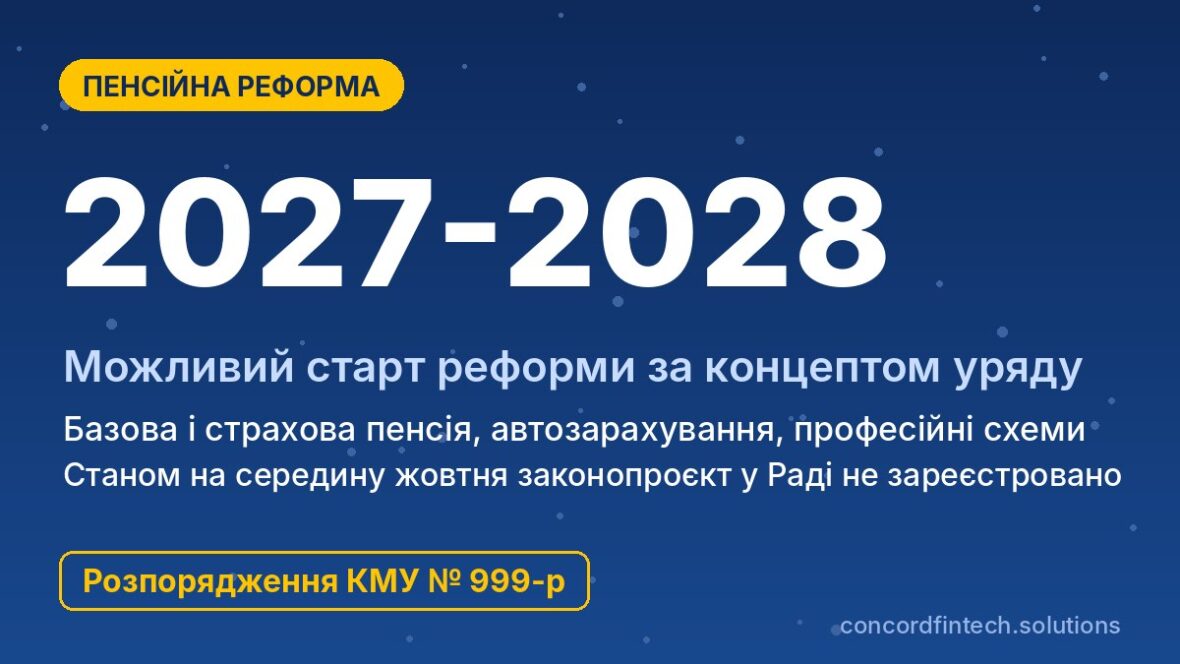
As of mid-October 2026, pension reform in Ukraine remained a government plan rather than an enacted law. Cabinet of Ministers Order No. 999-r obliged the Ministry of Social Policy to prepare a bill by the end of October 2026, but there is no record of its registration in the Verkhovna Rada, so pensions are still calculated under the old rules.
The concept that the ministry presented during the year consists of three parts: a revised pay‑as‑you‑go pension, professional schemes to replace special pensions, and a funded system with automatic enrolment. Below we separately note what has already been formalised in documents and what exists only as a proposal.
Timeline of the pension reform in 2026
Cabinet of Ministers (CMU) Order No. 999-r of 30.09.2026
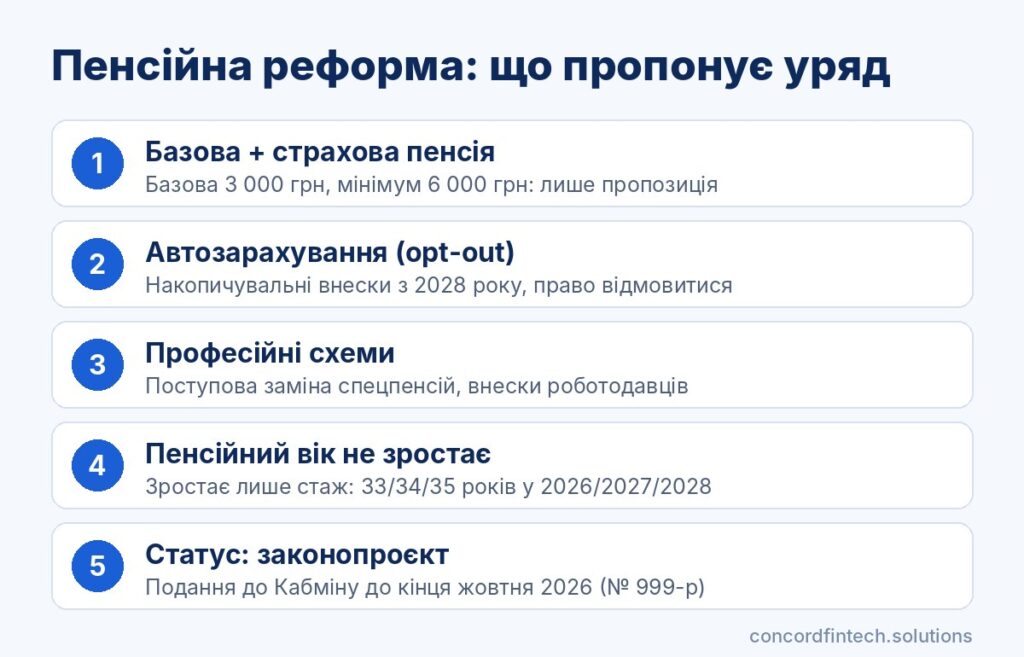
The Cabinet approved the Government’s priority action plan for 2026 by Order No. 999-r of 30 September 2026. The operational objective “A stable and fair pension system” foresees the development of a comprehensive reform.
Deadline for submitting the bill
The draft law was to be submitted to the Cabinet by the end of October 2026, and that deadline has already passed. The version approved by the government had not been published at the time of preparing this article, so follow Cabinet news for updates. The key dates of the year are as follows:
- January–February 2026: the Ministry of Social Policy presented the idea of a basic pension and a minimum of 6 000 hryvnia;
- April 2026: Minister Denys Ulyutin said the draft had been written but calculations with the Ministry of Finance were ongoing;
- June–July 2026: the concept was discussed within the coalition and MPs returned it for revision;
- 30 September 2026: Order No. 999-r was adopted;
- end of October 2026: deadline for submitting the bill to the Cabinet.
Role of the Ministry of Social Policy
The executor has been designated as the Ministry of Social Policy, which is preparing the draft together with the Ministry of Finance and experts from the World Bank. The calculations must demonstrate sources of financing for at least 15 years.
Basic and insurance pension
Basic pension of 3 000 hryvnia
Under the concept, the pay‑as‑you‑go pension would consist of two parts, the first being a basic payment from the state. At the start of the reform it was proposed to set this at 3 000 hryvnia upon reaching pension age.
Insurance component
The second part would depend on length of service and paid single social contribution (ЄСВ), not on the year of retirement. The exact formula has not yet been published.
Minimum 6 000 hryvnia
If the sum of the two parts is less than 6 000 hryvnia, the budget would top up the difference. Currently guaranteed minimums range from 3 406‑4 213 hryvnia depending on age and service.
Funded system with automatic enrolment
What opt‑out means
Automatic enrolment with the right to opt out means that a worker is included in the system automatically. If a person does not wish to participate, they may opt out.
Who will pay contributions
The size of contributions and the split between employee, employer and the state had not been determined at the time of writing. Earlier drafts featured rates of 2‑3% of salary with gradual increases.
How it would work
Funds would accumulate in individual accounts and belong to the person, unlike pay‑as‑you‑go contributions. The start of contributions was previously proposed for 1 January 2028, subject to the law being adopted.
Employer professional contributions
Mechanism
The professional system is intended to replace some special pensions and early‑retirement privileges. They would be financed not from the pay‑as‑you‑go system but from separate employer contributions, in particular through a higher single social contribution (ЄСВ).
For whom
This concerns workers in harmful and demanding industries as well as categories that currently receive special pensions. According to government estimates, the transition from special pensions to professional schemes will take at least 13 years.
Tax implications
How employer contributions will be taxed and whether they will count as business expenses is not yet known. For reference, pensions paid by the Pension Fund of Ukraine (PFU) are currently exempt from personal income tax (ПДФО) regardless of amount.
What the reform does not provide for
Raising the retirement age to 61
The government does not plan to raise the retirement age, and the memorandum with the International Monetary Fund (IMF) records only a commitment not to lower it. Rumours about 61 years originated from MP draft bill No. 5566 of June 2021, which never became law. Under the current schedule the required length of service increases: 33 years in 2026, 34 in 2027 and 35 from 2028 for retirement at 60.
Abolishing indexation
The concept does not propose abolishing annual indexation. On the contrary, the government promised the IMF a uniform approach, whereby all pensions would increase through indexation, and it proposes to remove the linkage of certain special pensions to salaries.
Reducing pensions
Previous versions of the Ministry of Social Policy’s draft stated that no granted pension would be reduced. At the same time, the recalculation mechanism for current pensioners is not yet described in the text. A comparison of current rules and the concept is shown in the table.
| Parameter | Now | Under the concept |
|---|---|---|
| Pension structure | single payment calculated by the formula Zs × Kz × Ks | basic part + insurance part |
| Minimum pension | 3 406-4 213 hryvnia depending on age and service | 6 000 hryvnia with budget top‑ups |
| Funded system | none, only voluntary funds | automatic enrolment with the right to opt out |
| Special pensions | from the pay‑as‑you‑go system and the budget | gradual transition to professional schemes |
| Retirement age | 60 years with sufficient service | no increase |
| Pension increases | annual indexation from 1 March | indexation for all, without linking special pensions to salaries |
Timing and risks of implementation
Consideration in the Rada
After Cabinet approval the draft law must be registered in the Verkhovna Rada and pass two readings. It will then require the President’s signature and implementing regulations from the government.
Start in 2027–2028
The concept mentioned an effective date of 1 January 2027 for the pay‑as‑you‑go part. Funded contributions were proposed to start on 1 January 2028.
Lessons from the failure of No. 9212
The government draft No. 9212 on funded pension provision received only 214 votes in the first reading on 25 April 2024 and was returned for revision. Thus even a government bill without broad MP support can remain stalled for years. Until a new law is adopted, rely on the amounts paid by the Pension Fund of Ukraine (PFU).
Frequently asked questions
Will the reform affect current pensioners?
Earlier drafts promised not to reduce granted pensions, and the biggest increases could be for those receiving minimum pensions with top‑ups. How current pensions will be recalculated will become clear from the text of the bill.
When will automatic enrolment start?
The earliest date mentioned in the concept is 1 January 2028. For that to happen the law must be adopted in advance, and as of mid‑October 2026 it had not even been registered in the Rada.
Can you opt out of the funded system?
Yes, the opt‑out model provides the right to exit the system after automatic inclusion. The procedure and deadlines for opting out have not yet been determined, so no applications are necessary until the law is adopted.