




Ukraine is seeking at least ten years of financial support to sustain an army of 800,000 troops, according to Agence France-Presse (AFP). The report does not specify whether this refers to a permanent active strength or the total force including reserves.
Defence budgets and troop numbers in other countries
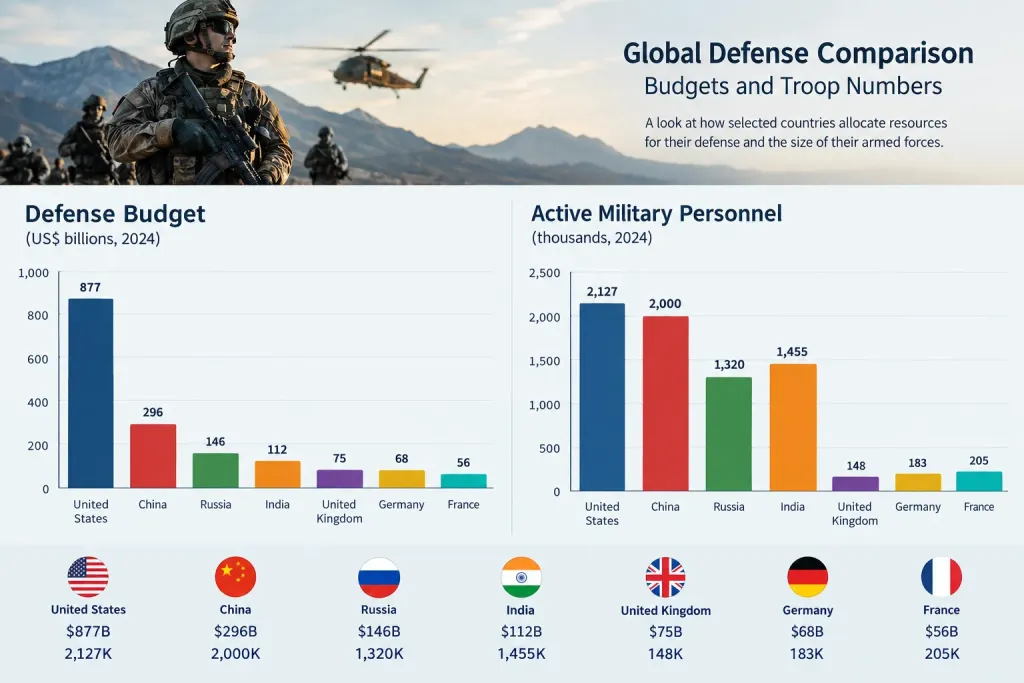
In 2025 Germany had a defence budget of $107.3 billion and 184,200 military personnel in the Bundeswehr. The United Kingdom in the same period had a budget of $94.3 billion, and the size of its regular armed forces was approximately 137,000 people at the start of 2026.
India in 2025 had a defence budget of $78.3 billion and about 1.4 million military personnel in service. These countries are among the top ten by defence budgets; Ukraine is mentioned in that ranking with $44.4 billion and a current size of the Defence Forces of between 880,000 and 900,000.
Indicative calculations of the cost of an 800,000-strong army
By proportionally scaling the defence budgets of Germany and the United Kingdom to 800,000 troops, annual costs could be roughly $450-550 billion. Using the budget-to-personnel ratio of Pakistan, the amount is estimated at roughly $13.5-14.5 billion.
Similar estimates come from recalculation based on Taiwan for a system with reservists. The piece emphasises that the final sum will depend on the proportion of regular forces and the number of reservists.
Examples of systems with large reserves and their expenditures
According to the International Institute for Strategic Studies (IISS), in May 2025 Israel had 169,500 military personnel in service and 465,000 reservists. After an increase in the budget in September 2025, total Ministry of Defence spending was expected to rise to approximately 135.7 billion shekels, or about $42.79 billion, of which almost 39 billion shekels ($12.30 billion) was attributable to personnel.
According to the IISS for 2022, Taiwan had 169,000 in service and about 1.66 million reservists. In 2026 the Taiwanese government planned defence expenditure of 949.5 billion New Taiwan dollars, or roughly $31.2 billion.