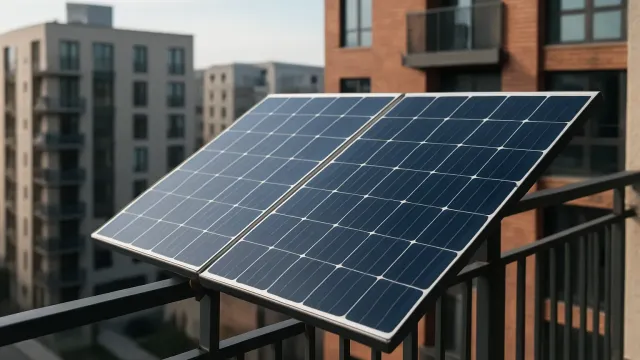



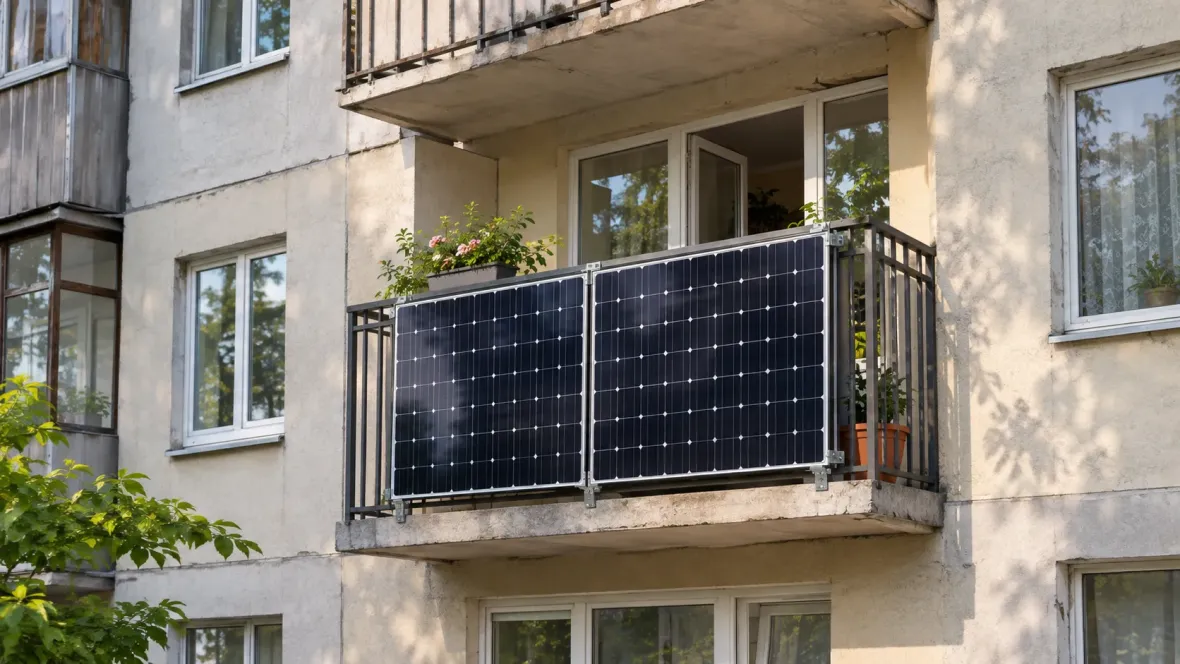
Two solar panels with a combined capacity of 800 W can reduce a flat’s electricity costs by approximately 650-2 940 UAH per year under three illustrative scenarios. In the average scenario the system produces 600 kWh, of which the flat uses 420 kWh. At a tariff of 4.32 UAH per kWh this is 1 814 UAH saved per year, or about 151 UAH per month on average. The actual amount on the bill depends on sunlight, shading and when appliances are used at home.
| Conditions for an 800 W kit | Annual production | Share used by the flat | Less bought from the grid per year | Saving per year |
|---|---|---|---|---|
| Balcony shaded part of the day | 300 kWh | 50% | 150 kWh | 648 UAH |
| Bright balcony and some daytime activity | 600 kWh | 70% | 420 kWh | 1 814 UAH |
| Sunny location with favourable tilt and high daytime consumption | 850 kWh | 80% | 680 kWh | 2 938 UAH |
These are scenarios for comparison. Production and self‑consumption shares are assumptions. All three calculations are made without a battery and without revenue from selling surpluses. The basic household tariff of 4.32 UAH per kWh applies until 30 April 2027. Annual sums in the tables show how much the system would produce in 12 months at an unchanged tariff.
How to calculate the savings for your flat?
Start with your meter readings. Suppose a flat in Kyiv consumes 200 kWh per month, or 2 400 kWh per year. Under single‑zone metering this is 10 368 UAH per year. If the panels replace 420 kWh, the flat will buy 1 980 kWh from the grid and spend about 8 554 UAH. The annual electricity bill will fall by approximately 17.5%.
Annual saving = annual production × share of self‑consumption × tariff for replaced electricity.
How to check how much your balcony panels will produce?
In the free PVGIS calculator select your city, enter the total panel capacity, their azimuth and tilt. For two 400 W modules enter 0.8 kW. If modules will be mounted vertically, set 90° from horizontal. Look at the monthly results. The annual average smooths out the difference between summer and winter.
Then assess shading at the installation site. The overhang of the upper balcony, a neighbouring building or a tree can block sunlight during peak production hours. If panels are installed behind glass, account for additional losses. The calculator helps estimate the solar resource, while shading from a specific building is best checked on site.
How to determine how much solar energy the flat will use?
Take meter readings in the morning and evening over several weekdays and weekends. For individual appliances use a plug‑in watt meter. If you have hourly consumption data, compare it with an hourly estimate of generation. For each hour use the smaller of the two values. That is roughly how much energy the flat can use directly.
| Flat mode with identical 600 kWh annual production | Estimated share of self‑consumption | Displacement per year | Saving per year |
|---|---|---|---|
| During the day mostly the fridge and router run | 40% | 240 kWh | 1 037 UAH |
| Some washing and dishwashing cycles moved to daytime | 55% | 330 kWh | 1 426 UAH |
| Appliances are regularly used during the day | 70% | 420 kWh | 1 814 UAH |
With the same generation the difference between the first and third scenarios is 778 UAH per year by exact calculation. Even if a flat consumes a lot of electricity monthly, for a system without a battery the decisive factor is when that consumption coincides with generation.
Which rate to use if you have a day-night meter?
Under the basic tariff and two‑zone metering the daytime rate is 4.32 UAH per kWh, the night rate between 23:00 and 07:00 is 2.16 UAH. Estimate savings at the rate you would have paid for electricity without panels. If a washing machine previously ran at night and is now entirely covered by solar, 1 kWh of that consumption will save 2.16 UAH. If part of a daytime cycle is still supplied by the grid, it will be billed at the daytime rate.
What will change on the bill after adding a battery?
A battery shifts some daytime generation to the evening. In the average scenario without one the flat uses 420 of 600 kWh. If a battery allows another 90 kWh per year to be used after charge/discharge losses, total savings rise to 2 203 UAH per year. The additional saving from the battery is about 389 UAH per year under single‑zone tariffing.
| Option with 600 kWh annual generation | Displacement per year | Saving per year |
|---|---|---|
| Panels without battery | 420 kWh | 1 814 UAH |
| The same panels with a battery | 510 kWh | 2 203 UAH |
| Increase due to the battery | 90 kWh | 389 UAH |
How to check if you’ll have power during an outage?
A standard grid‑tied microinverter stops feeding the flat’s wiring when the external grid is de‑energised. This also applies to the grid output of the EcoFlow PowerStream. To power a router, laptop or other devices during an outage you need a charging station with its own outputs or a system with a dedicated backup output and appropriate connection scheme. Before purchase check which appliances can be connected to the backup output and what power it supports.
How many years will it take for solar panels in a flat to pay back?
Divide the total installation cost by the annual saving. Include panels, inverter, mounting, cables, protection and installation in the estimate. If a battery or additional electrical work is required, list them separately.
| Indicative kit price with installation | At 648 UAH/year saving | At 1 814 UAH/year saving | At 2 938 UAH/year saving |
|---|---|---|---|
| 20 000 UAH | 30.9 years | 11.0 years | 6.8 years |
| 30 000 UAH | 46.3 years | 16.5 years | 10.2 years |
| 40 000 UAH | 61.7 years | 22.0 years | 13.6 years |
This is the simple payback under unchanged conditions. It does not account for tariff changes, panel degradation over time or repair and replacement costs. If a kit costs 30 000 UAH and operates under the average scenario, the payback period is about 16.5 years. Calculate the battery’s payback separately. With an extra 20 000 UAH and additional savings of 389 UAH per year the battery’s simple payback from bill savings alone would be about 51 years.
What to check before installing panels on a balcony?
- Mounting location. If installation affects the façade, roof or other common property of the building, consult the condominium association (OSBB) or the building manager about obtaining a decision from co‑owners. For installing a solar power plant (SES) on a façade or roof under a simplified procedure a technical inspection report is required. Mountings must withstand loads, including wind gusts.
- Connection scheme. Ask an electrician to check wiring and protection. Before connecting a grid‑tied inverter check with the distribution system operator the metering and registration requirements for your scheme, even if you plan to consume all energy at home.
- Share of surpluses. If you plan to sell electricity, check the metering and contract conditions under the self‑generation mechanism. In calculations separate income from sales from the savings on electricity the flat consumes itself.