

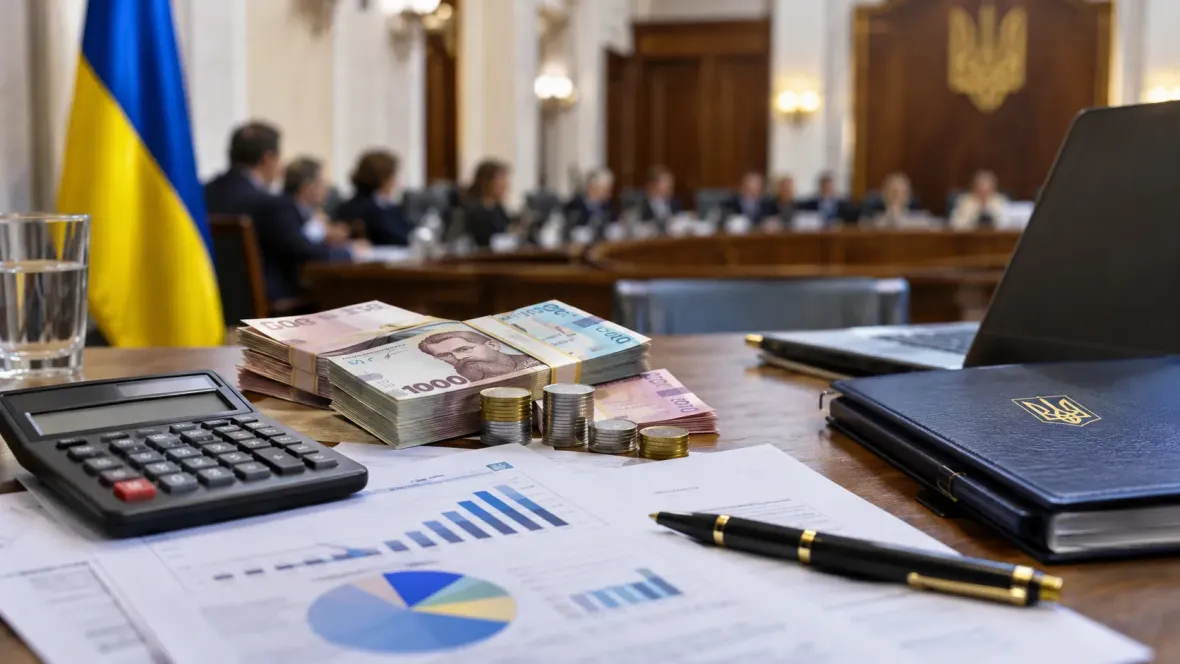
On 27 November the Cabinet approved a revised draft budget for 2027 and sent it to the Verkhovna Rada. Value‑added tax (VAT) and excise duties will not be increased. UAH 31 bln is now allocated for insuring business against war risks, an additional UAH 20,4 bln for payments to the military, and the forecast for the state’s own revenues has been reduced by UAH 49 bln.
Main figures of Budget‑2027
For the second reading the government took into account proposals from MPs, agreements with the International Monetary Fund (IMF) and a new macro forecast. The calculations were affected by strikes on the energy sector, factories and transport, as well as delays in international funds.
| Indicator | Plan |
|---|---|
| Revenues | 5,5995 trln UAH |
| Expenditures | 7,2236 trln UAH |
| Nominal GDP | 11,1851 trln UAH |
| Real GDP growth | 0,4% |
| Inflation | 8,5% |
| Average wage | 36 804 UAH |
| External financing need | 52,6 bln dollars |
How the macro forecast changed
The economy, by the new estimates, will recover more slowly. GDP growth was lowered from 1,3% to 0,4%, and inflation was raised from 8% to 8,5%. The average wage in the forecast was increased from 34 409 UAH to 36 804 UAH; nominal GDP rose by UAH 40,7 bln.
The wage forecast is an average figure, not a guaranteed income for any individual. The real situation will depend on the course of the war, the condition of the energy system and whether international aid arrives on time.
What about VAT and excise duties
In the first draft the government expected to raise UAH 67 bln by increasing VAT and excise duties. That idea did not find support among MPs, so those revenues were removed from the calculations.
VAT remains 20%
There was discussion of raising the base rate from 20% to 21%. For example: a good costing 10 000 UAH before tax now sells for 12 000 UAH, and would have sold for 12 100 UAH under the increase. These additional revenues are no longer included in the budget, although other changes to tax law during 2027 are not ruled out.
Fuel could get more expensive anyway
There will be no further increase in excise duties. But previously adopted changes will come into force on their own timetables, so the price of petrol, diesel and auto‑gas depends not only on the new budget.
Where the money will come from
Aside from the UAH 67 bln from taxes, almost UAH 65 bln from customs de‑shadowing was removed from the forecast. The reason is simple: in 2026 customs did not overall exceed the plan. Other lines, however, were revised upwards.
| Source | Change |
|---|---|
| Increase of VAT and excise duties | -67 bln UAH |
| Customs de‑shadowing | about -65 bln UAH |
| Profit of the National Bank of Ukraine (NBU) | +36,3 bln UAH |
| Personal income tax and military levy | +25,7 bln UAH |
| Rent for subsoil use | +14 bln UAH |
| Import duty | +2,1 bln UAH |
If customs in 2027 nevertheless raise more than planned, those funds will go to the defence reserve.
Contribution of the National Bank
The National Bank of Ukraine (NBU) must transfer at least UAH 85 bln to the budget. That is UAH 36,3 bln more than planned before the first reading. Part of this money will go to insure against war risks, and this is not a new tax but a distinct source of revenue.
Where spending was increased
| Direction | Additional |
|---|---|
| Insurance against war risks | 30 billion UAH |
| Cash provision for the Armed Forces of Ukraine (AFU) | 20,4 billion UAH |
| Reserve fund | 13,4 billion UAH |
| Public investment | 6,9 billion UAH |
| Procurement of weapons | 2 billion UAH |
| Pilot reform of teacher pay | 2 billion UAH |
| Sheltering in schools and kindergartens | 1,3 billion UAH |
| Research at the National Academy of Sciences of Ukraine (NASU) | 970,7 mln UAH |
| Support for farmers | 600 mln UAH |
| Medicines and medical devices | 450 mln UAH |
Some of these sums are part of broader programmes, so they should not be added mechanically.
Insurance of business against war risks
It was UAH 1 bln, now UAH 31 bln - 31 times more. The money is intended to partly compensate companies whose property was damaged or destroyed by Russian forces.
The following may be eligible for such schemes:
- factories whose equipment was damaged by shelling;
- companies that lost warehouses or commercial premises;
- enterprises with investment projects in Ukraine;
- owners, operators and charterers of sea vessels.
Exact conditions, compensation levels and application procedures will be set by separate programmes. For banks, insurance coverage means easier risk assessment: if a factory borrows to buy equipment, part of possible losses from shelling will be covered by insurance. The Ministry of Economy is still seeking UAH 2-3 bln from international partners for this direction (in dollars).
Defence and the reserve fund
Almost UAH 5 trln is allocated to security and defence, about 43% of GDP. Salaries for the military including charges will exceed UAH 1,8 trln; an additional UAH 2 bln was added for weapons.
The reserve fund rose from UAH 91,6 bln to UAH 105 bln. It finances what cannot be foreseen in advance: the consequences of damage to critical infrastructure and emergencies.
Education, healthcare and social programmes
| Programme | Total for the year |
|---|---|
| Sheltering in educational institutions | 5 billion UAH |
| Research at the National Academy of Sciences of Ukraine (NASU) | 7,3 billion UAH |
| Medicines and medical devices | 21,3 billion UAH |
| Support for the agricultural sector | 2,8 billion UAH |
| Humanitarian demining of agricultural land | 1,8 billion UAH |
| Housing for internally displaced persons in villages | 2 billion UAH |
| Loans for farmers | 280 mln UAH |
Teacher salaries and CampeX
UAH 2 bln was allocated for an experimental reform of teachers’ pay. Schools will join voluntarily, so the new system will not immediately apply to all teachers nationwide.
A further UAH 1 bln will go to CampeX - a joint project of the Ministry of Education and Science (MES) and the World Bank to develop research campuses at state universities.
Veterans and emergency brigades
UAH 801,9 mln is allocated for feeding veterans during treatment and rehabilitation. Energy workers, utilities and railway workers engaged in restoration after attacks received an additional UAH 536 mln, and in total this programme will have UAH 1,2 bln.
Payments decoupled from the minimum wage
At present some salaries and payments are linked to the minimum wage and the subsistence minimum. Because of this, every increase in social standards automatically raises public‑sector costs. In 2027 the government wants gradually to remove this linkage, but this requires separate laws.
International aid and voting in the Rada
52,6 bln dollars from abroad
The need for external financing has not changed. Main hopes rest with the EU, the IMF and other partners.
The EU package of 45 bln euros will be included in the budget only after an official decision by the European Council. According to the budget committee’s expectations, this could happen in June 2027, and until then those funds cannot be considered guaranteed.
When the vote will take place
The first reading of draft law N 16000 took place on 28 October 2026. The revised version was approved by the government on 27 November and must next be examined by the budget committee. Voting in the Verkhovna Rada is scheduled for 9 December, and figures may still change before then.