



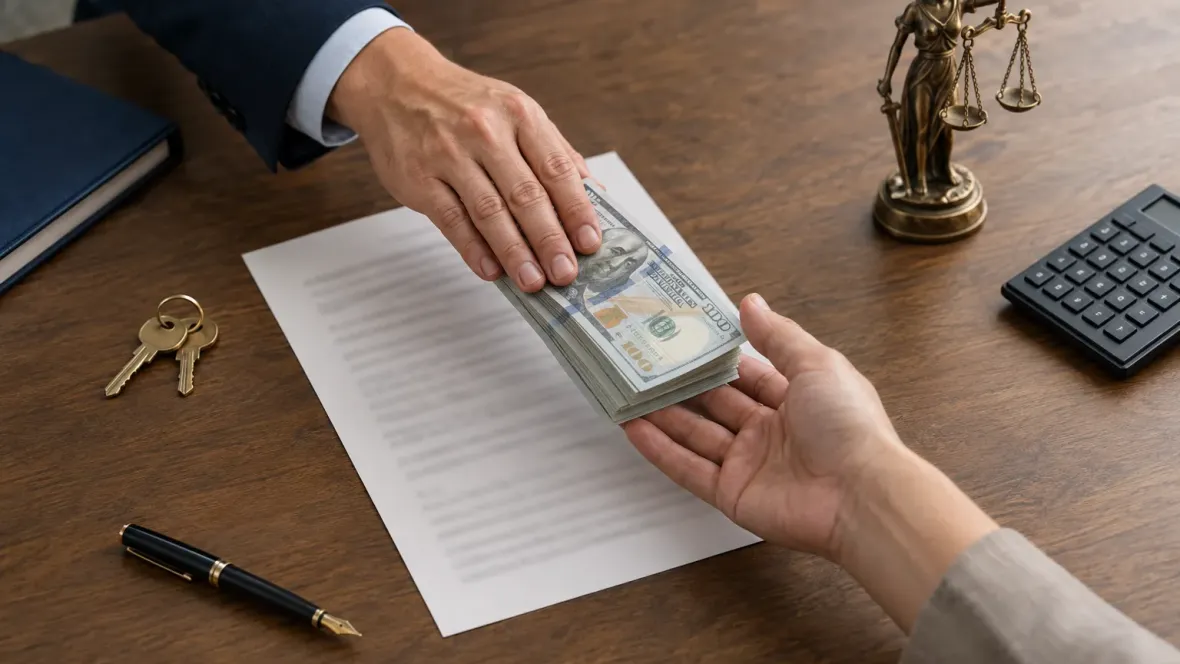
If the sale and purchase agreement for a flat was never concluded, the buyer will normally be able to demand the return of the advance in the amount paid. Double the amount can be claimed where the payment is a deposit and the seller, through their own fault, has breached the obligation that the deposit secured. If the buyer has breached such an obligation through their own fault, the deposit remains with the seller.
| Question | Advance | Deposit |
|---|---|---|
| Why is it paid? | As a prepayment towards the price of the flat | As part of the contractual payment due and as security for performance of the obligation |
| What happens if the buyer changes their mind? | If the purchase did not go ahead, the advance is subject to return. Separate terms on penalties or damages may apply | Remains with the seller if the buyer is at fault for breaching the secured obligation |
| What happens if the seller breaches the agreement? | The buyer may demand the return of the amount paid. Additional claims require a separate legal basis | The seller must return the deposit and pay an equal sum in addition if the secured obligation was breached through the seller’s fault |
How to check what you paid for the flat
Open the agreement and find the clause on payment. It is important to establish under which agreement you were supposed to pay the money and which obligation the payment was securing. Under Article 570 of the Civil Code of Ukraine (CCU), if it is not established that the amount paid towards due payments is a deposit, it is regarded as an advance.
Is the word «deposit» in a receipt enough?
The word alone is not enough. A receipt helps to prove who received the money, when and for what. A bank slip confirms the transfer, and its payment purpose helps to link the sum to a specific flat or agreement. For a deposit there must be a valid obligation that it secures and a written arrangement on the security. The requirement for a written form is established by Article 547 of the CCU.
Does a preliminary agreement with a notary change anything?
A preliminary agreement records the obligation to conclude the main agreement within the agreed term. For the sale of a flat, such a preliminary agreement, like the main agreement, generally requires notarisation. This follows from Articles 635 and 657 of the CCU.
If the parties only agreed to formalise the purchase in future and the money was paid towards the future price, courts treat such a payment as an advance. Notarisation of the preliminary agreement does not, by itself, change that. At the same time, the agreement may contain specific terms on liability for refusing to sign.
How much money can be returned if the sale falls through?
Suppose the flat costs 2 million UAH, and the buyer paid 50 000 UAH. That is 2.5% of the flat’s price. With the same payment amount, the outcome depends on what the buyer actually paid for and why the sale fell through.
| Scenario | How much the buyer may receive |
|---|---|
| The buyer paid an advance. The sale and purchase agreement was not concluded | 50 000 UAH, if there are no separate claims affecting the calculation |
| The seller, through their own fault, breached a valid obligation secured by a deposit | 100 000 UAH |
| The buyer, through their own fault, breached a valid obligation secured by a deposit | 0 UAH |
| The obligation ceased before performance began or because performance became impossible | 50 000 UAH (deposit) |
When can you demand double the amount?
Article 571 of the CCU provides for this remedy where the seller received a deposit and, through the seller’s own fault, the secured obligation was breached. For example, if the parties have already concluded the sale and purchase agreement, agreed the deposit in writing, and the seller without good reason refused to hand over the flat on the agreed date, then for a deposit of 50 000 UAH the buyer may demand their 50 000 UAH back and an additional 50 000 UAH.
If proved losses exceed the amount of the deposit, the law also allows a claim for the difference, unless the contract states otherwise.
Will an advance be returned if the buyer withdraws from the purchase?
If the main agreement was never concluded, the buyer’s withdrawal alone does not give the seller the right to keep the advance. If the seller relies on a penalty or damages for unjustified refusal to conclude the agreement, such a claim requires a separate legal basis. In a dispute a court will examine the contract terms, the reason for the deal’s failure and the evidence of breach.
How have courts decided disputes over advance payments?
| Situation | Outcome |
|---|---|
| The buyer paid 7 500 dollars under two preliminary agreements for flats. The seller treated the money as a deposit and blamed the buyer for the failure of the deals | In August 2026 the Supreme Court of Ukraine upheld the decision to recover 15 000 dollars of advance |
| The parties failed to conclude a sale and purchase agreement for a house within the agreed term due to the temporary occupation of Kherson. The buyer demanded the return of 7 000 dollars and the same amount as a contractual penalty | In June 2025 the Supreme Court of Ukraine upheld the decision to recover 7 000 dollars. The court rejected the claim for the penalty |
What to check before transferring money
- The seller and the flat. Reconcile the owner’s details with the records in the State Register of Property Rights to Real Estate. If a representative is requesting the money, check whether they have authority to receive it.
- Payment and refund terms. Record the flat’s address, the full price, the amount and type of payment, the deadline for signing the main agreement and the timeframes for returning money. If the purchase depends on a mortgage, agree in writing what will happen to the prepayment in the event of the bank’s refusal.
- The payment recipient. Specify the type of payment in the payment purpose, the date and number of the agreement if any, and the flat’s address. If an agency receives the funds, check whether this is part of the flat’s price or a separate fee for its services. For cash payments keep a signed receipt.
How to demand the return of money for a flat
- Gather proof of payment. Keep the agreement, the receipt or the bank slip and correspondence about the amount and purpose of the payment.
- Confirm why the deal fell through. If the agreement can still be concluded within the agreed term and you are ready to sign, make a written proposal to the other party with a date, time and place to meet at the notary. Keep proof of sending and delivery.
- Send a written demand. State who and when received the money, why you demand its return, the amount you request and the account details. Check the return deadline against the contract. If no deadline is set and the second part of Article 530 of the CCU applies, the general rule gives the debtor seven days from the presentation of the demand, unless the obligation to comply immediately follows from the contract or the law.
- If the money is not returned, apply to court. To recover an advance it is important to prove payment, the payment’s purpose and the basis for return. For double the deposit you will additionally need evidence that the payment secured a valid obligation and that the seller breached it through their own fault.