


The Ministry of Finance on 19 November presented a preliminary model of an independent Fiscal Council in Ukraine that will assess macroeconomic forecasts, monitor compliance with fiscal rules and analyse the state of the public finance system.
Why Ukraine needs a Fiscal Council
The Fiscal Council is intended to provide an independent and professional assessment of the realism of the macroeconomic forecasts on which the state budget and medium-term plans are based, and to check the Government’s compliance with fiscal rules. Its conclusions will be published for public access, for parliament and for international partners.
The creation of such a body is set out as a requirement for advancing towards EU membership and is enshrined in a number of documents, including the National programme for the approximation of Ukrainian legislation to EU law, the Roadmap for public administration reforms and the Strategy for reforming the public finance management system for 2026-2030. Legislative grounds for the work of the Fiscal Council are proposed to be put in place by the end of 2027.
Requirements of the European Commission
Representatives of the European Commission called the establishment of a Fiscal Council one of the key benchmarks for closing the negotiation cluster. They supported the idea of an autonomous independent body and emphasised the need for an open and independent appointment procedure for members and access to information to carry out its powers.
The European Commission also stressed the advisability of defining a narrow list of the council’s powers and highlighted the need for a clear delineation of its powers from those of the Accounting Chamber.
Which model international experts recommended
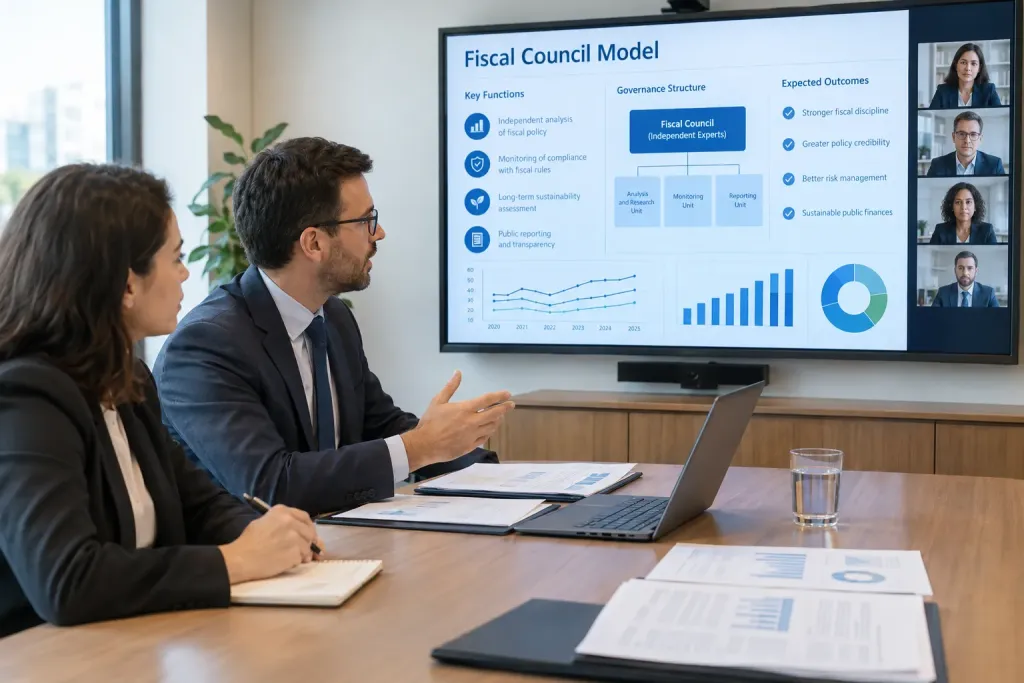
International experts compared the experience of EU countries and examined four organisational models of an independent fiscal institution. The experts concluded that the best option is to create an autonomous independent Fiscal Council separate from the Accounting Chamber, the National Bank of Ukraine (NBU) and parliamentary bodies.
The experts noted the risks of combining functions: the Accounting Chamber should concentrate on ex-post budget audit, the National Bank of Ukraine (NBU) could face conflicts of interest with monetary responsibilities, and the Parliamentary Budget Office exists as a model only in Italy. To meet the EU’s minimum requirements a composition of part-time members and a small staff of about six people is sufficient, with the possibility of expanding powers later.
Which model the Ministry of Finance proposes
The Ministry of Finance supported the key findings of the report and proposed a preliminary model for discussion. It proposes to enshrine the main principles of the Fiscal Council’s operation in a separate law with targeted amendments to other acts, including the Budget Code and the Rules of Procedure of the Verkhovna Rada of Ukraine (VRU).
The draft provides guarantees of the council’s functional, political and financial independence; definitions of powers, appointment procedure and member requirements; access to information; communication with the public; organisational and financial support; and external evaluation of its activities.
The Ministry proposes a narrow and exhaustive set of functions that corresponds to the minimum requirements of the revised EU Directive 2011/85. The Fiscal Council will participate in hearings of the Budget Committee and in sessions of the Verkhovna Rada of Ukraine (VRU), and will publish its conclusions. For the government the “comply or explain” principle is proposed: either to take the Council’s conclusions into account or to publicly explain why they were not.
The council’s composition is proposed to be between three and five members who will work on a part-time basis. Members will be selected by a selection commission composed of representatives of the Ministry of Finance, the Ministry of Economy, the Accounting Chamber, the National Bank of Ukraine (NBU) and the Budget Committee of the Verkhovna Rada of Ukraine.
Candidate requirements include fluency in the state language and one of the official languages of the Council of Europe, a higher education not below a Master’s degree and at least five years of relevant experience, as well as professional competence, integrity and impartiality. The term of office is proposed at five years with the possibility of reappointment no more than twice; grounds for early termination should be exhaustively defined by law.
The Fiscal Council will have the right to request and receive from authorities the information necessary for its work, and regular data will be provided without a separate request. Two options are being considered to ensure its operation: organisational-analytical support provided by the Ministry of Finance or the creation of a small separate Office of the Fiscal Council, and expenditures are planned in a separate budget programme of the Ministry of Finance.
The activity of the Fiscal Council will be evaluated at least once every three years by an independent Ukrainian or foreign institution or experts. The evaluation report will be submitted to the government and to the Verkhovna Rada of Ukraine (VRU) Committee on Budget and published on the Fiscal Council’s website.