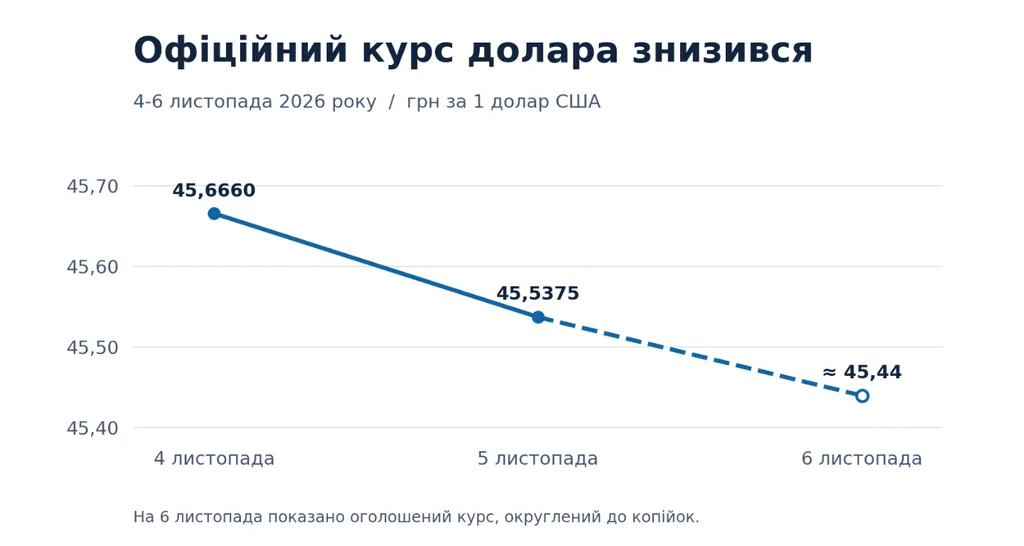


On Friday, 6 November, the National Bank of Ukraine (NBU) set the official dollar rate at 45.4432 UAH, which is 9.43 kopecks lower than on Thursday. The euro fell even more, by 20.83 kopecks, and now stands at 51.0406 UAH. Thus the hryvnia has strengthened for the second day in a row. However, dollars in cash are not cheap. According to the baseline forecast of analyst Andriy Shevchyshyn, the cash dollar will trade between 45.50 and 46.50 UAH until the end of November.
| Currency | 5 November | 6 November | Change during the day |
|---|---|---|---|
| Dollar | 45.5375 UAH | 45.4432 UAH | -9.43 kopecks |
| Euro | 51.2489 UAH | 51.0406 UAH | -20.83 kopecks |
Why the dollar is weakening globally, but may not weaken in Ukraine
After the US midterm elections on 3 November the dollar slipped on global markets. On the morning of 5 November the DXY index fell to 101.25 points. Recall that it compares the dollar with the world’s major currencies. It has not fallen below this level since 30 September. The yield on ten‑year US Treasuries also moved down, to 4.847%. Investors, who now receive less from those securities, have a weaker appetite for the dollar. At the same time the market is reassessing what US trade policy will be. However, this is only a first‑days reaction.
But for the hryvnia the global backdrop matters less than it seems. On the interbank market everything is decided by the balance between how much currency importers buy, how much exporters sell and how much the NBU supplies. If importers buy more and exporters sell less, the dollar here will get more expensive even when it is weakening globally. The euro needs separate attention because it is also influenced by the euro–dollar rate. For example, on Thursday the official dollar fell while the euro, by contrast, rose. Only on Friday did both currencies move down.
Cash for bank branches and the policy rate
From 3 to 5 November the NBU offered banks the opportunity to exchange their non‑cash foreign currency for banknotes so that branches would not run short of dollars and euros. All applications were satisfied. Four banks participated in the operation on the final day.
| Date | NBU offered | Banks took |
|---|---|---|
| 3 November | 100 million dollars and 100 million euros | 14 million dollars |
| 4 November | 50 million dollars and 50 million euros | 40 million dollars and 21.4 million euros |
| 5 November | 50 million dollars and 50 million euros | 40 million dollars and 9 million euros |
Reserves do not fall as a result, because only the form of the currency changes: it was on an account and became cash in the till. It is different with an intervention. Then the NBU sells currency on the interbank market to close a deficit and smooth sharp jumps, but the exchange rate can move either way. Also, on 29 October the NBU raised the policy rate from 16% to 16.5%. The reason given was stronger inflation and worse inflationary expectations. If banks respond by raising deposit rates, some people will hold funds in hryvnia and demand for the dollar will fall slightly. But banks do not change rates quickly, so the effect will be noticeable in a few weeks.
Forecast until the end of the month
In Shevchyshyn’s baseline scenario the NBU sells currency more actively and the cash‑related rush gradually subsides. He links the pessimistic scenario to several risks occurring simultaneously: new strikes on the energy sector, disruptions at ports and uneven receipts from partners.
| Scenario | Interbank | Cash |
|---|---|---|
| Baseline | 45.10–45.95 UAH | 45.50–46.50 UAH |
| Stress | around 46.90 UAH | around 47.50 UAH |
Whether the first scenario materialises will be seen from three things: how the interbank market behaves, how far cash rates diverge from the interbank rate and how reserves change. As of 1 November they stood at around 49.08 billion dollars, but they are affected by partner funds, interventions and debt payments.
Some figures for those planning to buy currency. At a selling rate of 46.10 UAH, 500 dollars will cost 23,050 UAH without commission. At the upper bound of the baseline forecast, i.e. at 46.50, those 500 dollars will cost 23,250 UAH, and in the stress scenario 23,750 UAH. The difference is 200 and 700 UAH respectively. The rate in an individual branch may differ from the average. If you pay with a hryvnia card in dollars, check the conversion rate your bank uses.