


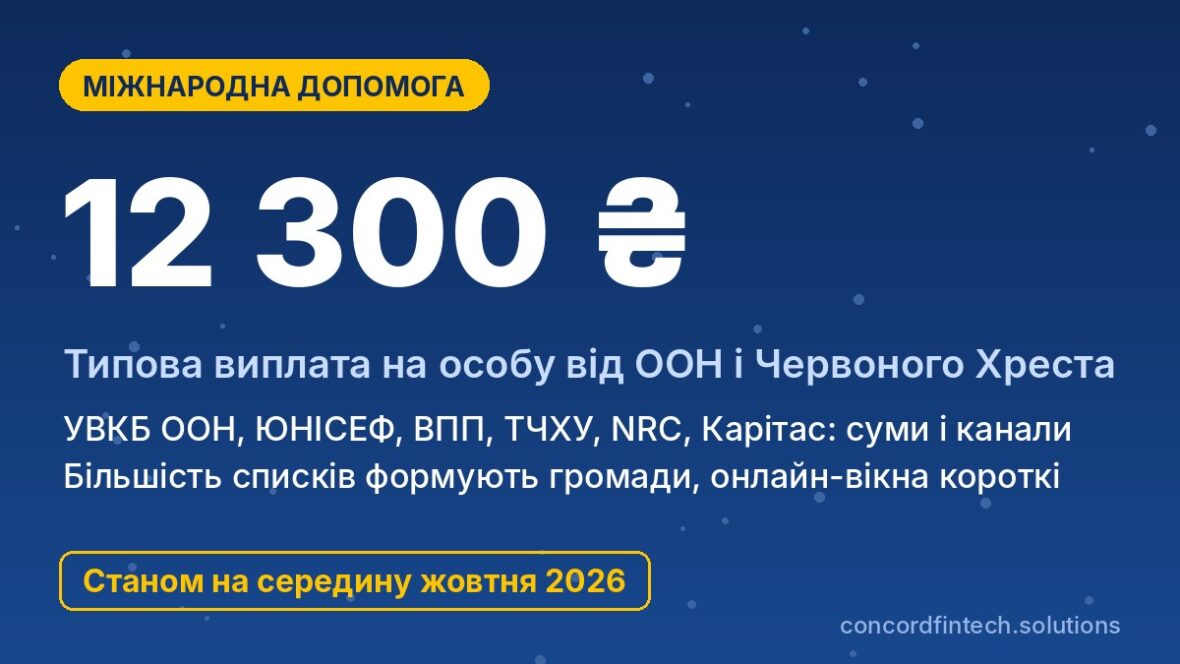
Cash assistance from international organisations in 2026 cannot be obtained with a single joint application: each organisation has its own criteria, and registration rounds open in waves. As of mid-October 2026, the largest programmes operate under the same priority model, so typical amounts across different organisations coincide: 10 800 UAH or 12 300 UAH per person.
Below are programmes verified on the organisations’ official websites. This is an overview and ways to find out which rounds are open at the time of application.
Programmes active as of mid-October 2026
UN agencies: United Nations High Commissioner for Refugees (UNHCR), the United Nations Children’s Fund (UNICEF), the World Food Programme (WFP) and the International Organization for Migration (IOM)
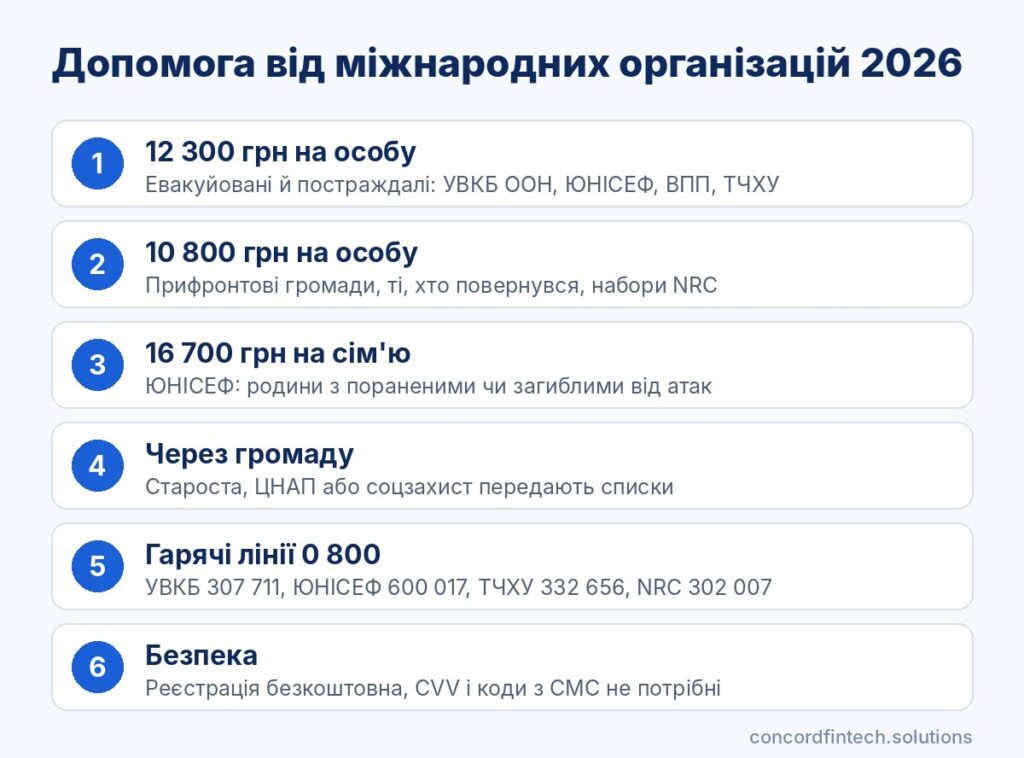
The United Nations High Commissioner for Refugees (UNHCR) pays 12 300 UAH per person to evacuees and those affected by shelling, and 10 800 UAH to residents of frontline communities and to those who have returned home. Registration is carried out only by partners in an interview; there is no online form on the agency’s website.
The United Nations Children’s Fund (UNICEF) on the programme page names 12 300 UAH per person after an attack or evacuation (up to 86 100 UAH per family), 16 700 UAH for families where someone has been injured by explosive weapons, and 4 100 UAH per person when basic services are disrupted. Families are identified by local authorities and social workers; there is no online registration.
The World Food Programme (WFP) in its May 2026 report notes the same 12 300 UAH per person for evacuees and those affected by strikes. The International Organization for Migration (IOM) has a hotline and a service to check application status, but as of mid-October it had not announced open registration for everyone.
Ukrainian Red Cross Society
Payments are made by the Ukrainian Red Cross Society (URCS): 10 800 UAH in frontline communities, 12 300 UAH to evacuees and those affected, and 2 000-3 000 UAH per month for certain internally displaced persons (IDPs). Recipient lists are formed together with local authorities.
Caritas, the Norwegian Refugee Council (NRC) and People in Need
Caritas operates through regional branches, so conditions vary even between neighbouring communities. In August 2026 some branches registered households for winter assistance.
The Norwegian Refugee Council (NRC) accepts applications only via an online form during short windows. People in Need combines cash assistance with grants and on 1 September 2026 announced micro‑grants for IDPs.
Deadlines and eligibility conditions
Submission deadlines
Most programmes have no permanent deadline because recipients are selected from community lists. Exceptions are NRC online rounds lasting about a week and evacuation registration, which must be completed within 45 days of departure.
Eligibility criteria
Priority is given to evacuees, people affected by shelling, residents within 50 km of the front line, IDPs without access to state aid, families with people with disabilities and large families. Meeting the criteria does not guarantee payment, as funding is limited.
Covered regions
The Ukrainian Red Cross Society and UNICEF operate primarily in nine oblasts, while UNHCR partner centres work in 16 oblasts. The table is compiled from official websites as of mid-October 2026.
| Organisation | Who it’s for | Amount | How to apply |
|---|---|---|---|
| United Nations High Commissioner for Refugees (UNHCR) | Evacuees, those affected by shelling, frontline communities | 12 300 / 10 800 UAH per person | Interview with a partner |
| United Nations Children’s Fund (UNICEF) | People affected by attacks, evacuees | 12 300 UAH per person | Through local authorities |
| United Nations Children’s Fund (UNICEF) | Families with wounded or deceased | 16 700 UAH per family | Through child protection specialists |
| World Food Programme (WFP) | Evacuees, those affected by strikes | 12 300 UAH per person | Via community lists |
| Ukrainian Red Cross Society (URCS) | Frontline communities, evacuees, IDPs | 10 800 / 12 300 UAH, 2 000-3 000 UAH/month | Through local authorities |
| NRC | Residents of combat zones, displaced people | 10 800 UAH per person (June 2026) | Online form during the intake window |
| Caritas | IDPs, older people, persons with disabilities | Depends on the branch | In person at the regional office |
How to apply to an international organisation
Official websites of organisations
First find out whether the organisation is accepting applications from individuals at all. UNHCR, UNICEF and the URCS receive lists from communities, so the steps are as follows:
- Identify your category: evacuee, affected person, resident of a frontline community or internally displaced person (IDP).
- Check the conditions on the organisation’s official website, not in messaging apps.
- Contact the starosta (community leader), the Centre for Administrative Services (CNAP) or the social protection office to be added to the community list.
- Prepare your passport, Taxpayer Registration Number (RNOCPP), an IDP certificate, documents for children and an IBAN account in your name.
- Check status only via the official hotline.
Hotlines
Calls to numbers starting 0 800 are free within Ukraine. Official organisation websites list the following numbers:
- UNHCR: 0 800 307 711;
- UNICEF: 0 800 600 017;
- IOM: 0 800 215 510;
- Ukrainian Red Cross Society: 0 800 332 656;
- NRC: 0 800 302 007;
- People in Need: 0 800 210 174.
Partner organisations in communities
Interviews for UNHCR are conducted by partners, including the Charitable Foundation «Pravo na zakhyst» and NGO «Proliska», while the URCS works through oblast and district branches. Check the partner’s website for the centre address and opening hours.
Programmes with closed registration
Rounds already closed
An NRC online intake ran from 16 to 25 June 2026. Applications for the state “Winter Support” of 19 400 UAH, partly funded by UNICEF, the URCS and UNHCR, were accepted until 30 October 2026.
Expected new waves
The UN humanitarian community adopted a winter response plan for October 2026-March 2027 aiming to reach 2.1 million people. The UNICEF plan foresees cash assistance for 225,000 people, but timing depends on funding.
How to monitor openings
Follow organisations’ official websites and community announcements. Check the NRC site more frequently because its online windows are short.
How to protect yourself from fraud
Verifying the official channel
Genuine announcements are posted on domains unhcr.org, unicef.org, redcross.org.ua, iom.int, nrc.no and caritas.ua. Verify an unfamiliar site via the hotline.
Paid “registration services”
Registration for international programmes is free; intermediaries who “guarantee” payment do not exist. Any demand for a commission, CVV, PIN or SMS code is a sign of fraud.
Where to report
Report a fake site to the organisation being impersonated. If card details have already been shared, block the card through your bank and contact the police at 102.
Frequently asked questions
Can you receive assistance from several organisations at once?
Receiving the same payment from two organisations is generally not possible, because partners cross‑check lists through a shared duplication‑prevention system. International assistance does not cancel state social payments.
How often do new assistance programmes open?
There is no fixed schedule; new waves depend on donor funding. UN winter programmes cover October 2026-March 2027.
How can I check that a programme is genuine?
Find the announcement on the organisation’s official website and call its hotline. If the hotline staff are unaware of the programme, do not provide any personal data.