



“Municipal nanny” in 2026 allows parents to reclaim part of what they pay a nanny, up to 8 580 UAH per month for one child. The state reimburses 52 UAH for each hour of care, but not more than for 165 hours per month and not more than the amount the parents actually paid.
The compensation is awarded by the social protection authority at the place of residence, and only certain categories of families with children up to 3 or up to 6 years old are eligible. Below we explain how the payment is calculated, who is entitled to it, what requirements the nanny must meet and whether this programme can be combined with “єЯсла”.
How the nanny compensation is calculated
Rate of 52 UAH per hour
The procedure, approved by the Cabinet of Ministers Resolution No.68 of 30.01.2019, links the compensation to the hourly minimum wage set on 1 January of the relevant year. 100% of that hourly rate is reimbursed for each hour of actual care.
The State Budget Law for 2026 sets the hourly minimum wage at 52 UAH, so that rate applies from January through December 2026. If the minimum wage changes from 1 January 2027, the rate will change accordingly.
Limit of 165 hours per month
Payments are made for no more than 165 hours of care per month, which roughly corresponds to a full-time working schedule. Hours worked beyond that limit are paid for by the parents, and the state does not reimburse them.
The number of hours is confirmed by an act of services provided, which the nanny draws up monthly. Without that act and a proof of payment the social protection authority cannot calculate the payment.
Maximum amount 8 580 UAH
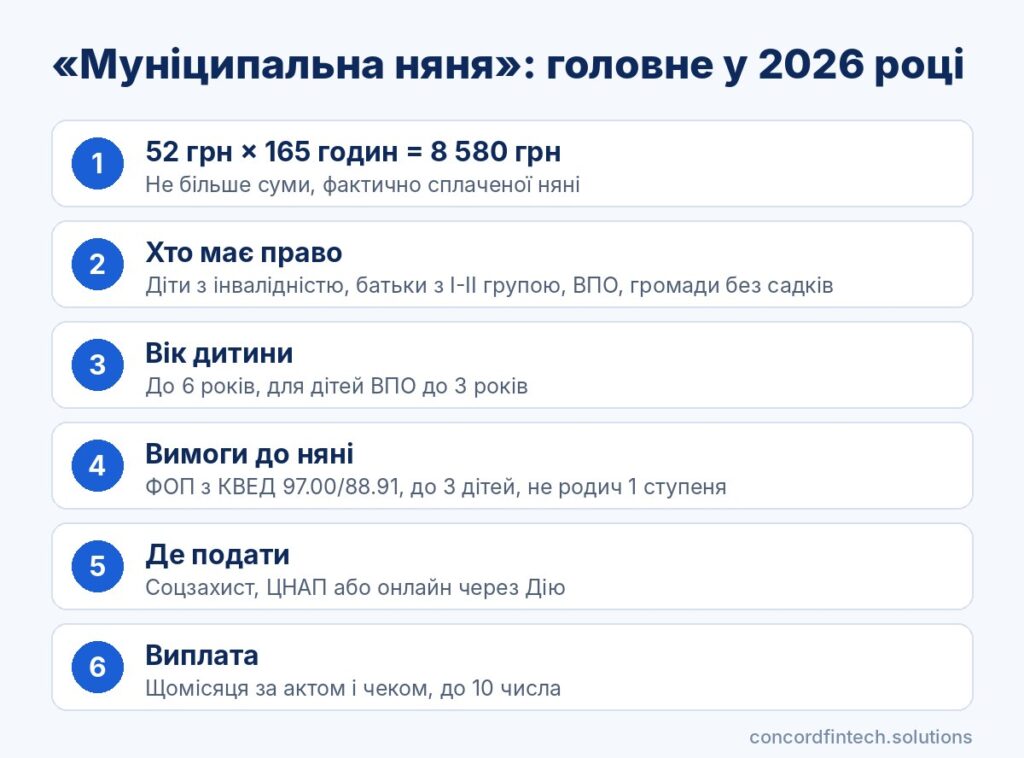
The maximum possible amount per child is 52 UAH multiplied by 165 hours, i.e. 8 580 UAH per month. The compensation cannot exceed the amount actually paid, so a family paying a cheaper nanny will receive less.
How the payment changes depending on hours is shown in the table. The calculation is made for a nanny who charges at least 52 UAH per hour.
| Hours per month | Rate | Compensation amount |
|---|---|---|
| 40 | 52 UAH/hour | 2 080 UAH |
| 80 | 52 UAH/hour | 4 160 UAH |
| 120 | 52 UAH/hour | 6 240 UAH |
| 165 | 52 UAH/hour | 8 580 UAH |
| 200 | 52 UAH/hour, only 165 paid | 8 580 UAH |
Which families are entitled to compensation
Family categories under the programme
The circle of beneficiaries was significantly changed by Cabinet of Ministers Resolution No.664 of 07.06.2024, which applies for the period of martial law and for three months after its end. The application is submitted by one of the parents or a guardian, including a foreign national lawfully residing in Ukraine. Compensation is awarded if the family cares for:
- a child with a disability or a child who needs additional care because of a serious health condition;
- a child whose one parent or guardian has a Group I or II disability;
- a child whose one parent is an internally displaced person (IDP);
- a child who lives in a community where pre-school institutions are not operating due to a decision by the military administration or the local council.
For IDPs and families from communities without kindergartens there is an additional employment requirement. One of the parents must be employed under a contract, run a business, study or retrain, be unemployed for no more than 6 months, or participate in defence activities.
Age requirements for the child
For most categories the age limit is 6 years, while for IDPs compensation is awarded only up to 3 years. Children needing additional care include, in particular, those with cancer or rare diseases, cerebral palsy, type 1 diabetes, severe developmental disorders or serious injuries.
Compensation is not awarded to parents who are on parental leave to care for a child up to three years old, nor to foster carers and adoptive parents. The entitlement also ends when kindergartens in the community resume operation.
Requirements for the nanny
The nanny may be an individual entrepreneur (FOP) registered with the Classification of Economic Activities (KVED) 97.00 and/or 88.91, who simultaneously cares for no more than three children. A legal entity with KVED 78.20 and/or 85.10 may accept up to six children, but at least two employees must supervise them and children must have access to a shelter.
Close relatives in the first degree, as well as state and communal kindergartens, cannot act as service providers. The Procedure does not require a special certificate or training, but safety conditions for children must be specified in the contract.
The main conditions are summarised in the table. Check your situation against it before applying.
| Condition | Requirement |
|---|---|
| Child’s age | Up to 6 years, for IDPs up to 3 years |
| Parents’ employment | Mandatory for IDPs and communities without kindergartens |
| Parental leave to age 3 | Excludes entitlement to compensation |
| Nanny status | FOP with KVED 97.00/88.91 or legal entity with KVED 78.20/85.10 |
| Number of children per nanny | FOP up to 3, legal entity up to 6 |
| Family ties | Not a first-degree relative |
Contract with the nanny and her registration
Registering the nanny as an individual entrepreneur (FOP) or a service provider
The social protection authority checks whether the nanny is registered as an individual entrepreneur or a legal entity with the required type of activity. If a private nanny works unofficially, parents can suggest she registers as an individual entrepreneur (FOP), which takes only a few days and is free in the Diia portal or at a Centre for Administrative Services (CNAP).
Payments from parents are the income of the nanny-FOP, from which she pays the single tax. The state transfers the compensation to the parents, not to the nanny.
Mandatory terms of the contract
The contract must be concluded in writing before submitting the application, and compensation is not awarded earlier than its signing date. The document should specify the parties, the child, the care address, schedule, hourly rate, payment terms and safety measures.
If a FOP cares for children from several families, the place of care is determined by written consent of the parents of all children. It is also worth specifying a substitute nanny for periods of illness.
Recording hours worked
Each month the nanny draws up an act of services provided with the number of hours, and parents keep the receipt, bank statement or payment receipt. The payment document must include the surnames of the applicant and the nanny, the month, year and amount.
The simplest option is to pay cashless to the FOP’s account with a payment purpose referencing the contract. Cash without a receipt or a transfer to the nanny’s personal card may be grounds for refusal.
Application procedure for the compensation
Submission via Diia
The application can be submitted online via the Diia portal if the service is enabled in the community. Documents are uploaded as scans, and the decision is made by the same social protection authority. If online submission is not available in the community, a paper procedure applies.
Submission via CNAP or social protection authority
Documents are accepted in person by the structural unit of the social protection authority, and in many communities also by the CNAP. The Pension Fund does not award this compensation, so there is no need to contact its service centres. The procedure usually looks like this:
- find a nanny who is a FOP or a legal entity with the appropriate KVED and sign a written contract;
- pay for the services for the first month and obtain from the nanny an act with the number of hours;
- submit an application for compensation and an application for fund transfer with bank account details;
- attach a copy of the contract, the payment document and certificates required for your category;
- wait for the decision and then submit the act and proof of payment monthly.
IDPs and parents from communities without kindergartens add a certificate from the workplace about employment and the absence of parental leave, and FOPs add an OK-7 certificate (OK-7). The unemployed submit a certificate from the employment centre, and a council decision to suspend kindergarten operation is not required if it is published on the community website.
Consideration periods and monthly payment
The decision is made within 10 working days, and the applicant is informed within 3 working days. Missing documents can be provided within 5 working days.
Compensation is awarded from the month of application and is transferred to a bank account by the 10th day of the following month. Concealment of circumstances or submission of false information leads to termination of payment and repayment of funds received in excess.
Combination with the “єЯсла” programme
Can both payments be received
“єЯсла” is awarded by the Pension Fund for children aged 1 to 3 years, while “municipal nanny” is awarded by the social protection authority under a separate procedure. At the time of writing there is no explicit prohibition in the regulations on receiving both payments simultaneously.
However, “municipal nanny” reimburses only actually paid funds. If you pay the nanny from the “єЯсла” account and then request compensation for the same payment, the social protection authority may consider this double funding, so it is better to obtain a written clarification from the Department of Social Protection of the Population (USZN).
Which is more advantageous for a family
“єЯсла” is available to all full-time working parents of children aged 1 to 3 years, while the nanny compensation is targeted at a narrower set of privileged categories. On the other hand, “municipal nanny” applies up to 6 years for most categories, and funds arrive on an ordinary card, whereas “єЯсла” funds are spent only from a special account.
Calculation examples
A mother who is an IDP with a 2-year-old child pays a nanny-FOP 60 UAH per hour for 160 hours, i.e. 9 600 UAH. The compensation will be 52 UAH multiplied by 160 hours, or 8 320 UAH, and the remaining 1 280 UAH the family pays themselves.
A father with a Group II disability hires a nanny for a 5-year-old child for 100 hours at a rate of 45 UAH. Since the nanny’s rate is below 52 UAH, the refund will be the actually paid 4 500 UAH, not 5 200 UAH.
Common mistakes and where to turn
Why compensation is refused
The most common reason for refusal is a nanny who is not registered as a FOP or who has an inappropriate KVED. Refusals also occur because the contract was signed after care began, payment was made without a confirming document, or one of the parents is on parental leave to care for a child up to three years old.
How to appeal a decision
A refusal can be appealed to the higher-level social protection authority, i.e. the regional military administration, or to a court. Include copies of the contract, acts and payment documents with the complaint.
Advice is provided at the USZN at the place of residence or at the CNAP. Before signing the contract it is useful to clarify the list of documents required for your category there.
Frequently asked questions
Can a grandmother or another close relative be the nanny?
A grandmother, grandfather, brothers and sisters are first-degree relatives, and under the programme rules they cannot be the “municipal nanny”. An aunt or more distant relative may formally provide the service if she registers as a FOP with the required KVED and signs a written contract.
Does the nanny need to register as a FOP?
Yes, without registration as a FOP or a legal entity with KVED 97.00, 88.91, 78.20 or 85.10 the compensation will not be awarded. Registration is free, and the nanny pays taxes according to the chosen single tax group.
What happens if the nanny works more than 165 hours?
Only 165 hours will be reimbursed, i.e. no more than 8 580 UAH per month in 2026. Parents pay for the remaining hours themselves under the contract terms.