


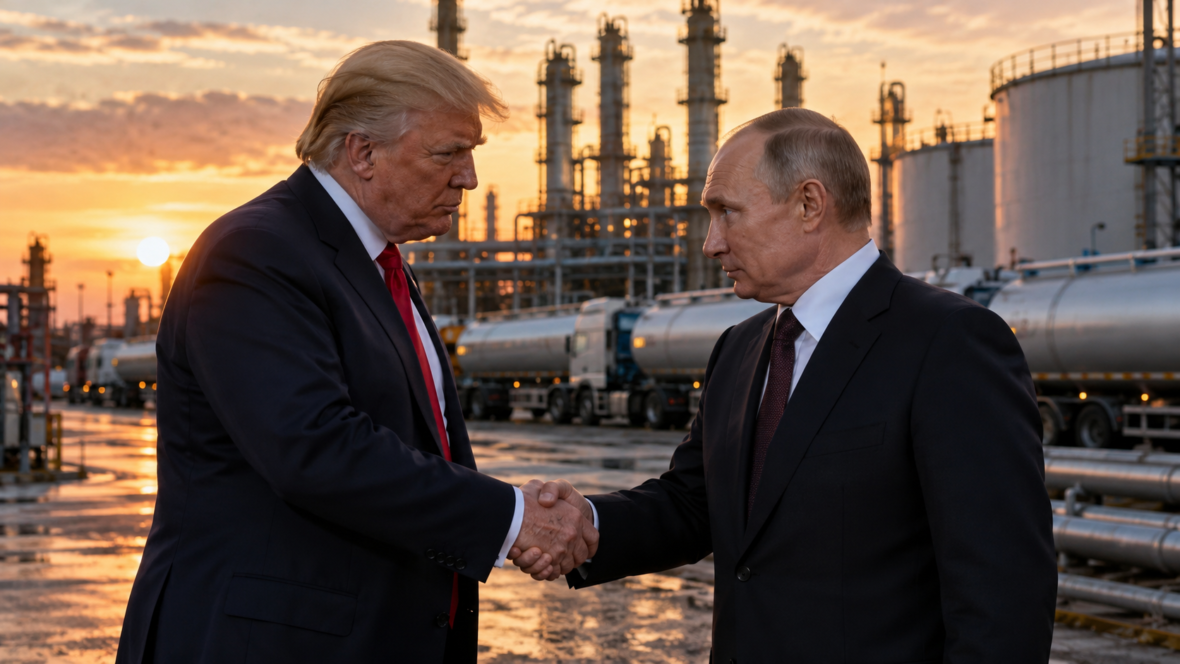
Fuel in the US is getting more expensive, the midterm elections are a few weeks away, and Donald Trump has found an unexpected way out. He agreed with Vladimir Putin that Russian diesel will be put onto the global market, and Washington has eased some of the sanctions imposed over the war against Ukraine to make that possible.
Diesel for America means trucks, farms and construction. When it gets more expensive, business costs rise and so do shop prices. And on 3 November 2026 the US has midterm elections that will decide who controls Congress. A cheaper cost of living could be an argument for voters, but economists doubt that Russian supplies will have time to change anything noticeably.
What was agreed
Volumes on paper
On 9 October Trump announced that Moscow had agreed to increase diesel supplies to the American and global markets. The plan is phased: first over 300,000 tonnes, in November a further 500,000, then an additional one million tonnes.
Trump also hinted at a possible 3 million tonnes in a short time, but that depends on the condition of Russian refineries. Altogether that comes to more than 4.8 million tonnes. These are only announced volumes, not what has actually been shipped.
Licence until April 2027
After the announcement of the deal, the US Treasury issued a temporary licence: certain operations with Russian diesel are permitted until 7 April 2027. Previously sanctions had blocked this to cut Moscow’s energy revenues. Other restrictions still remain in place.
Important nuance: not every cargo will go directly to the US. Fuel may go to other markets and affect the global balance. Subsequently Trump himself clarified that the talk was primarily about increasing global supplies.
Why Trump wants cheap diesel now
6.28 dollars per gallon
Expensive fuel has become one of the biggest economic problems for the White House in 2026. According to the American Automobile Association (AAA), on 8 October diesel in the US averaged 6.28 dollars per gallon. That’s nearly a record and much more expensive than last year.
Carriers suffer most: trucks transport food, raw materials and industrial goods across the country every day, and when diesel gets pricier they raise their rates. Farmers also struggle — tractors and combines run on diesel, so the cost of production for harvests rises, and later this shows up on price tags.
Elections and the voter’s wallet
In the midterms the entire House of Representatives is renewed and roughly one third of the Senate. Americans are currently most worried about inflation and prices, and Republicans urgently need to hold on to Congress. So the administration wants to show some economic results by 3 November.
The logic is simple: people see petrol and diesel prices at every forecourt, and the consequences in every receipt. If fuel becomes cheaper, Republicans can claim credit for it, and even the news of upcoming deliveries will be used in campaign messaging. But there are no guarantees: voters also look at inflation, jobs, wages and foreign policy.
Why Russian diesel is not a magic wand
A drop in the ocean
Analysts are cautious about the deal, and the main reason is scale. The first 300,000 tonnes is less than the US consumes in diesel in one day. On a global scale it’s even less.
And the global market is currently volatile: the war around Iran, damaged refineries, problems with maritime transport, disruptions at Russian plants. The analytics company Kpler estimates the global diesel deficit at roughly 130,000 tonnes per day. Against that backdrop even several hundred thousand tonnes will not close the gap.
The market has already priced in the news
Plus logistics: fuel needs to be produced, loaded into tankers, transported and distributed to forecourts, and that takes time. After the deal was announced, exchange diesel prices initially fell, but by 13 October futures had again risen by 4.5%. A political news item on the market does not mean petrol will be cheaper at the pump for long.
What Moscow gains from this
Money for the war
For Russia this means new sales markets, foreign currency for producers and tax revenue for the budget — and under sanctions and with huge military spending every such dollar counts. Estimates suggest the first shipments alone could bring Moscow about 400 million dollars. The final sum will depend on actual shipments, prices and commercial terms.
In addition, eased sanctions could make it easier for Russian producers to find buyers and to conduct deals within the licence.
Attacks on refineries as a bargaining chip
A separate issue is the Ukrainian strikes on Russian refineries, which reduce refining, including that used by the military. According to US media, the Trump administration repeatedly asked Kyiv to stop such attacks, linking them to higher fuel prices.
Ukraine offered reciprocity: Zelensky said he was ready to stop strikes on refineries if Russia stopped hitting Ukrainian energy infrastructure. Trump even announced an energy truce, but its implementation became contentious: the Russians continued attacks, and Ukraine later resumed strikes on Russian plants.
Scandal in Washington and a new decision on sanctions
Criticism from both parties
The deal was unpopular not only with the Democrats. As early as 2022 the US banned imports of Russian energy, so the new permissions raised questions about legality. A group of Republican and Democratic senators called for a review of the agreement, arguing it could give Russia money to continue the war.
However, Republican John Barrasso sided with the president. He supported attempts to lower energy prices and suggested that economic ties could become another lever of influence over Moscow.
16 October — a pause on new sanctions
At the end of the week the story continued. On 16 October Trump signed an order pausing a new package of sanctions against Russia, citing US national interests. These measures were to target Russian banks, officials, energy traders and export structures, and would also have imposed large tariffs on the biggest buyers of Russian oil and gas.
This was a separate decision, broader than the diesel licence, and it added another reason for disputes between the White House and Congress.
How Kyiv and Europe reacted
Zelensky criticised the easing of sanctions without any real steps by Russia towards peace. In his view, greater energy exports mean more money for the Kremlin. Kyiv insists any energy arrangements must be reciprocal, and is simultaneously negotiating guarantees of security and support.
In Brussels Trump’s decision was also met with concern. Europeans believe pressure on Russia should be maintained while the war continues. And it’s not only about diesel volumes: divergences between American and European sanctions could complicate negotiations, trade and the coordination of new restrictions.
What the near future will show
The coming weeks will show whether the promised volumes match what Russia can realistically export. Traders will watch shipments, refinery operations and routes, and in the US — prices at forecourts and carriers’ costs. The Middle East will also play a role: disruptions there may keep prices high even with Russian diesel.
Politically everything is open too. The White House wants to stabilise the market and continue talks with Moscow, while Ukraine and some US lawmakers are waiting for concrete Russian steps to end the war. By 3 November three things will decide it all: how much diesel actually arrives, what happens to prices at the pumps and what further sanctions decisions Washington makes.