

What happened and what the numbers show
The German government has cited a figure of 100 billion euros as the total volume of aid to Ukraine since the start of Russia’s full-scale war against Ukraine. But a detailed tally by experts shows a substantial gap between the figure announced and the money that actually ended up in Ukraine; DW reports.
The Ukraine Support Tracker group of the Kiel Institute for the World Economy calculated that of that 100 billion euros only 41.7 billion euros, or 40 percent, actually reached Ukraine. Other types of expenditures are included in the headline total but were largely directed within Germany or take the form of guarantees for future commitments.
Why experts are revisiting the figures now
The institute’s report appeared in October and focuses on data as of June 2026. In the document the researchers attempt to reconcile the sums announced by the government with actual payments and obligations that have already been made or built into budgets.
The issue gained urgency after a shift in transparency policy following June 2025, when the government of Friedrich Merz took office. According to the institute, after that date details of military support were no longer published systematically, whereas during the chancellorship of Olaf Scholz there had been an open, continually updated list of military aid provided.

Why a large share of the money stayed in Germany
Experts distinguish several categories of expenditure that are counted in German statistics as “bilateral aid to Ukraine” but in practice do not enter Ukraine’s state budget. First, almost 27.5 billion euros were spent on social payments to Ukrainian refugees living in Germany. These are direct payments addressed to people but made through Germany’s state social protection system.
Second, more than 7.1 billion euros went to federal states and local authorities as compensation for providing housing and services to refugees. A further 1.3 billion euros went towards export and investment guarantees for German companies. The institute classified 7.4 billion euros as non-military assistance, a category that includes humanitarian aid, emergency energy assistance and funding for the reconstruction of Ukrainian public institutions.
On the military component and future guarantees
The federal government calls 57.6 billion euros out of the 100 billion euros military assistance. But the Kiel Institute for the World Economy counted 56.3 billion euros of military aid that had already been allocated or promised since 2022, which is 1.3 billion euros less than the government’s figure.
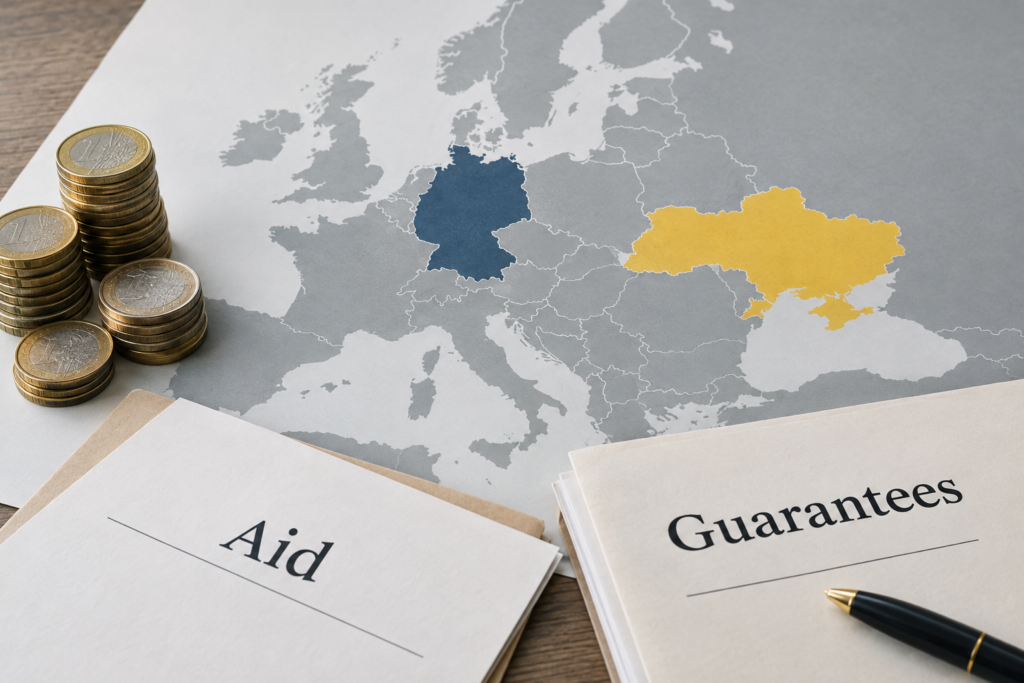
More importantly, 22 billion euros of the declared military expenditures are in fact guarantees or planned future commitments. A guarantee is a state promise to back certain loans or supplies if needed, but it is not an immediate cash payment — which means that real resources for Kyiv may arrive later or in another form.
Who is affected by this distribution of funds
First and foremost, the arithmetic means that the Ukrainian government has received less financing than the headline figure of 100 billion euros suggests. Specifically, 41.7 billion euros reached the state budget or direct needs of Ukraine. That is the key figure for planning public spending, defence and reconstruction.
The second group affected are Ukrainian citizens living in Germany — they received substantial social payments that were spent within Germany. The third group are German Länder and municipalities that received compensation for hosting refugees. Finally, German companies received support in the form of export and investment guarantees, which shifts part of the assistance into the commercial domain.
Risks to transparency and what the lack of public data changes
Rebalancing trust in the numbers, experts complain about increasingly less orderly government communication. If public lists of military aid stopped being updated after the new cabinet took office, it becomes harder for independent analysts to track who received equipment or funding and when.
This is important not as a critique of policy but to understand the financial resources actually available to Ukraine today and in the near future. The authors of the analysis offered no forecasts; they present the data and emphasise that the 100 billion euro figure is misleading if presented as purely bilateral aid that has already been placed at the disposal of the Ukrainian government.