



According to estimates by the Organisation for Economic Co-operation and Development (OECD), in 22 of the 30 European countries studied public pension payments will not provide the equivalent of 70% of previous earnings, so workers will need to save additional funds over their working lives.
Where the largest additional contributions are needed
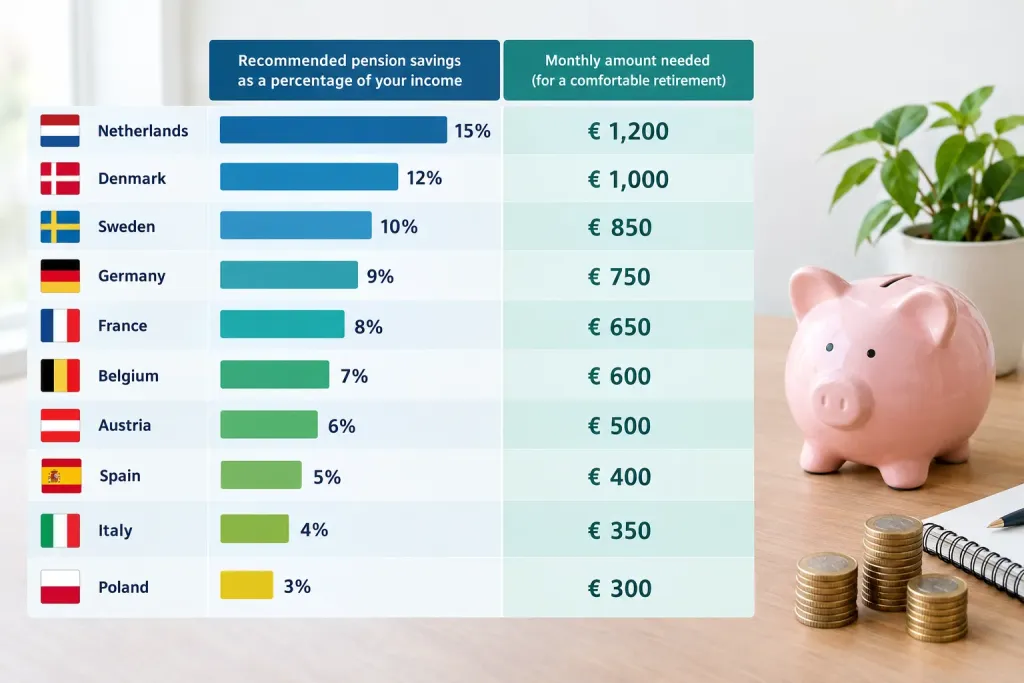
The OECD calculated the share of salary that workers would need to put into voluntary savings to achieve a 70% retirement income. In Lithuania this amounts to 20.7% of salary, in Ireland - 19.4%, in Poland - 17.3%, in Croatia - 15.7%, in Slovenia - 12.5%, in Switzerland - 12.1%, in Germany - 11.1%, and in Belgium - 10.7%.
By contrast, the figure is 9.1% in the United Kingdom, 6.2% in France, 2.2% in Sweden, and the smallest gap was recorded in Turkey - 0.4%. According to the OECD’s projection, public pensions should be sufficient to reach the target income level for men with average earnings in Austria, Denmark, Greece, Italy, Luxembourg, the Netherlands, Portugal and Spain.

How much that is in euros per month for men with average earnings
Converting the savings share into concrete sums using 2025 average wages shows large disparities between countries. In the United Kingdom one would need to save about 494 euro per month, in Poland - 360 euro, in France - 238 euro, while in Turkey that amount is approximately 5 euro.
The difference is explained not only by pension systems but also by income levels. For example, in 2025 the average monthly wage was 8 957 euro in Switzerland and 5 558 euro in Germany, 3 830 euro in France, and 2 078 euro in Poland.