


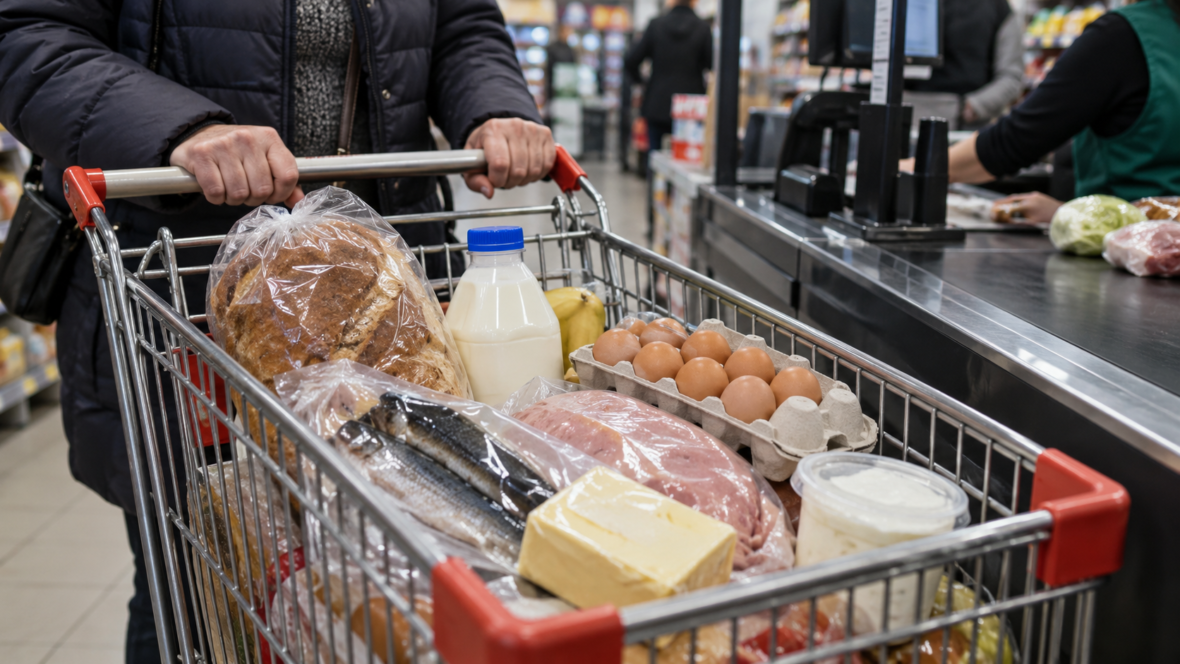
Anyone who remembers how much a pack of butter cost in 2022 now only sighs by the supermarket shelf. Over four years of the full-scale war, some everyday products have become almost twice as expensive. The leaders are herring, butter and meat, but milk, eggs and bread have not lagged far behind.
Comparing average prices in 2022 and 2026, herring has risen by almost 115%, while butter is up 91%. And these are not isolated cases. The increase has affected practically everything that usually ends up in the shopping basket.
Herring and butter — the outright record holders
Herring +115%
In 2022 a kilogram of herring cost on average 108,82 UAH. Now it is 233,51 UAH. That is +114,58%, or 124,69 UAH more per kilogram.
Butter +91%
Butter follows almost as closely. A 200 g pack that used to be bought for about 60 UAH now costs more than 115 UAH. So two packs that in 2022 cost roughly 121 UAH now cost over 230 UAH.
How much meat costs now
Pork near 325 UAH
Pork neck cost on average 176,58 UAH per kilogram in 2022. Now it is 324,72 UAH, which is 83,89% more. In other words, each kilogram now costs almost one and a half hundred hryvnia more.
Chicken fillet
Chicken, which many families buy almost weekly, has also become noticeably more expensive. The average price of fillet rose from 127,79 to 227,90 UAH per kilogram, that is +78,34%. Two kilograms that four years ago cost about 256 UAH now cost roughly 456 UAH.
The full picture of price increases
Fish and meat are only part of the story. Here is how prices for key products changed from 2022 to 2026.
- Herring – 108,82 UAH/kg in 2022, 233,51 UAH/kg in 2026 (+114,58%).
- Butter, 200 g – 60,32 UAH in 2022, 115,10 UAH in 2026 (+90,82%).
- Pork neck – 176,58 UAH/kg in 2022, 324,72 UAH/kg in 2026 (+83,89%).
- Chicken fillet – 127,79 UAH/kg in 2022, 227,90 UAH/kg in 2026 (+78,34%).
- Eggs, a dozen – 43,06 UAH in 2022, 75,24 UAH in 2026 (+74,73%).
- Milk, litre – 34,41 UAH in 2022, 59,69 UAH in 2026 (+73,47%).
- Wheat loaf – 27,67 UAH in 2022, 47,23 UAH in 2026 (+70,69%).
- Sour cream, pack – 33,93 UAH in 2022, 57,62 UAH in 2026 (+69,82%).
These are average figures. In a particular store the price may differ depending on the producer, region, chain and promotions.
Everyday products have not fallen behind
A dozen eggs became more than 32 UAH more expensive, from 43,06 to 75,24 UAH. A litre of milk now costs 59,69 UAH instead of 34,41 UAH — a difference of over 25 UAH.
A loaf of wheat bread added almost twenty and costs on average 47,23 UAH. Sour cream, which used to be bought for 33,93 UAH, now costs about 57,62 UAH.
How much a simple set costs
Four basic products
Take the simplest set — a litre of milk, a dozen eggs, a loaf of bread and a pack of butter. In 2022 at average prices it cost 165,46 UAH. In 2026 it is already 297,26 UAH.
The difference is 131,80 UAH, which is almost +80% over four years. However, this calculation is not an official indicator for the whole food basket, but merely illustrates the price change for specific items.
A family’s weekly shop
Another example. A family buys two litres of milk, a dozen eggs and two packs of butter each week. In 2022 this cost 232,52 UAH, now it is 424,82 UAH.
So each such purchase is 192,30 UAH more expensive. Over a month that adds up to an extra 769,20 UAH, and that is only for three products, without meat, fish, vegetables or cereals.
Cucumbers have risen the least
Of all products, prices rose most modestly for cucumbers. A kilogram cost on average 63,04 UAH, and now 80,60 UAH. That is +27,86%, or 17,56 UAH more.
But with vegetables everything depends on the season. In summer and early autumn there are many local cucumbers and their price falls. In winter prices are pulled up by greenhouses, storage and imports, so figures can vary greatly between months even within the same year.
Why food prices rise during the war
Logistics and fuel
The war has hit the entire production, transport, storage and retail chain. Due to hostilities, damaged infrastructure and new routes, delivery is significantly more expensive.
Fuel affects the price not only because of trucks. It is also needed for agricultural machinery and factories themselves.
Electricity and generators
The food industry is highly dependent on power, especially dairy plants, meat processing and cold storage. Due to attacks on the energy sector, enterprises have had to switch to generators, which adds extra costs for fuel and maintenance.
On top of that come packaging, wages, rent and delivery. All of this is ultimately built into the price tag.
Exchange rate
Many pieces of equipment, packaging materials and feed additives are purchased from abroad. When the hryvnia weakens, these costs rise.
For imported products the currency factor is even more visible. Their price depends on the exchange rate, transportation and all costs associated with delivery.
Why some items double while others rise by a quarter
Food inflation does not affect all products equally. Dairy depends on milk yields, processing and cooling. Meat depends on feed, animal upkeep and the operation of processing plants.
Fish is closely linked to imports, the exchange rate and cold logistics. Eggs react to seasonal demand and feed costs, while vegetables depend on weather and harvest. That is why herring could rise by 114% while cucumbers only by 28%.
What will happen to prices next
Further dynamics will depend on the energy situation, producers’ costs, the hryvnia exchange rate, harvests and supply conditions. Seasonal vegetables and fruits may temporarily become cheaper when a new harvest appears. But products that use a lot of energy will remain sensitive to resource prices.
It is important not to confuse these figures with annual inflation. The percentages show how average prices for individual products changed over four years, not over the last twelve months. The biggest rises over this period were in herring, butter, pork and chicken, but even basic eggs, milk and bread increased in price by more than 70%.