




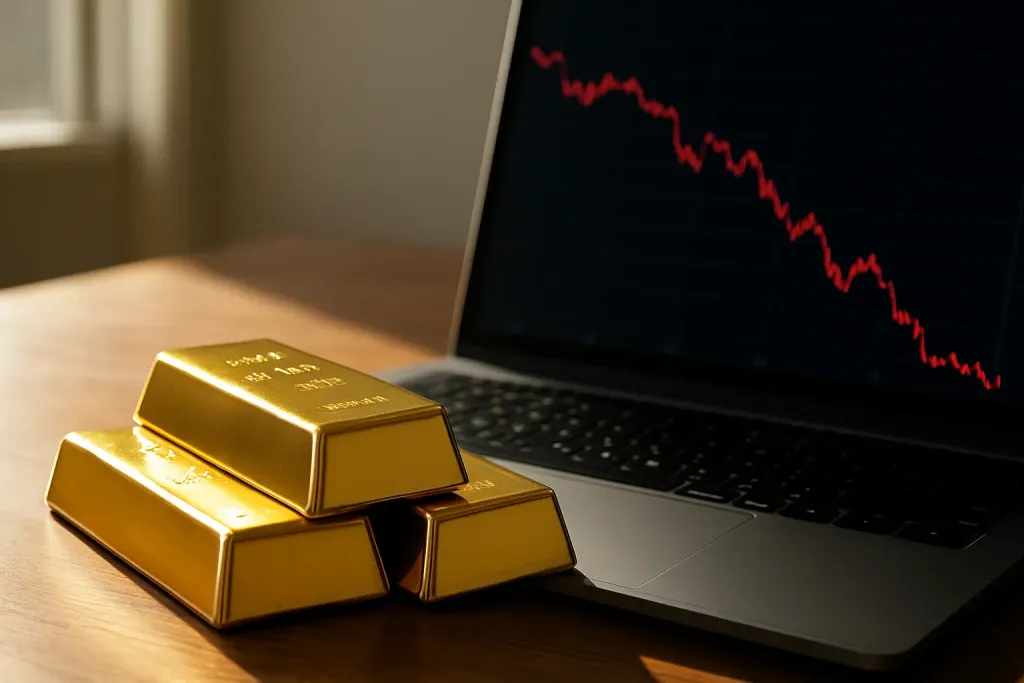
Gold has lost more than 30% of its value since the January 2026 peak, and US indices experienced sharp one-day declines, investment expert Erik Naiman said in a post on Facebook.
Gold price movements and stock indices
In January 2026 gold reached about $5 595 per troy ounce, and by mid-November it had fallen to roughly $3 760−3 800, losing about a third from the peak. At the same time, on 5 November the S&P 500 fell 4.4% and the Nasdaq 5.5%, marking their biggest one-day drops since April 2025.
Two reasons for the fall in the price of gold
Naiman named two main reasons for the decline in gold’s value: high real interest rates in the US, which make a non-yielding metal less attractive, and investors’ need for liquidity during sell-offs. In periods of heavy selling some market participants may sell gold to cover losses or margin calls, so the metal can fall alongside risk assets.
The expert also reminded readers that after the 1980 peak it took gold decades to return to previous nominal records; while over the very long term the metal can help preserve purchasing power, over a three- to five-year period its price can fluctuate significantly.
Losses on government bonds in different cycles
Naiman gave the example of long-term government bonds (government securities with a fixed term): during the 2008 crisis Vanguard’s long-term treasury fund rose by about 22.5%, while the S&P 500 lost 37%. By contrast, in 2022, when the Federal Reserve raised rates, the same fund fell by about 30%, while the S&P 500 declined roughly 18%.
This divergence is explained by the greater sensitivity of long-term bonds to changes in market interest rates: when market rates rise, the prices of already-issued securities with lower yields fall.
Assets to protect against different risks
Naiman emphasised that it is important to determine which risk an investor needs protection from. In the event of a recession and falling interest rates, long-term government bonds have historically tended to rise.
In periods of high inflation and rising rates, short-term bonds and inflation-protected securities are better suited, in particular US Treasury Inflation-Protected Securities (TIPS) - inflation-indexed securities. To guard against a decline in a specific sector of the stock market, diversification across sectors can provide protection; in a systemic financial crisis cash, short-term government paper and some market-neutral strategies can show relative resilience.
Attitude towards gold and analysts’ forecasts
Naiman does not recommend abandoning gold entirely after the price drop: central banks continue to buy the metal, and investment banks maintain forecasts for its potential recovery. In particular, Goldman Sachs in November revised its target price for the end of 2026 to $4 150 per ounce and for 2027 to $4 800 per ounce.
He described such forecasts as analysts’ estimates rather than guaranteed future prices.