
You can change or add a classification of economic activities (KVED) for an individual entrepreneur (FOP) online in the web version of the Diia Portal within a few minutes, and this service is free. For a single tax (EP) payer, Diia automatically generates a statement for the tax authority, but it is worth checking the result in the register of single tax payers in the Electronic Cabinet.
Before changing codes, it is important to make sure that the new activity is allowed on the simplified tax system and for your group. Below is a step‑by‑step instruction, deadlines, the activities prohibited under paragraph 291.5 of the Tax Code of Ukraine (TCU) and common mistakes.
When an individual entrepreneur (FOP) needs to change or add a KVED
New type of activity
The KVED code in the Unified State Register (EDR) must correspond to what the entrepreneur actually earns from. If a hairdresser starts selling cosmetics online, or a programmer starts running training courses, the new codes should be entered before the first payment for the new activity is received.
Bank and counterparty requirements
Banks, as part of financial monitoring, compare the purpose of payments with the client’s activity codes. A mismatch often prompts requests for documents or restrictions on account operations, and counterparties may require a recent extract showing the relevant code before signing a contract.
Transition to NACE 2.1-UA
From 01.01.2027 Ukraine will introduce the NACE 2.1-UA classification, and 2027 will be a transition year. If you change codes now, in 2026 Diia still offers the KVED-2010 codes, so in 2027 you will need to convert them to the new classifier with a separate application.
Step‑by‑step change of KVED via Diia
Selecting the service and codes
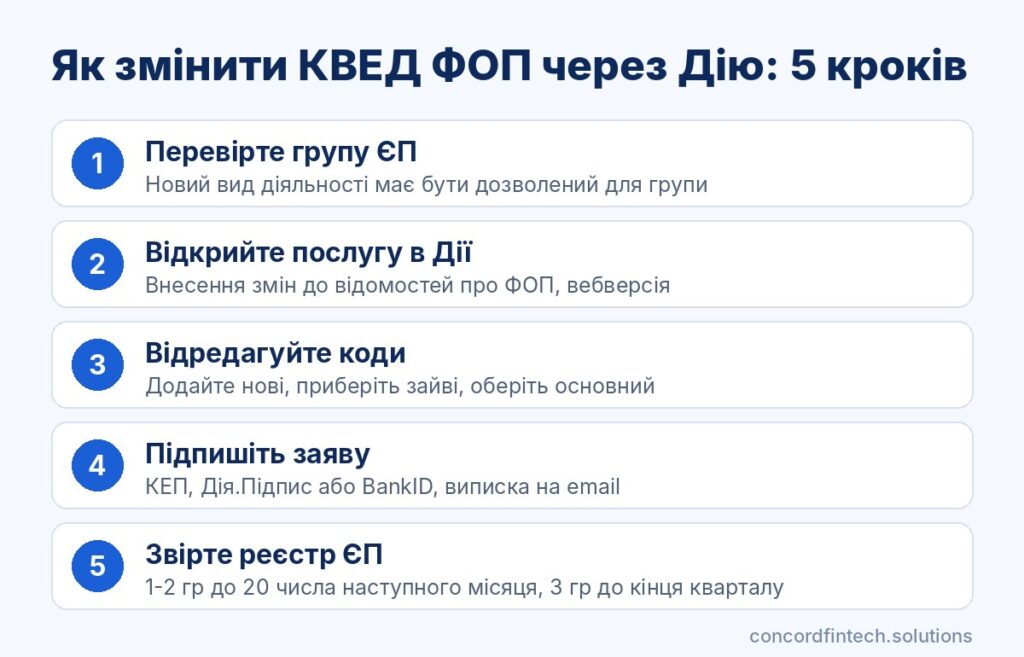
Online changes are available only in the web version of the Diia Portal, not in the mobile app. To sign in and sign the application you need a qualified electronic signature (QES), Diia.Signature or BankID, and an up‑to‑date phone number and email address in the FOP data. The procedure is as follows:
- find the service “Making changes to information about an FOP” and click “Submit application”;
- sign in via BankID, Diia.Signature or a file key QES;
- in the “Types of economic activity” block click “Edit”;
- add new codes using the search by number or name, and remove unnecessary ones with the “×” mark;
- if needed, change the primary type of activity;
- check the application and sign it with an electronic signature.
Primary and additional activities
The primary activity should be the code that brings the largest share of income. To replace the primary KVED, first remove the current one, then add the new one and mark it as primary; the old code can then be kept as an additional activity if desired.
Signing and processing time
Filling in the application takes up to 10 minutes, and additional documents are not required for online submission because the statement is generated automatically. According to the State Services Guide, changes are entered within a working day, and the extract from the EDR is sent to the email and to the citizen’s cabinet. After signing, the application cannot be corrected, so check the codes in advance.
Notification of the tax authority after changing KVED
Do you need to change data in the single tax register?
Activity types are recorded not only in the EDR but also in the register of single tax (EP) payers, and these data must match. The Diia Guide states that for a single tax payer a statement to the tax authority is automatically formed when changing KVEDs, so a separate visit to the State Tax Service (DPS) is usually not required.
Statement about changing activity types for groups 1–2
Check the extract from the register of single tax payers in the Electronic Cabinet after 3–4 working days. If the new codes are not there, submit a statement to amend the register yourself: under paragraph 298.5 of the Tax Code of Ukraine (TCU) for groups 1–2 the deadline is no later than the 20th day of the month following the month of changes, and for group 3 by the last day of the quarter in which the changes occurred.
Consequences of not submitting
The Tax Code does not establish a separate fine for a missed statement. However, income of groups 1–2 from activity not listed in the register of single tax payers is taxed at 15%, and during an inspection the tax authority may question the right to use the simplified system.
Activities prohibited for the single tax
Excise goods and exception for fuel and alcohol
The production, import, export and sale of excise goods disqualify access to the simplified system for all three groups. There are two exceptions: retail sale of motor fuels and lubricants in containers up to 20 litres, and retail sale by individuals of beer, cider, perry without added spirit and table wines provided a licence is held.
Financial and insurance services
Financial intermediation is prohibited, except for the work of insurance agents, surveyors, claims adjusters and adjusters. Banks, credit unions, pawnshops, leasing and insurance companies, as well as insurance brokers cannot be single tax (EP) payers.
Other restrictions in paragraph 291.5 of the TCU
The list in paragraph 291.5 of the Tax Code of Ukraine is formulated by activity descriptions rather than KVED codes, so the actual activity should be assessed. The main types incompatible with the single tax are:
- organising gambling, lotteries (except distribution) and pari‑mutuel betting;
- foreign currency exchange;
- extraction and sale of precious metals and stones, except for jewellery and household items;
- extraction and sale of mineral resources, except for locally significant deposits;
- enterprise management, postal services (except courier) and licensed communications;
- sale of art and antiques, organisation of auctions and touring events;
- technical testing and research, audit;
- renting land over 0.2 ha, housing over 400 sq. m or non‑residential premises over 900 sq. m.
Restrictions for groups 1 and 2
Household services for group 1
Group 1 may only sell goods from market trading places and provide household services to the public listed in paragraph 291.7 of the Tax Code of Ukraine (TCU). This includes, in particular, tailoring and repair of clothing and footwear, hairdressing services, repair of household appliances, laundry and photo services; renting housing or selling via the internet are not included.
Real estate brokerage and consulting
Intermediary services for buying, selling, renting and valuing real estate (group 70.31 KVED DK 009:2005) are allowed only for group 3. The same applies to the manufacture and sale of jewellery and household items made of precious metals and stones. Consulting is not explicitly prohibited for group 2, but clients may only be individuals and single tax payers.
Services group 2 cannot provide
Group 2 provides services to the public and single tax payers, produces and sells goods and works in the restaurant sector. According to clarifications from the State Tax Service (DPS), services to legal entities or to FOPs on the general tax system fall outside group 2, so for such clients, in particular in IT, group 3 is required.
| Type of activity | Group 1 | Group 2 | Group 3 |
|---|---|---|---|
| Household services to the public | Yes | Yes | Yes |
| Retail at a market | Yes | Yes | Yes |
| Shop, internet trade | No | Yes | Yes |
| Wholesale trade | No | Yes | Yes |
| Restaurants, cafés | No | Yes | Yes |
| IT services to legal entities on the general tax system | No | No | Yes |
| Consulting | No | Only to individuals and single tax payers | Yes |
| Real estate brokerage | No | No | Yes |
| Jewellery | No | No | Yes |
| Excise goods (except exceptions) | No | No | No |
Mistakes when changing KVED and their consequences
Activity without the corresponding code
If an FOP in groups 1–2 receives income from an activity that is not listed in the register of single tax payers, 15% single tax is charged on that amount. Therefore, it is better to enter the new code before the first payment rather than after it.
An incompatible code on the simplified system
An activity not allowed for groups 1–2 forces a switch to group 3 or to the general tax system from the first day of the month after the quarter in which it started. If this is not done, the tax authority may cancel the single tax registration, and a return to the simplified system will be possible only after four quarters.
Discrepancies with bank data
After changing codes, provide the bank with the new extract or update the client questionnaire in the app. Also check contracts, the public offer and the settings of the software fiscal registrar (PPRRO), if they specify types of activity, to avoid additional questions during financial monitoring.
Frequently asked questions
How long does it take to change KVED via Diia?
Filling in and signing the application takes up to 10 minutes. The entry in the EDR usually appears within a working day, and data in the register of single tax payers should be checked after a few working days.
Can I operate under a KVED that is not in the extract?
Formally there is no ban, but for a single tax payer in groups 1–2 income from such activity is taxed at 15%. In addition, the bank may request explanations for payments that do not match the codes in the register.
Which KVEDs are prohibited for group 2?
Besides the general prohibitions in paragraph 291.5 of the TCU, group 2 cannot provide real estate brokerage services or sell jewellery made of precious metals. Services to legal entities and to FOPs on the general tax system are also unavailable to group 2, even if the code is in the register.
How much does it cost to change KVED?
Changing KVEDs via the Diia Portal is free. According to the Guide, only changes to the full name (PIB) or address are paid services, and these currently cannot be submitted online.