




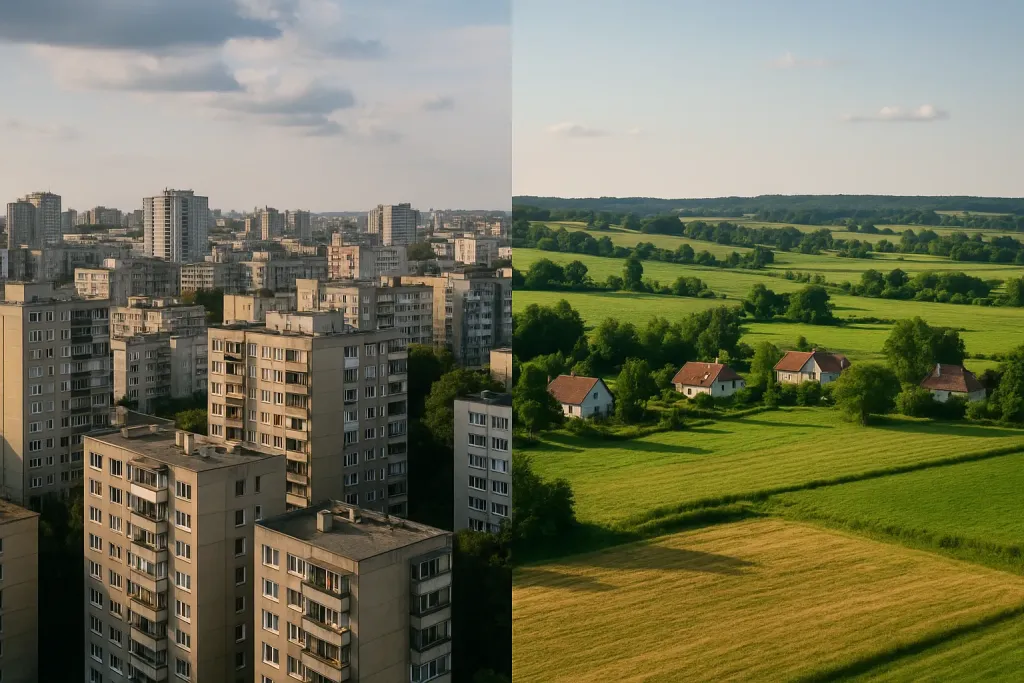
According to the Organisation for Economic Co-operation and Development (OECD) in the report Regions and Cities at a Glance 2026, Europe shows substantial differences in housing prices between city centres and areas outside them. In Denmark the gap is the largest: housing in city centres costs roughly 3.4 times more than in areas outside cities and suburban zones.
Extent of deviations across countries and specific figures
The OECD assessed data for several countries and found that in 16 European states housing in city centres is on average 31% more expensive than the national average. By contrast, prices in suburban areas are on average 11% below the national level, and in territories outside cities they are 30% lower.
In Denmark prices in city centres exceed the national average by 64%, while in territories outside cities and suburban areas they are 51% lower, yielding a ratio of roughly 3.4 to 1. In Hungary the corresponding deviations are +57% and -45%, and in Finland +55% and -44%.
Countries with the smallest gap - the Netherlands and the United Kingdom
The smallest difference between prices in city centres and outside them was recorded in the Netherlands and the United Kingdom. In the Netherlands urban housing is only 1% more expensive than the national average, while outside cities it is 9% cheaper.
In the United Kingdom the figures are +4% for city centres and -9% for areas outside cities. The OECD notes that a small gap does not necessarily mean housing is affordable, and methodological differences (for example, using the median price for an entire house in the UK comparison rather than a price per square metre) can reduce the apparent disparity.
Reasons why housing is more expensive in cities
One key explanation is the concentration of jobs, universities, services and cultural infrastructure in large cities, which increases demand for housing in areas with good transport links. If construction is constrained by geographic conditions, planning rules or local opposition, supply cannot keep up with demand and prices rise.
The scale of the difference also depends on how concentrated economic activity is in a limited number of urban labour markets. In densely populated countries demand may be spread across many employment centres, whereas in the Scandinavian states it is often concentrated in a narrow set of large cities.
Regional differences, disparities between cities and affected groups
The OECD also shows intra-country differences: in Germany the ratio of housing cost to available income in Munich is around 17 years of income higher than in Chemnitz. Overall, in 11 of the 13 countries with available data the price-to-local-income ratio in the largest urban region is higher than the average across all urban agglomerations.
Those most affected by high prices are newcomers to the market: young people, first‑time buyers and renters, as well as lower‑paid workers who service urban amenities. Hungarian researcher József Hegedűs says that access to homeownership in Hungary increasingly depends on parental financial support.
The OECD also gives an example: in 2025 the average net wage in Lisbon and Istanbul was not enough to cover the rent for a one‑room apartment in the city centre.