


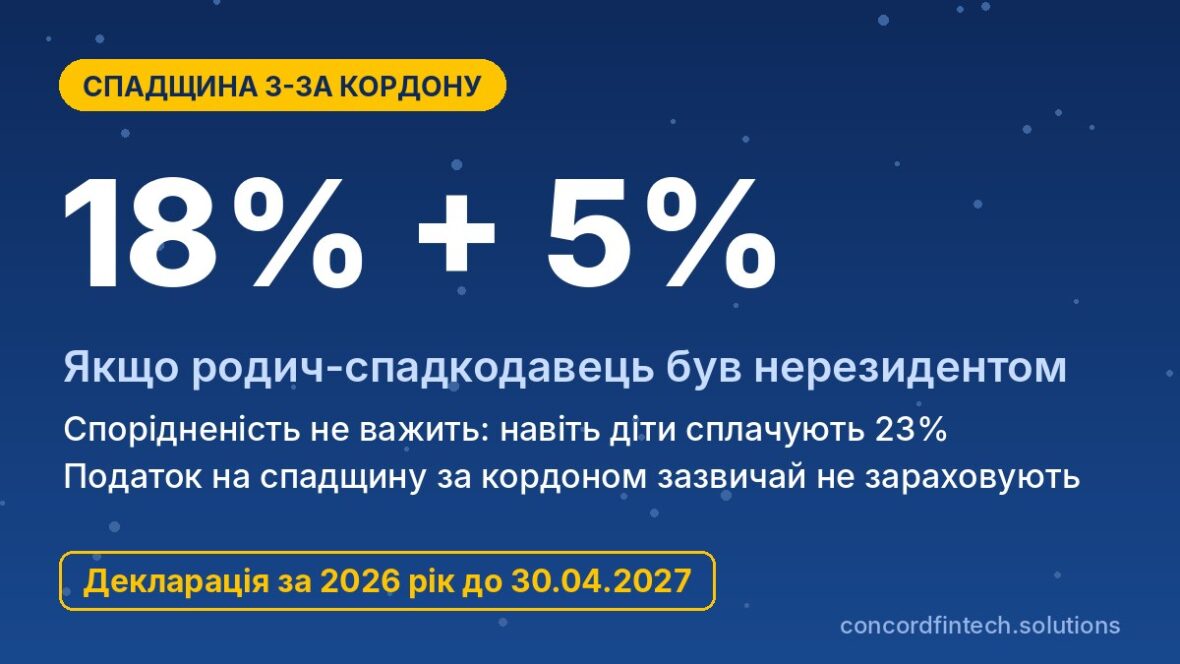
An inheritance from abroad for a tax resident of Ukraine is taxed at a rate of 18% personal income tax (PIT) and 5% military levy (ML) if the deceased relative was a non-resident. Kinship does not matter here, so even children pay 23% of the value of the estate. A zero rate for close relatives applies only when the testator was a resident of Ukraine.
Tax paid on an inheritance in Poland, Germany or Italy will most likely not be credited in Ukraine. Ukraine’s current conventions with those countries cover taxes on income and property, not inheritance tax. Below we examine the rates and rules in those countries, transferring funds and declaration requirements.
How Ukraine taxes inheritances from abroad
Rates depending on kinship
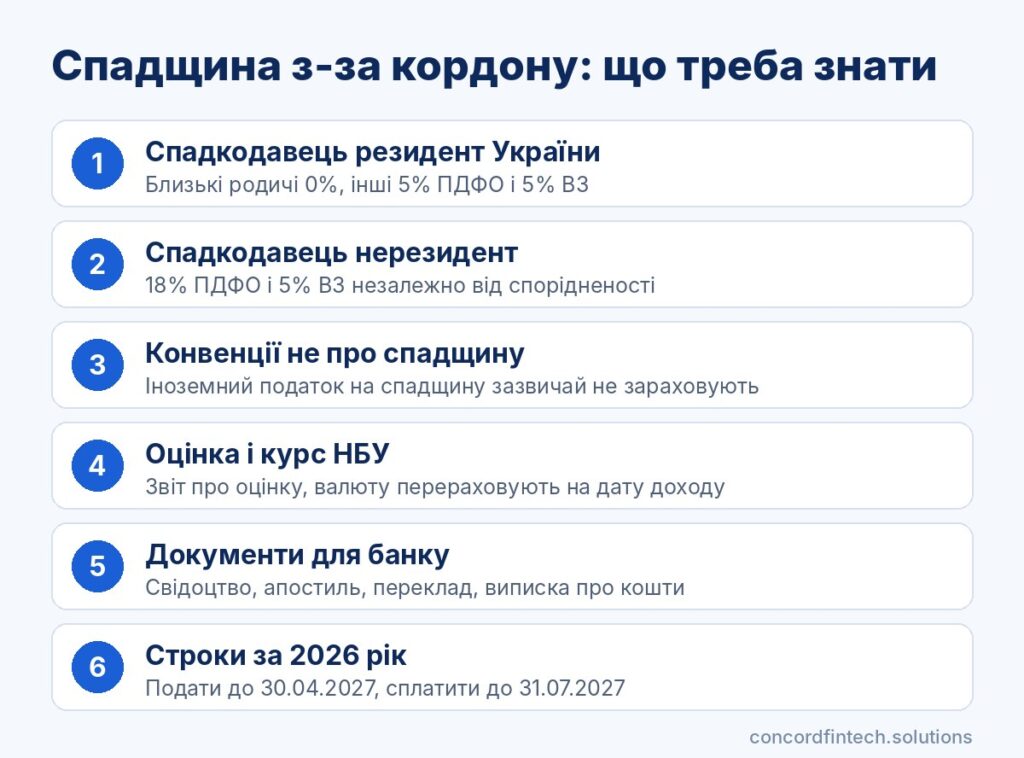
Rates are set by Article 174 of the Tax Code of Ukraine. If the testator was a resident, members of the family in the first and second degree of kinship (parents, children, spouse, brothers, sisters, grandmother, grandfather, grandchildren) pay 0%, while other heirs pay 5% PIT and 5% ML.
The location of the property does not change the rate. An apartment in Warsaw that a son inherited from a mother who was a resident of Ukraine is also taxed at 0%.
Inheritance from a non-resident: 18% + 5%
Subparagraph 174.2.3 of the Code establishes an 18% rate for any property a resident inherits from a testator who was a non-resident. The tax authority in its explanations confirms that a 5% military levy is added to the PIT, so the total is 23%.
A non-resident is typically a relative who has lived and worked abroad for years, owned housing and a family there. If a person left after 2022 under temporary protection but kept housing and close relatives in Ukraine, they may have retained resident status, and then the 0% rate applies for relatives in the first and second degree.
The role of the heir’s tax residency
Ukraine taxes a foreign inheritance only when the heir is its tax resident. A non-resident pays tax here only on income from Ukrainian sources, so a house in Germany received by someone who has long lived there is not taxed in Ukraine.
Double taxation and conventions
How double taxation treaties operate
The treaties listed by the Ministry of Finance allocate the right to tax income and property between two states. Agreements with Poland (1993), Germany (1995) and Italy (1997) cover taxes on income and property but not inheritance taxes, so each country applies its own rules.
Credit for tax paid abroad
Paragraph 170.11.2 allows reducing Ukrainian PIT by a foreign tax only when this is provided for by a ratified international treaty. In addition, paragraph 170.11.3 expressly excludes taxes on property and capital from crediting, and the military levy cannot be reduced by foreign tax in any case.
Before expecting a credit, check several things. The procedure is as follows:
- Find on the Ministry of Finance list whether there is an agreement with the country where the inheritance is located and verify that it is in force.
- Read Article 2 of the treaty: if inheritance tax is not named there, no credit will be available.
- If the tax is covered, obtain a certificate from the foreign tax authority showing the amount and the tax base.
- Convert the amount into hryvnia at the National Bank of Ukraine (NBU) exchange rate and report it in the tax return, but not exceeding the Ukrainian 18%.
Certificate from the foreign tax authority
Article 13 of the Code requires that a foreign tax be confirmed by a certificate from the competent authority of the country where it was paid. The document is legalised or apostilled unless an international treaty eliminates that requirement, and it must be translated into Ukrainian.
| Country | Rate for close relatives | Tax-free threshold | Note |
|---|---|---|---|
| Ukraine | 0%, if the testator was a resident; 18% + 5% ML if a non-resident | None | Tax is paid by a resident heir via a declaration |
| Poland | 0% for the “zero group” provided a notification is filed; group I 3-7% | 36 120 zloty for group I | Property in Poland is taxed regardless of the heir’s citizenship |
| Germany | Class I 7-30% | €500 000 for spouse, €400 000 for child, €200 000 for grandchild | Under limited liability the allowance is reduced proportionally |
| Italy | 4% for spouse and direct-line relatives | €1 000 000 per heir | Brothers and sisters 6% above €100 000, others 6-8% |
Rules in Poland, Germany and Italy
Poland: zero group and notification within 6 months
Polish inheritance tax is levied on property located in Poland, and on foreign property only when the heir is a Polish citizen or a permanent resident there. Spouses, children, grandchildren, parents, brothers, sisters, stepfathers and stepmothers can be fully exempt if they notify the tax authority within 6 months.
For other heirs, according to the Polish tax authority, the tax-free amounts are 36 120 zloty (group I), 27 090 zloty (group II) and 5 733 zloty (group III). Rates rise on a scale from 3-7% for group I to 12-20% for group III, and exemptions for foreigners should be clarified with the Polish tax authority.
Germany: classes and personal allowances
German inheritance tax is levied on all property if either the testator or the heir was resident in Germany, and otherwise only on property in Germany. According to the Baden-Württemberg tax office, spouses have a tax-free allowance of €500 000, children €400 000, grandchildren €200 000 and parents €100 000.
Brothers, sisters and other heirs have an allowance of only €20 000. Rates are 7-30% for class I, 15-43% for class II and 30-50% for class III.
Italy: high thresholds for family
In Italy the spouse and direct-line relatives pay 4% only on the portion exceeding €1 000 000 per heir. Brothers and sisters pay 6% above €100 000, other relatives 6% with no threshold, and outsiders 8%.
If the testator was not resident in Italy, tax is charged only on Italian property. An inheritance declaration is filed with the Italian Revenue Agency.
Valuation of foreign property and foreign-currency funds
Real estate abroad
Tax in Ukraine is calculated on the appraised value of the inheritance, so a report on valuation is required for a house or apartment abroad. The Code does not directly regulate whose appraisal of foreign property is acceptable, so it is advisable to obtain an individual tax consultation from the State Tax Service of Ukraine (STS) before submitting a declaration.
Civil-law matters are governed by the law of the foreign state. Under the Law on Private International Law, succession to real estate is determined by the law of the country where it is located, while other property is governed by the law of the deceased’s last place of residence.
Accounts and deposits in foreign banks
Funds in accounts are not appraised; the base is the amount of the balance. It is confirmed by a certificate or bank statement from the foreign bank and a document proving the right to the inheritance.
Recalculation at the exchange rate of the National Bank of Ukraine (NBU)
Amounts in foreign currency are converted into hryvnia at the official exchange rate of the National Bank of Ukraine (NBU) on the date the income is recognised. For inheritances that is usually the date of the document that confirms the right to the inheritance.
For example, at an exchange rate of 45 hryvnia to the dollar, a deposit of $20,000 equals 900,000 hryvnia. From a testator who was a non-resident this yields 162,000 hryvnia PIT and 45,000 hryvnia ML, a total of 207,000 hryvnia.
Transferring inherited funds to Ukraine
Proof of source of funds for the bank
An Ukrainian bank that credits a large international transfer will usually ask for an explanation of the origin of the money. Be ready to provide the following documents:
- a certificate of the right to inherit or a foreign equivalent with a translation;
- the testator’s death certificate;
- a foreign bank statement showing account closure or a certificate of sale of property;
- documents proving the family relationship;
- receipts for tax paid abroad, if tax was levied.
Currency controls and financial monitoring
There are no limits on inflows of foreign currency from abroad for individuals, but the bank screens transactions under financial monitoring rules. A threshold operation of 400,000 hryvnia only arises with an additional sign, however an atypical amount may delay the transfer.
Tax consequences under the Common Reporting Standard (CRS)
Ukraine exchanges account data under the Common Reporting Standard (CRS), and in October 2026 the STS transmitted data to 97 jurisdictions and received data from 83. During martial law such data are not applied if the total balance on 31 December does not exceed $250,000.
Declaring foreign inheritance and penalties
Deadlines for filing the 2026 tax return
A resident who received a taxable inheritance from abroad in 2026 must file a declaration of property status and income formally by 1 May 2027, although it is safer to do so by 30 April. The tax and the military levy must be paid by 31 July 2027.
The declaration is filed via the Electronic Cabinet or by post no later than 5 days before the deadline. An inheritance from a close relative who was a resident and taxed at 0% does not need to be declared.
Documents with translation and apostille
Foreign certificates of inheritance, death certificates and documents from tax authorities are apostilled unless a mutual legal assistance treaty removes that requirement. Poland, Germany and Italy are parties to the Hague Convention of 1961, so an apostille is placed in the country of issue and a certified Ukrainian translation is added in Ukraine.
Liability for non-filing
The penalty for failing to submit a declaration is 340 hryvnia, and for a repeated violation within a year 1,020 hryvnia. If the declared tax is paid late, 5% or 10% of the amount and interest are charged after 90 days.
If the STS itself discovers an undeclared inheritance, it will reassess the tax and apply penalties under paragraph 123.1: 10% of the amount, 25% in the case of intent and 50% for a repeated intentional violation within 1,095 days. A common mistake is to assume that tax paid abroad exempts from Ukrainian tax.
Frequently asked questions
Will I have to pay tax twice?
If the testator was a non-resident and the country levies an inheritance tax, most often yes. Treaties with Poland, Germany and Italy do not cover inheritance tax, so it cannot be credited in Ukraine.
Is an apostille required for inheritance documents?
Yes, unless a bilateral legal assistance treaty waives this requirement. A Ukrainian translation with the translator’s certified signature is also required.
How do I transfer inherited funds to Ukraine?
Ask the foreign bank to transfer the funds to your account in Ukraine. Prepare inheritance documents in advance because the Ukrainian bank may request them.
What should I do with inherited real estate abroad?
You can keep it, rent it out or sell it, but income from rent or sale must be declared by a resident in Ukraine. The tax of the country where the property is located on such income can be credited because income from real estate is covered by the treaties.