


What happened to rental housing in September 2026 in Ukraine
In September 2026 rent for housing in Ukraine rose in almost the entire country while demand fell in most regions. According to the analytical report of the real estate marketplace DIM.RIA, the largest monthly jump was recorded in Mykolaiv Oblast — an increase of 104 per cent — and the capital remained the most expensive for tenants.
The average price of a one‑room flat in Kyiv in September was 33,000 UAH per month. The report also covers regions with sharp changes in both prices and the balance of supply and demand.
Before and after: key indicators
| Indicator | Before | After |
|---|---|---|
| Kyiv, one‑room rent | 5 per cent lower month‑on‑month and 12 per cent lower year‑on‑year | 33,000 UAH per month |
| Mykolaiv Oblast, monthly dynamics | previous months level | increase of 104 per cent month‑on‑month |
| Zakarpattia Oblast, one‑room rent | 29 per cent lower month‑on‑month and 38 per cent lower year‑on‑year | 29,000 UAH per month |
| Ivano‑Frankivsk Oblast, one‑room rent | 11 per cent lower month‑on‑month and 34 per cent lower year‑on‑year | 22,500 UAH per month |

Where prices rose the most and what that represents in cash
Aside from Mykolaiv Oblast with its 104 per cent rise, the most notable monthly increases in September were seen in Zaporizhzhia Oblast with 46 per cent, Kherson Oblast with 32 per cent, Zakarpattia Oblast with 29 per cent and Vinnytsia Oblast with 22 per cent. These percentages mean that rents in these regions became significantly more expensive within a single month.
In several oblasts the average monthly rent for a one‑room flat exceeded 20,000 UAH. Zakarpattia Oblast recorded 29,000 UAH per month, Ivano‑Frankivsk Oblast 22,500 UAH, Vinnytsia Oblast 22,000 UAH and Dnipropetrovsk Oblast also 22,000 UAH. Lviv Oblast remained slightly below that threshold at 20,300 UAH.
Supply and demand — where there are fewer listings and where there are more applicants
The dynamics of rental listings were uneven across the country. In September the number of offers increased in Kyiv by 27 per cent, in Kyiv Oblast by 36 per cent and in Odesa Oblast by 23 per cent. This means that in these regions the market was temporarily filled with new listings.
At the same time, listings fell in other regions. Ivano‑Frankivsk Oblast lost 33 per cent of its offers, Zakarpattia 26 per cent and Volyn 20 per cent. This picture, combined with local increases in demand, created a significant imbalance in certain markets.
Where competition among renters is highest
In several oblasts the number of people wanting to rent per listing turned out to be very large. Ternopil and Rivne Oblasts have 18 renters per listing each, and Lviv Oblast has 15 applicants per listing. This means that high competition is observed not only in the most expensive regions.
For example, in Rivne Oblast demand rose by 18 per cent while listings fell in a number of other places. In some oblasts demand, on the contrary, showed growth. In particular, demand rose by 15 per cent in both Volyn and Kharkiv Oblasts, and by 18 per cent in Rivne Oblast.
Kyiv within the city — where it is most expensive and where it is more affordable
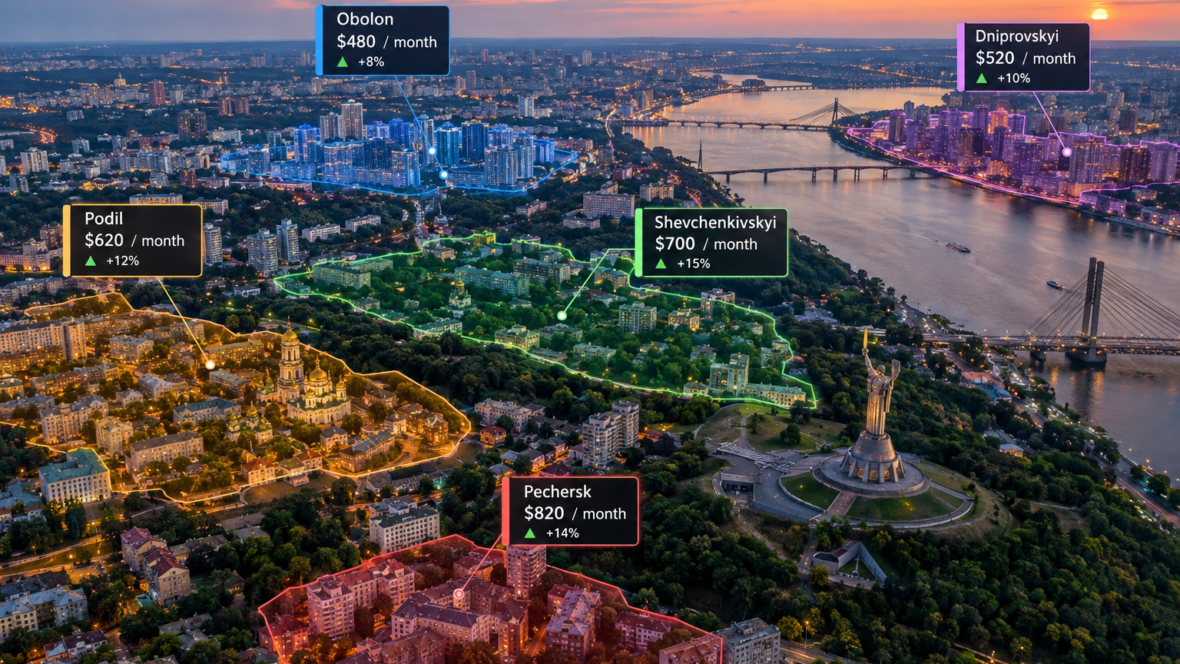
In the capital the central districts remain the most expensive. In Pecherskyi District the average rent for a one‑room flat in September was 38,300 UAH per month. This makes Pecherskyi one of the most expensive districts for the rental market in Ukraine.
By contrast, the most affordable offers are concentrated in Desnianskyi District, where the average price for a one‑room flat is 13,300 UAH per month. Such a difference between districts illustrates the significant segmentation of the Kyiv market.
A reminder for property owners
As we reported, there is no tax on the flat, but 512 UAH was charged for the basement: what the owner should do. This is a reminder that tax and charge issues sometimes concern not only the main dwelling but also ancillary premises.
The DIM.RIA report provides a numerical picture of the market for September 2026 and allows comparison of previous periods with the current state of demand, supply and prices.