


On 30 October Intel (NASDAQ: INTC) shares plunged nearly 29% in a single session. The company’s market value fell by roughly $140 billion. Intel shares have only fallen more sharply once before: in July 1974, when they lost almost 30% in a day. The cause was not a weak quarter. The third-quarter report beat expectations, but the outlook for the final months of the year clearly frightened investors.
Strong quarter, weak guidance
For the fourth quarter Intel expects around $15.5 billion in revenue, while Wall Street had been expecting $17 billion. The gap on earnings is even wider:
| Q4 2026 | Intel guidance | Analysts expected | Difference |
|---|---|---|---|
| Revenue | $15.5 billion | $17 billion | -8.8% |
| Adjusted earnings per share | $0.25 | $0.43 | -41.9% |
The third quarter was, however, one of the best in recent years. Revenue rose 21% to $16.5 billion. Adjusted earnings per share reached $0.52, up from just $0.23 a year earlier. The fastest-growing division was Data Center and AI: +78%, to $7.3 billion. Contract manufacturing at Intel Foundry added 58% and generated $6.7 billion, but still produced roughly $1.85 billion of operating loss. The only major area that declined was processors for personal computers (PCs): -5%, to $8.1 billion.
It was the personal computers (PCs) segment that spoiled the forecast. Chief Financial Officer David Zinsner warned that the downturn in the PC market will continue at least until mid-2027. Bank of America expects PC shipments to fall 25–30% in the fourth quarter versus the prior quarter. With servers the problem is different: demand for Xeon processors is high, but production capacity is lacking. Chief Executive Officer Lip-Bu Tan says the company is now focused on increasing that capacity.
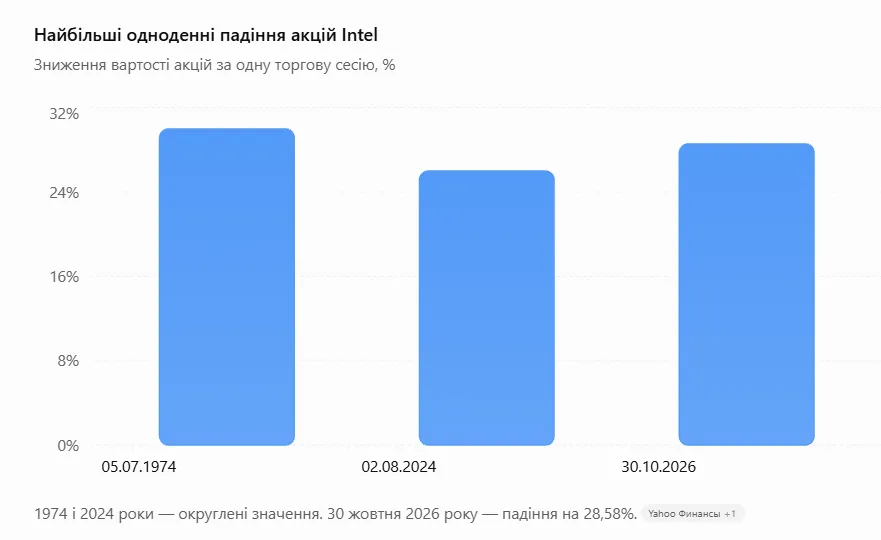
Largest one-day drops in Intel shares in 1974–2026. On 30 October 2026 the company’s quotes fell by 28.58%, to $65.76 per share.
Market and analyst reaction
Before the report the stock traded above $92, and during the session it fell to roughly $65. The lost $140 billion is not an actual company loss but a reduction in its market valuation. Even after the crash Intel shares are about 80% higher than at the start of 2026, although they have fallen more than half from the June peak. A similar shock came in August 2024, when shares lost about 26% in a day after announcements of layoffs and a dividend pause.
Analysts’ recommendations diverged:
- Bank of America downgraded its rating from Buy to Neutral and cut the target price from $145 to $100. Analyst Vivek Arya cited the weak PC market and manufacturing challenges.
- Seaport Global and Roth Capital also moved to a neutral stance.
- KGI Securities, by contrast, upgraded its rating to Outperform.
The decline dragged down the whole sector. AMD lost about 9.3% during the session, and the exchange-traded fund (ETF) VanEck Semiconductor ETF fell roughly 5.9%. For 2027 Intel is betting on the 18A and 14A process nodes, new generations of Xeon and the expansion of contract manufacturing. The company has already agreed with Oracle to use its server processors in Oracle Cloud Infrastructure. The next test will be the fourth-quarter report, which will show whether Intel lands within its own $15–16 billion range.