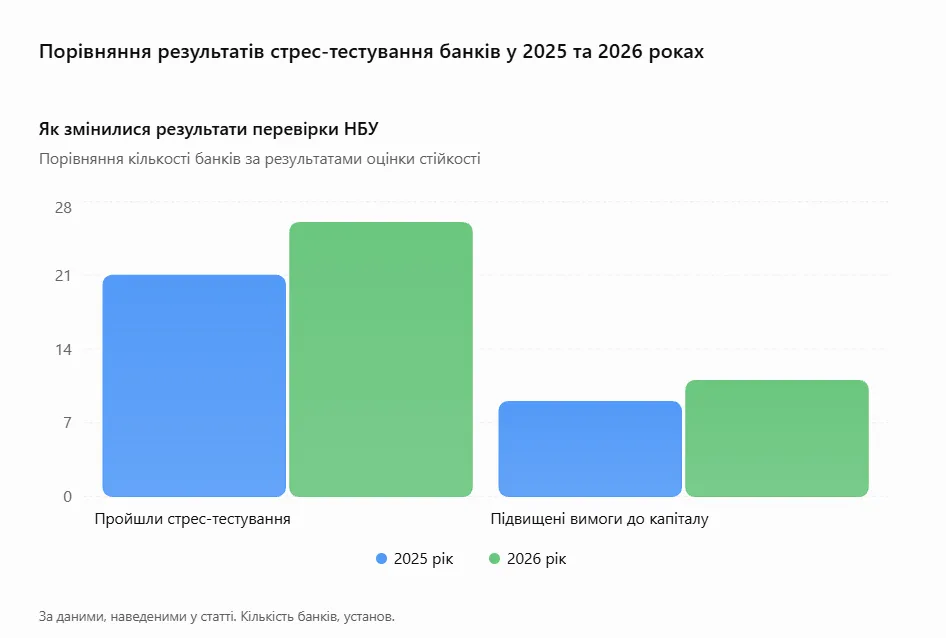




The National Bank of Ukraine (NBU) concluded its annual assessment of banks’ resilience. Following the stress test, 11 of the 26 largest institutions must build up their capital buffers. At the same time, the system as a whole has become stronger: banks’ need for additional capital has fallen threefold over the year. The regulator insists that the banks holding the vast majority of the sector’s assets would withstand even a deep and protracted crisis.
| Key results | Indicator |
|---|---|
| Banks in the stress test | 26 |
| Their share of system assets | over 90% |
| Banks with heightened requirements | 11 |
| Share of assets of these banks | 10% |
| Reduction in capital need | threefold |
| Deadline for meeting the requirements | by the start of 2027 |
How the tests were conducted
The assessment was carried out in three stages. First, independent auditors checked asset quality: loan portfolios, collateral and whether banks were correctly measuring credit risks as of 1 January 2026. They found no systemic problems, and most adjustments were minor. A second stage, in which the findings are applied to the remainder of a portfolio, was not needed by any bank this year. The third stage was a stress test for the 26 largest banks, which were run through a baseline and an adverse macroeconomic scenario.
In total, 57 of 60 banks passed the assessment: 31 underwent only an asset review, and 26 also took the stress test. “Motor-Bank” (Motor-Bank) and “First Investment Bank” (First Investment Bank), which were declared insolvent in February, were not tested, nor was the transitional “Ute Bank” (Ute Bank), which started operating after the procedure began.
Which banks received higher requirements
Under the adverse scenario, 11 banks received higher regulatory requirements, and eight did so under the baseline scenario. The overall need for capital fell to roughly 3% of the system’s regulatory capital.
| Indicator | 2025 | 2026 |
|---|---|---|
| Banks in the stress test | 21 | 26 |
| Banks with heightened requirements | 9 | 11 |
| Share of assets of such banks | 18% | 10% |
| Need for capital | three times larger | approximately 3% of regulatory capital |
The increase in the number of problematic banks is explained by the expanded sample. Five new institutions were added to the stress test, and four of them received higher requirements. Conversely, two banks that were tested for the second time showed no capital need this round.
Heightened requirements do not mean a bank is already “leaking”. For three institutions that account for 6% of the system’s assets, a capital shortfall appears only under the adverse scenario. Three other banks, which hold around 5% of assets, were already above the required levels as of the start of October.
Deadlines for recapitalisation and implications for customers
Banks must reach the required capital level by the start of 2027 and maintain it until the next assessment. They can do this in various ways: shareholders can inject funds, profits can be retained rather than paid out as dividends, risky loans can be reduced, or business models can be restructured. Those that fail must submit a capitalisation or restructuring programme to the NBU.
For depositors nothing changes: the regulator has not announced any restrictions on accounts, deposits or transfers. However, a stress test is a model, not a guarantee that problems will not arise in future. As for lending, some banks that need capital may become more cautious with borrowers. The test does not imply automatic higher borrowing costs or a rollback of programmes.
The NBU will publish the full list of banks and the results for each at the end of December.