


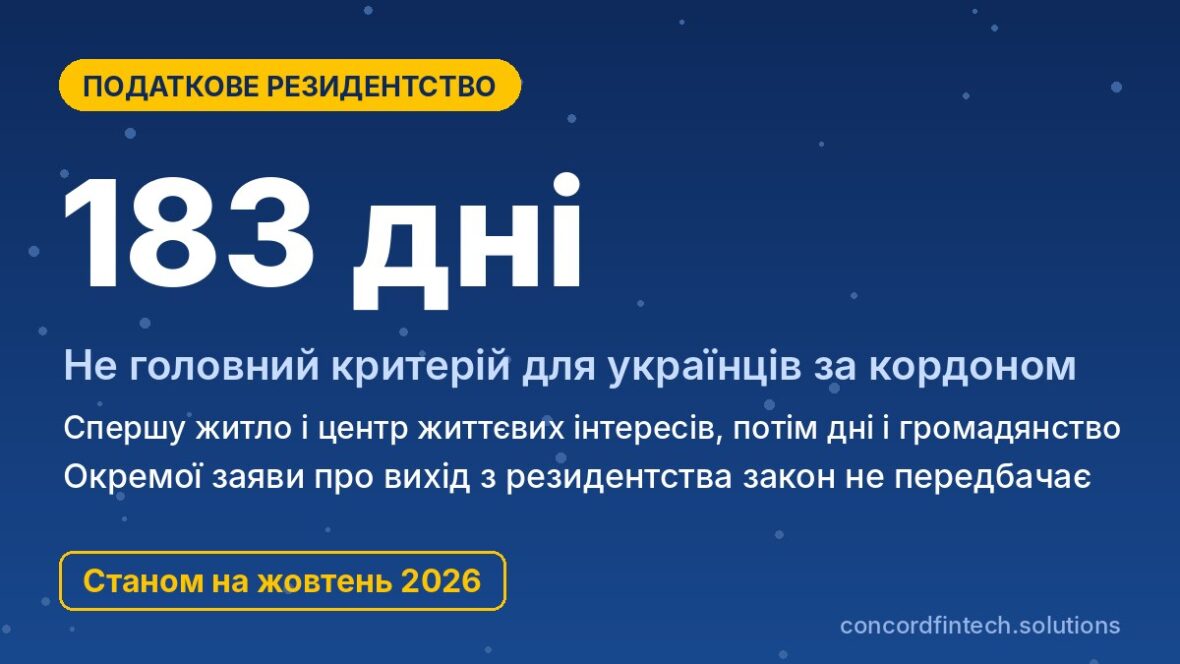
Tax residency of Ukraine is not determined by passport or simply by the number of days spent abroad, but by a sequential test in the Tax Code of Ukraine (TCU): a place of residence, centre of vital interests, the 183‑day rule and, only at the end, citizenship. Therefore most Ukrainians who left after 2022 but kept family, housing or individual entrepreneur (FOP) status in Ukraine formally remain residents, even if they spent the whole year abroad.
The law does not provide a separate application by which one can formally “exit” Ukrainian residency. Status changes when the facts change, and to prove that you can use a foreign tax authority certificate and the proof of relocation described below.
Criteria for tax residency under the TCU
Having a place of residence in Ukraine
Subparagraph 14.1.213 of the Tax Code names as a resident an individual who has a place of residence in Ukraine. If there is housing in another country as well, the test checks where the permanent place of residence is located - that is, the dwelling the person uses continuously rather than episodically.
Centre of vital interests: family, property, work
When a permanent dwelling exists in both countries, closer personal and economic ties become decisive. The Code explicitly lists as a sufficient, though not exclusive, condition the permanent place of residence of family members or registration of the person as an individual entrepreneur (FOP).
Thus a spouse, children in Ukraine or an active FOP will almost automatically keep the centre of interests here. Authorities also consider main place of work, bank accounts, business and property.
The 183‑day rule and citizenship
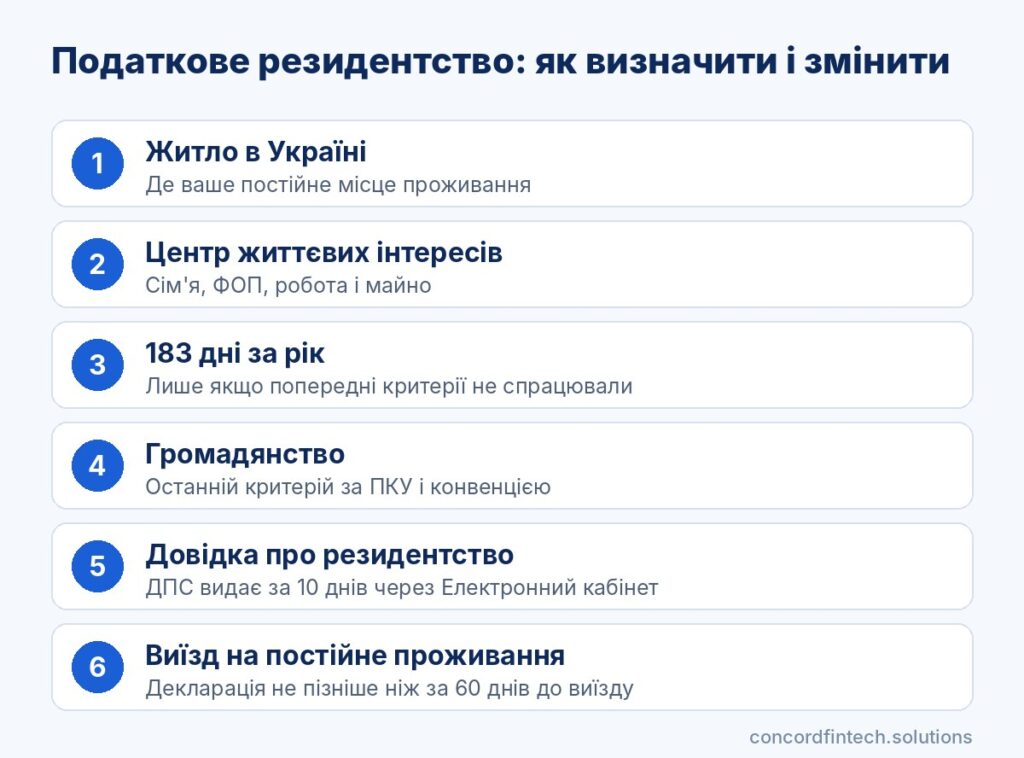
The criteria are checked in sequence, and each next test is applied only when the previous one does not give an answer. The sequence is as follows:
- Is there housing in Ukraine? If you have no housing here at all and only abroad, you are most likely a non‑resident.
- Where is the permanent dwelling? If only in Ukraine, you are a resident.
- Where is the centre of vital interests? Family or FOP in Ukraine give the answer “resident”.
- Did you spend 183 days in Ukraine during the year, counting arrival and departure days? This criterion is needed only when the centre of interests cannot be determined.
- Are you a citizen of Ukraine? Citizenship decides only when all the previous steps did not.
The Code also considers a person’s own determination of their main place of residence in Ukraine to be a sufficient ground. Therefore spending more than 183 days abroad by itself does not make you a non‑resident.
Typical situations of Ukrainians abroad
Actual status depends on the combination of circumstances and documents. The table shows only the most likely outcome.
| Situation | Likely status |
|---|---|
| Temporary protection in Poland, husband and an apartment in Ukraine | Resident of Ukraine |
| Whole family abroad, housing in Ukraine rented out, FOP active | Resident of Ukraine due to FOP |
| Whole family abroad, FOP closed, rented housing and work there | Likely non‑resident, if there is a foreign certificate |
| Work abroad 7-8 months a year, family in Ukraine | Resident of Ukraine |
| Housing and family in both countries | Decided by the tiebreaker in the convention |
Dual residency and convention rules
Tiebreaker test in Article 4 of conventions
Each state defines residents under its own laws, so a person can easily be considered a resident of two countries at once. For such cases Article 4 of the double taxation avoidance conventions contains a tiebreaker, and current agreements take precedence over the TCU provisions.
The order is almost identical everywhere: permanent home, then centre of vital interests, then habitual abode and citizenship. The list of current agreements, including with Poland, Germany and the Czech Republic, is maintained by the Ministry of Finance.
Permanent home in both countries
If there is a permanent home in both Ukraine and abroad, authorities compare where ties are stronger. When the centre of interests also cannot be determined, they count where the person habitually stays, i.e. where they in fact spend more time over several years.
Mutual agreement procedure
If even citizenship does not resolve the issue or a person holds citizenship of both states, tax authorities of the two countries determine status through a mutual agreement procedure. The procedure is long and requires carefully assembled documents.
Certificate of tax residency of Ukraine
How to request a certificate via the Electronic Cabinet
The certificate confirming tax residency is issued by the State Tax Service (DPS) under the procedure approved by Ministry of Finance (MinFin) Order No. 248 dated 19.08.2022. It is issued only for countries with which Ukraine has a current convention, and the application can be submitted through the Electronic Cabinet, by post or in person.
Only a few data and documents are needed for the application. Here is what to prepare in advance:
- qualified electronic signature (QES) or the “Diia.Signature” service to log into the Electronic Cabinet;
- application form F1308202 with full name (PIB) in Ukrainian and English and taxpayer registration number (RNOKPP);
- the name of the country for which the certificate is needed and the year for which the status is being confirmed;
- the basis for residency, for example place of residence or centre of vital interests;
- forms of the foreign tax authority with a Ukrainian translation, if they are required.
Issuance period and document form
The certificate is issued free of charge within 10 calendar days in electronic or paper form. It confirms status for a specific year, so it must be ordered again for each new year.
An apostille requires the paper original, because an electronic PDF is not suitable. If you do not meet the criteria of subparagraph 14.1.213, you will receive a letter of refusal.
Foreign certificate for a Ukrainian tax agent
A non‑resident who receives income in Ukraine and wants to apply a convention relief provides the tax agent with a certificate from the tax authority of their country. The document usually must be apostilled or legalised and translated into Ukrainian; without it the agent withholds tax at the general rates.
Tax residency of Ukrainians in Poland and Germany
Polish rules for employees and temporary protection
Poland considers a person a resident if they have the centre of personal or economic interests there or spend more than 183 days a year. For Ukrainians who arrived because of the war a simplified mechanism applied: a declaration to the employer to shift the centre of interests made the person a Polish resident, and the Polish tax office confirmed that status at least for 2024.
That declaration does not cancel the 1993 convention tiebreaker. If family and housing remained in Ukraine, Ukraine may still consider the person its resident, creating dual residency.
German rules: Wohnsitz and gewöhnlicher Aufenthalt
Germany recognises as a resident someone who has a dwelling (Wohnsitz) there with the intention to use it, or a habitual abode (gewöhnlicher Aufenthalt) of more than 6 consecutive months. These 6 months can fall across two calendar years, so residency may arise sooner than under the 183‑day rule.
A new agreement with Germany was signed on 19 May 2026, but until it enters into force the 1995 agreement applies. Its Article 4 resolves disputes about dual residency.
How residency affects CRS exchange
Foreign banks ask clients to complete a self‑certification of tax residency. Account information under the Common Reporting Standard (CRS), and from 1 July 2026 under the wider CRS 2.0 rules, is sent to the country you declared, so the wording in the bank’s questionnaire should match your actual status.
How to change tax residency: steps to take
Why there is no formal exit procedure
Ukrainian law contains no application or decision by which the tax authority “removes” resident status. A person becomes a non‑resident when, under subparagraph 14.1.213 or Article 4 of a convention, their ties with Ukraine are weaker than with another state, and this is proven by documents.
Confirming residency of another country
The main evidence is a certificate from the tax authority of the new country confirming residency for a given year. It should be supplemented with documents showing the shift of the centre of interests:
- residence permit, rental or purchase agreement for housing abroad;
- employment contract or business registration in the new country;
- documents proving relocation of a spouse and children’s education abroad;
- statement of termination of FOP in Ukraine;
- local tax declarations and a local tax identification number.
Declaration when leaving for permanent residence
A resident who leaves for permanent residence abroad files a declaration of property and income under paragraph 179.3 of the Code no later than 60 calendar days before departure. Within 30 calendar days the tax authority reviews the calculations and issues a certificate of tax payment or of absence of obligations.
That certificate is presented to customs on departure. The declaration itself does not automatically change status, but it is strong evidence of the date from which the centre of interests moved.
Consequences for income in Ukraine and common mistakes
A non‑resident does not declare foreign income in Ukraine, but continues to pay 18% personal income tax (PIT) and 5% military levy on income from Ukrainian sources such as salary, rent or sale of property. They cannot use a tax allowance and cannot be a payer under the simplified tax system, so a FOP on the simplified regime is incompatible with this status.
A common mistake is declaring non‑resident status to the bank while keeping a FOP and family in Ukraine. In that case the person risks additional tax assessments in both countries.
Frequently asked questions
Can you be a tax resident of two countries at once?
Yes, under domestic laws a person is often a resident of both Ukraine and the country of stay. For taxation the final status is determined by Article 4 of the convention, and only one state is then treated as the country of residence.
Do I lose Ukrainian residency by leaving the country?
No, leaving or receiving temporary protection does not change status by itself. If family, housing or FOP remain in Ukraine, you most likely remain a resident until those ties move abroad.
How do I obtain a residency certificate online?
Log into the Electronic Cabinet, create application F1308202, indicate the country, year and basis for residency and sign it with a QES. The certificate will be sent to your cabinet within 10 calendar days; if you need an apostille it is better to request the paper form.
How are incomes of Ukrainians under temporary protection taxed?
It depends on of which country the person is a resident under the convention. A resident of Ukraine declares foreign income here, and aid from foreign states during martial law is not taxed, whereas a resident of another country pays tax there.