


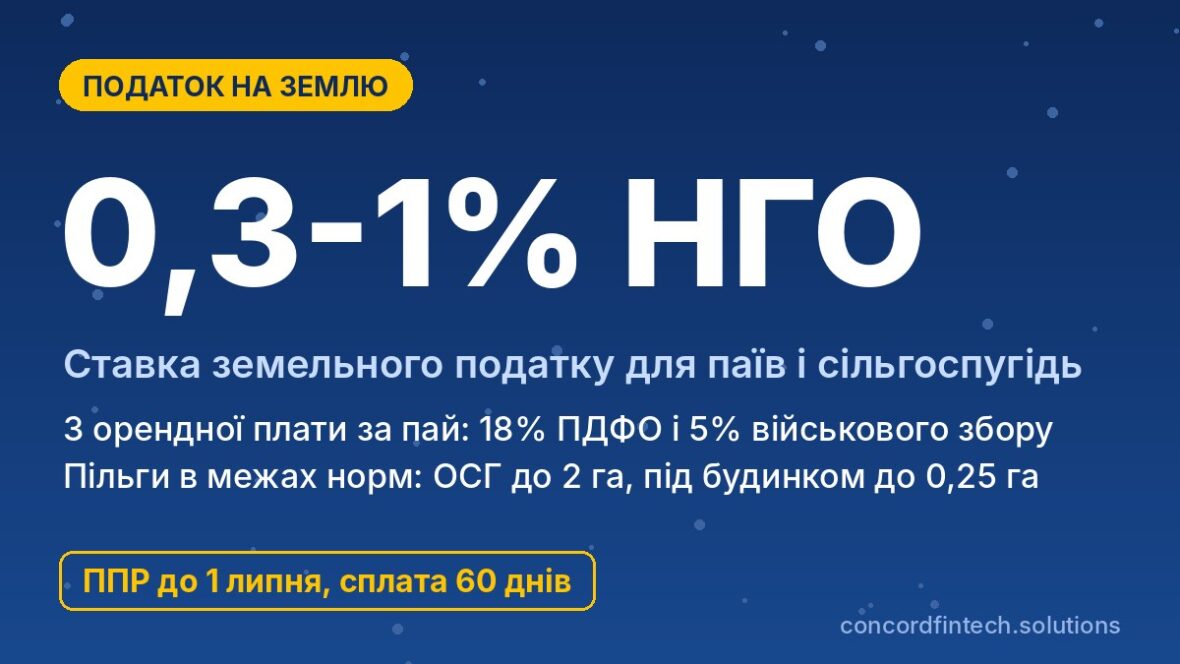
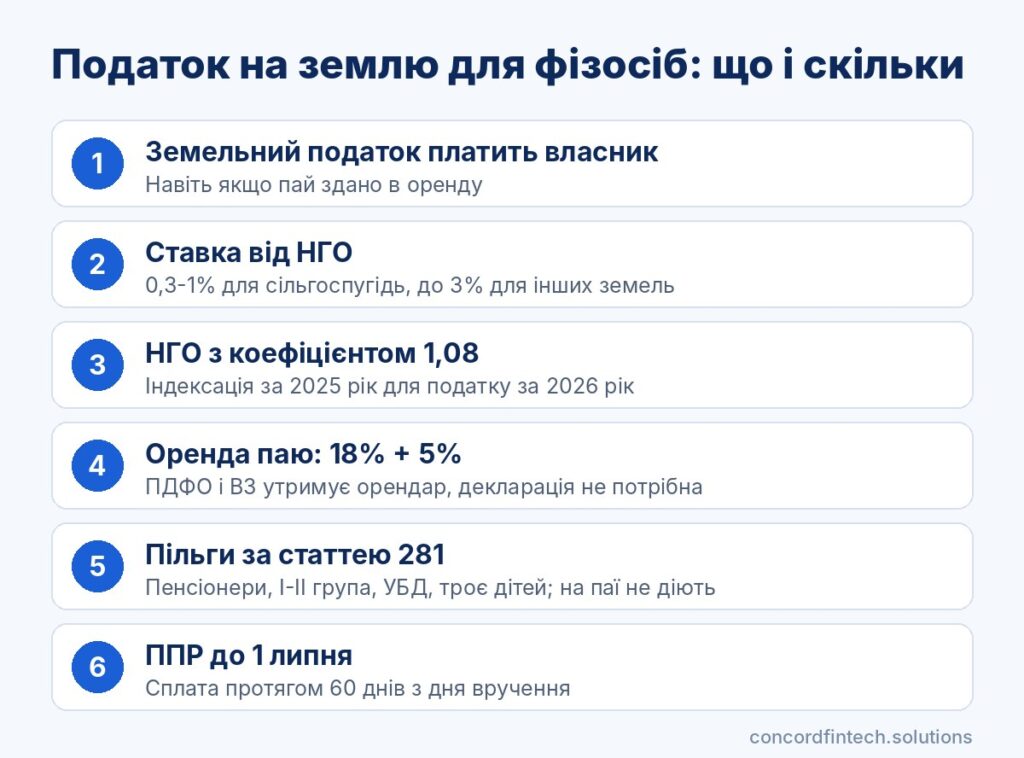
The land tax for individuals consists of two different charges that are often confused. The owner of a plot or land share pays an annual land tax based on the normative monetary valuation (NMV) at a rate set by the local community: for agricultural land from 0.3% to 1% of the NMV, for other land up to 3%. If a land share is rented out, the rental payment is subject separately to 18% personal income tax (PIT) and 5% military tax (MT), and the tenant acts as the tax agent responsible for withholding and remitting those amounts.
Citizens do not submit a declaration for the land tax because the tax authority calculates the amount and issues a tax notification-decision (TND) by 1 July of the current year. Below we explain who is the taxpayer, how to calculate the tax from the NMV, which exemptions apply to pensioners, people with disabilities and veterans and why those exemptions usually do not cover land shares.
Who pays the land tax
Owners of land plots
According to Article 269 of the Tax Code of Ukraine (TCU), taxpayers of the land tax are owners of land plots and land shares (shares). The obligation arises from the date of state registration of the ownership right and does not depend on whether the person cultivates the land themself, rents it out or does not use it at all. Therefore, the owner of a share transferred to an agricultural company remains the land taxpayer unless the contract shifts compensation for this charge to the tenant.
Land users
In addition to owners, the tax is paid by permanent land users, i.e. persons to whom the plot is provided for permanent use. Tenants of state or municipal land do not pay the land tax; instead they pay rent under their agreement with the community.
Preferential categories
Some citizens are fully exempt from the tax, but only within established area limits. The exemption applies to one plot of each type of use, and any area beyond the limit is taxed on the general basis. A detailed list of beneficiaries and the maximum sizes is given below in a separate section.
Rates and normative monetary valuation
Rates for different land categories
Article 274 of the TCU sets maximum rates for plots whose NMV has been determined. The overall maximum is 3% of the NMV; for agricultural land the rate must be no less than 0.3% and no more than 1%; for lands of general use up to 1%; and for forest lands up to 0.1%. If the NMV has not been determined, under Article 277 the tax is calculated from the NMV of one hectare of arable land for the region, and the rate may not exceed 5%.
| Category of land | Rate of NMV | Exemption under Article 281 |
|---|---|---|
| Arable land, hayfields, pastures, land shares | 0.3–1% | Only one plot for a personal farming household (PFH) up to 2 ha; does not apply to land shares |
| House plot next to a dwelling | up to 3% | 0.25 ha in a village, 0.15 ha in an urban-type settlement, 0.10 ha in a city |
| Garden, dacha, garage plot | up to 3% | 0.12 ha, 0.10 ha and 0.01 ha respectively |
| Forest lands | up to 0.1% | No separate norm |
| Plots without NMV | up to 5% of the NMV of arable land for the region | The same area norms |
How to find the NMV
The normative monetary valuation of a plot is indicated in the extract from the technical documentation on NMV, which can be ordered online through the State Service of Ukraine for Geodesy, Cartography and Cadastre (Derzhgeokadastr) services or at the centre for administrative services (CNAP). For valuations made previously, an annual indexation coefficient from Article 289 of the TCU is applied. For 2025 that coefficient is 1.08 for all land categories, and that coefficient is used to calculate the tax for 2026.
Local council decisions
The specific rate within the code is set by the village, settlement or city council separately for each land category. Councils publish their decisions on their websites, and consolidated data on communities is published by the State Tax Service (State Tax Service (DPS)).
For a land share of 3.2 ha with an NMV of 30 000 hryvnia per hectare, taking into account the coefficient 1.08 the valuation is 103 680 hryvnia. At a rate of 0.3% the tax equals 311.04 hryvnia per year, at 0.5% it will be 518.40 hryvnia, and at the maximum rate of 1% the amount reaches 1 036.80 hryvnia.
Taxation of rental payments for a land share
The tenant as tax agent
Pursuant to subparagraph 170.1.1 of the TCU, the tenant is the tax agent of the lessor for income from the lease of agricultural land, a land share or a property share. The tenant calculates the tax, withholds it from the rental payment and remits it to the budget at the location of the plot. Therefore the owner of a share who has leased land to a company or an individual entrepreneur (FOP) does not file a personal income declaration for this income.
A different situation arises when the tenant is a natural person without the status of an individual entrepreneur. In that case the landowner pays PIT quarterly within 40 calendar days after the end of the quarter and reports the income in the annual declaration.
18% PIT and 5% MT
Rental payments are subject to personal income tax at 18% and military tax at 5%. The tax base is the amount under the contract, but not less than the minimum rental payment, which under Presidential Decree No.92/2002 is 3% of the NMV. The law No.4903-IX adopted on 9 June 2026, which sets a 5% rate for part of rental income, had not been signed as of mid‑October 2026, so for land shares the 18% rate applies.
You can easily check the amount the owner will receive. Calculate in the following order:
- Determine the annual rent under the contract, for example 8 000 hryvnia.
- Check the minimum: 3% of the NMV 103 680 hryvnia is 3 110.40 hryvnia, so the contract amount is higher.
- Calculate PIT: 8 000 × 18% = 1 440 hryvnia.
- Calculate the military tax: 8 000 × 5% = 400 hryvnia.
- Subtract the taxes: the owner receives 6 160 hryvnia net.
In-kind rental payments
Rental payments are often made in grain, oil or other produce. Such payment is also income, and the value of the produce is determined by the prices specified in the contract or the issue ledger. For non-cash income the TCU provides a natural coefficient under paragraph 164.5, so the PIT base may be higher than the market value of the produce; it is worth asking the tenant for the tax calculation.
Exemptions from the land tax
Pensioners and people with disabilities
Paragraph 281.1 of the TCU exempts several categories of citizens from the tax. For a tax authority to take the exemption into account in the tax notification-decision, it must know the owner’s status, so it is better to submit supporting documents in advance. Exempt from the tax are:
- persons with disabilities of the first and second groups;
- natural persons raising three or more children under the age of 18;
- pensioners by age;
- war veterans, including combatants, and persons covered by the Law “On the Status of War Veterans and Guarantees of their Social Protection”;
- persons affected by the Chernobyl disaster.
Paragraph 281.3 additionally exempts owners of land and land shares for the period that they are leased to a payer of the single tax of the fourth group. The community may also establish its own exemptions, so it is worth checking the council’s decision.
Plots under housing
For plots under a residential house, outbuildings and structures the exemption applies within 0.25 ha in villages, 0.15 ha in urban-type settlements and 0.10 ha in cities. A pensioner with a house plot of 0.30 ha in a village therefore pays tax only for 0.05 ha. If the plot is located in temporarily occupied territory or in an active combat zone according to the list of the Ministry for Communities and Territories Development, land charges under paragraph 69.14 of the transitional provisions of the TCU are not assessed for the relevant months until martial law is ended.
Norms of gratuitous transfer
The exemption under paragraph 281.2 applies to one plot for each type of use: up to 2 ha for a personal farming household, up to 0.12 ha for gardening, up to 0.10 ha for dacha construction, up to 0.01 ha for a garage. Plots formed from land shares for commercial agricultural production are not included in this list, so a pensioner pays tax on such a land share on the general basis. If an exempt person has several plots of the same type, they must submit a statement to the tax authority by 1 May choosing which plot the exemption applies to.
Payment and reporting
Tax notification-decision by 1 July
Pursuant to paragraph 286.5 of the TCU the tax for citizens is calculated by the tax authority at the location of the plot based on data from the State Land Cadastre. The tax notification-decision is sent by 1 July of the current year, so the land tax for 2026 should have been calculated by 1 July 2026.
Payment within 60 days
The tax is paid within 60 days from the date of service of the notification-decision. If the tax authority did not send the document on time, paragraph 287.9 of the TCU relieves the citizen from liability for the delay. Payment can be made using the details from the TND at a bank or via the Electronic Taxpayer’s Cabinet (Electronic taxpayer's cabinet).
Reconciliation of area and NMV data
If the notification contains an incorrect area, valuation or fails to account for an exemption, submit an application for reconciliation to the tax authority with an extract on the NMV and documents proving ownership. After verification the tax authority sends a new tax notification-decision and cancels the previous one. If reconciliation does not help, the TND can be appealed administratively within 10 working days from the date of receipt.
Most errors arise from outdated NMV, an unaccounted indexation coefficient or duplicate plots in the cadastre. Owners of land shares also often fail to check whether the tenant has remitted the withheld taxes, although this information can be seen in the income records in the Electronic Taxpayer’s Cabinet.
Frequently asked questions
Does the owner pay tax on a share leased out?
Yes, the owner of a land share remains the payer of the land tax even if the land is cultivated by a tenant. Contracts often provide that the tenant will compensate that sum, but legally the tax notification-decision is issued to the owner. The exception is when the land is leased to a payer of the single tax of the fourth group, in which case the owner is exempt from the land tax.
How to find out the NMV of a plot?
The NMV is indicated in the extract from the technical documentation on the NMV, which is ordered via the State Service of Ukraine for Geodesy, Cartography and Cadastre services or at the CNAP. For older valuations you need to take into account the indexation coefficients for each subsequent year, in particular 1.08 for 2025. The tax authority uses the same amount in the tax notification-decision.
Are there exemptions for pensioners?
Yes, pensioners by age are exempt from the tax within the norms of Article 281: up to 2 ha for a personal farming household and up to 0.25 ha under a house in a village. This exemption does not apply to land shares used for commercial agricultural production. The local community may set additional exemptions by its decision.
What to do if the tenant does not pay the tax?
The obligation to withhold and pay PIT and the military tax from rental payments lies with the tenant as tax agent, and they are liable for breaches. You can check whether the tenant submitted information about your income in the Electronic Taxpayer’s Cabinet, and if there are discrepancies contact the tax authority. If the tenant systematically fails to pay the rent itself, Article 141 of the Land Code provides grounds to terminate the right to use the land through the courts.