


A Ukrainian individual entrepreneur (FOP) does not prevent you from living in Poland or Germany, but it does not exempt you from the rules of the country where you are staying. If you live there permanently, work for local clients or become a local tax resident, you will need to register the business: in Poland as a JDG, in Germany as a Gewerbe or Freiberufler.
Figures are shown as of mid-October 2026. The material is for reference and does not replace advice from a tax adviser.
When a Ukrainian individual entrepreneur (FOP) becomes a problem in the EU
Tax residency in the country of stay
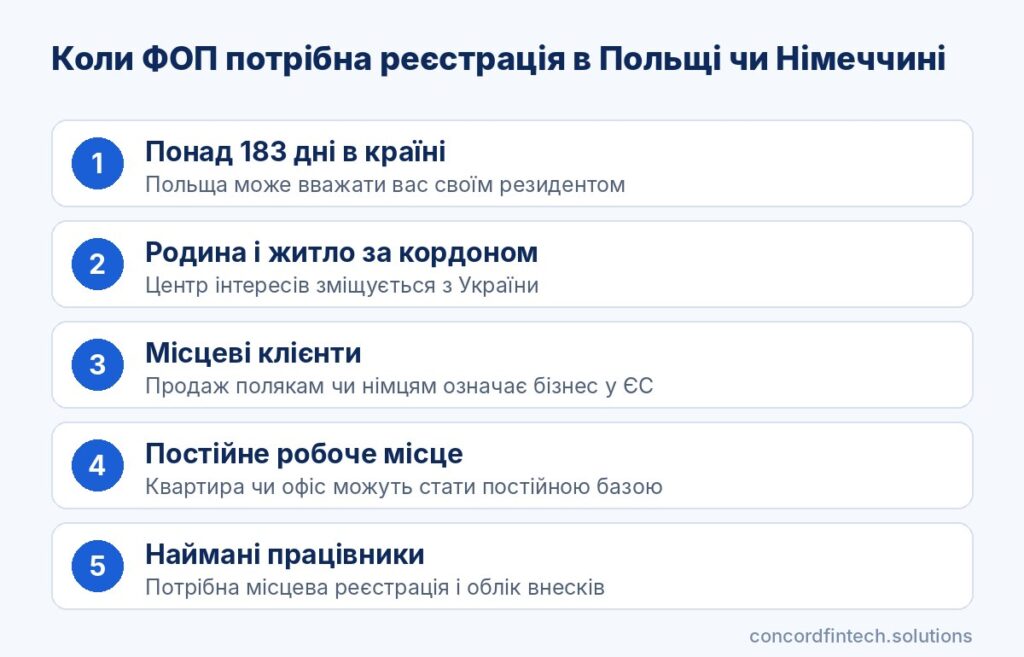
Poland considers a person a resident if they stay in the country for more than 183 days a year or have their centre of interests there. Germany recognises a resident as someone with a home in the country or ordinary residence of more than six months.
The single tax under clause 291.5 of the Tax Code is not available to non-residents of Ukraine. Therefore, if under Article 4 of the convention you become a resident of another state, the simplified system loses its basis and income becomes taxable in the new country.
Permanent establishment
Even a Ukrainian resident can create a permanent establishment abroad, that is, a fixed place of business. For professional services the 1993 convention with Poland uses the concept of a “permanent base”, which may be an apartment from which you work for months.
In that case part of the profit is taxed by the country of stay. A list of current agreements is kept by the Ministry of Finance.
Operating on the local market
Sales to Polish or German clients, renting an office or having employed staff are signs of business carried out in the EU country. Then local registration is required regardless of whether your FOP continues to operate.
Poland: JDG and taxes for Ukrainians
Registering a JDG
A Ukrainian citizen with legal stay and a PESEL registers a JDG in CEIDG on the same terms as a Pole, explains the portal biznes.gov.pl. From 5 March 2026 this right is available only to holders of specific grounds for stay, including PESEL UKR status, the CUKR card or permanent residence.
A JDG opened before 5 March 2026 continues to operate while the stay is legal; otherwise the entry in CEIDG is deleted. The registration procedure is as follows:
- obtain a PESEL and make sure your basis for stay gives the right to a JDG;
- create a Profil Zaufany or log in to mObywatel;
- submit a free CEIDG-1 application online or at the gmina, choosing PKD codes and the form of taxation;
- the tax number NIP is assigned automatically, and ZUS data can be provided in the same application;
- within 7 days of starting activity register with ZUS as a contributor and open a business account.
Forms of taxation and ZUS
An entrepreneur chooses the scale of 12% and 32% with a tax-free amount of 30 000 zloty, the flat 19% rate or ryczałt on turnover with rates of 2-17%. The health contribution is 9% of income on the scale, 4.9% on the linear tax and a fixed amount on ryczałt.
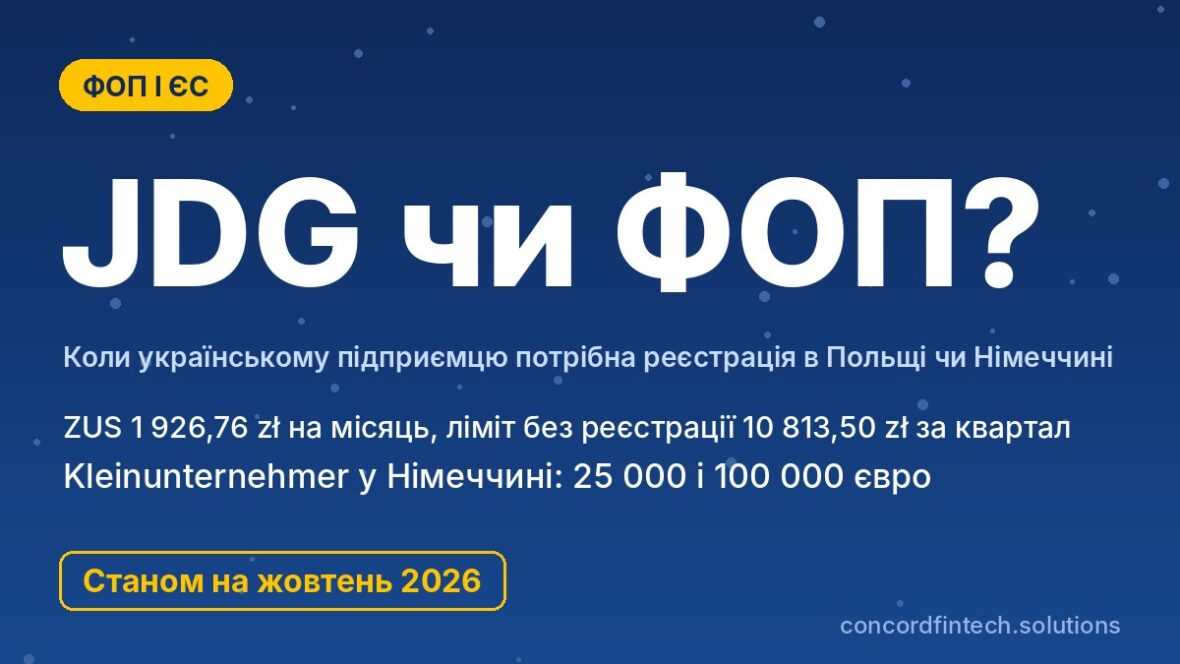
Full social ZUS in 2026 is 1 926,76 zloty per month. Value added tax (VAT) is waived for turnover up to 240 000 zloty a year, except for certain services.
Reliefs for new entrepreneurs
For the first 6 months there is an “ulga na start”, when social contributions are not paid and only health insurance remains. For the next 24 months you can pay preferential ZUS calculated from a base of 30% of the minimum wage, i.e. from 1 441,80 zloty when the minimum wage is 4 806 zloty.
For small income there is “działalność nierejestrowana” without CEIDG and ZUS, with a limit of 10 813,50 zloty per quarter. It can only be used by someone who has not conducted business in the last 60 months, so an active FOP may be an obstacle.
Germany: Gewerbe, Freiberufler and taxes
Registering a Gewerbe
Trade, craft or an online shop are registered as a Gewerbe at the local Gewerbeamt for a fee that depends on the city. Then the Finanzamt sends a questionnaire to register you on the books via ELSTER.
Profit is taxed at rates of 14-45%, and the tax-free allowance in 2026 is 12 348 euro. Gewerbesteuer is levied on profit over 24 500 euro and is partially credited against income tax.
Freiberufler for IT and creative professions
IT specialists, designers, translators and consultants mostly work as Freiberufler. They register only with the Finanzamt and do not pay Gewerbesteuer.
Health insurance is compulsory for all self-employed, pension insurance only for certain professions. The status of a liberal profession is finally determined by the Finanzamt.
Kleinunternehmer and VAT
Since 2025 the Kleinunternehmer status allows you not to charge VAT if turnover in the previous year did not exceed 25 000 euro and in the current year does not exceed 100 000 euro. Detailed rules are explained in the letter of the German Ministry of Finance.
Exceeding 100 000 euro cancels the status immediately, from the transaction that crossed the threshold. The standard VAT rate is 19%, the reduced rate 7%.
| Parameter | sole proprietor (3 group) | JDG (Poland) | Gewerbe (Germany) |
|---|---|---|---|
| Registration | Free via Diia or CNAP | Free in CEIDG, PESEL required | Gewerbeamt and Finanzamt, fee depends on the city |
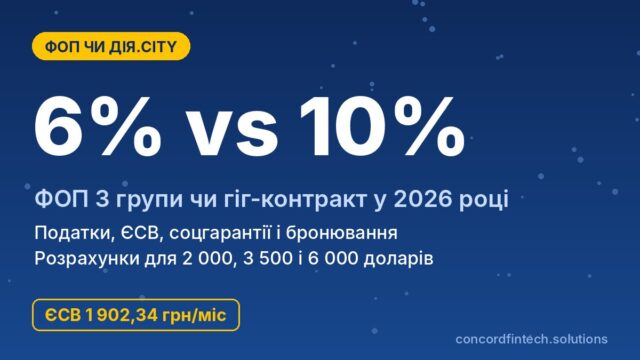
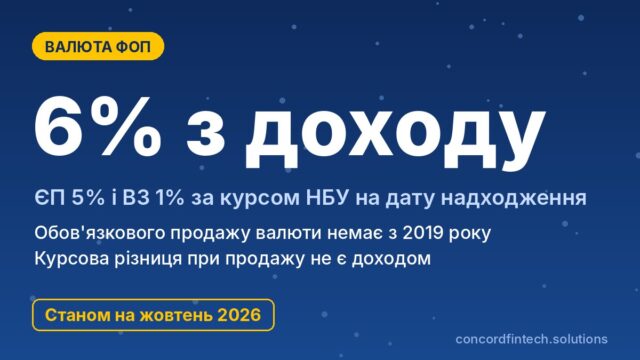
| Tax | 5% of income plus 1% military levy | 12%/32%, 19% or ryczałt 2-17% | Income tax 14-45% plus Gewerbesteuer over 24 500 euros |
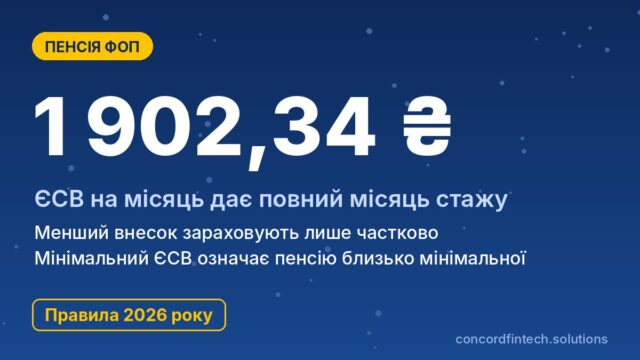
| Social contributions | SSC from 1 902,34 UAH per month | ZUS 1 926,76 zloty plus health insurance, initial reliefs | Mandato’ry health insurance, pension for certain professions |
| VAT threshold | With a 5% VAT rate no VAT applies, income limit 10 091 049 UAH | 240 000 zlotys per year | 25 000 euros for the previous year and 100 000 in the current one |
| Reporting | Quarterly declaration | Monthly ZUS and advances, annual PIT declaration | Annual declarations, VAT monthly or quarterly |
| Accountant | Usually not required | Recommended, especially with VAT | Steuerberater often required |
Practical scenarios for an FOP
Clients in Ukraine, living in Poland
If your family and home remain in Ukraine and your clients are Ukrainian, you can keep the FOP, although after 183 days Poland will also consider you a resident. The convention resolves conflicts, and the Ukrainian status is confirmed by a certificate from the State Tax Service (DPS).
If the whole family is in Poland and you do not plan to return, it is safer to register a JDG. In that case it makes sense to close or suspend the FOP.
Clients in the EU, living in Germany
Working for EU clients from a German flat almost always means an obligation to register as a Freiberufler or Gewerbe. The Ukrainian FOP is then better closed after the move to avoid paying the unified social contribution (ESV) and reporting twice.
Temporary protection and remote work
Temporary protection in the EU is in force until 4 March 2027 by a Council of the EU decision. In Poland PESEL UKR status gives the right to work and to open a JDG, while in Germany a permit under §24 with the note “Erwerbstätigkeit erlaubt” allows any gainful activity, including self-employment.
The protection status itself does not determine tax residency. Brief conclusions for three scenarios are:
- clients in Ukraine, family in Ukraine: you can keep the FOP, but count your days and have a certificate of residency;
- clients in the EU, living in Germany: registration as Freiberufler or Gewerbe is required, and it is advisable to close the FOP;
- temporary protection and remote work: you have the right to work, and local registration is determined by your centre of interests and client base.
| Situation | What to do with a sole proprietor | Registration in the EU |
|---|---|---|
| Poland, family and housing in Ukraine, Ukrainian clients | Keep, confirm Ukrainian residency | Not obli’gatory if there is no permanent establishment |
| Poland, family moved, Polish clients | Close after JDG registration | JDG in CEIDG |
| Germany, IT services for clients from the EU | Close or stop operating | Freiberufler at the Finanzamt |
| A few months abroad, then return | Keep unchanged | Not required |
How to combine an FOP and a business in the EU
Closing or keeping the FOP
You can formally keep both registrations, but each requires taxes, contributions and reporting. You can close the FOP via Diia even with a debt in the unified social contribution (ESV), but the debt transfers to you as a natural person.
Tax credit under conventions
Conventions with Poland and Germany allow crediting tax paid in one country against tax due in the other. A new agreement with Germany was signed on 19 May 2026, but the 1995 agreement still applies for now.
The single tax paid abroad is not always credited because it is a special regime. Keep receipts of payment together with translations.
Pension insurance record in both countries
Poland has a social security agreement since 2012, so periods in both countries are aggregated for pension rights. The agreement with Germany is not yet in force, and German periods are not counted towards a Ukrainian pension.
Mistakes to avoid
Working without registration in the country of stay
Serving local clients through a Ukrainian FOP for years is risky. The local tax authority may reassess tax, contributions and VAT for several years with penalties and fines.
Double payment of social contributions
Ukrainian unified social contribution (ESV) and Polish ZUS or German health insurance do not automatically replace each other. While both registrations are active, you will have to pay in both countries.
The agreement with Poland determines which country’s legislation applies, but exemption requires confirmation from the competent authority. Without it, each state may demand contributions.
Failing to notify tax authorities
A bank statement or telling an employer about residency in one country does not change your status in another, and states exchange account data. Notify the local tax office about starting activity and the State Tax Service (DPS) about closing the FOP.
Frequently asked questions
Can I work as an FOP while living in Poland?
Yes, if you remain a resident of Ukraine and do not work on the Polish market. If your centre of interests has moved to Poland or your clients are Polish, a JDG is required.
When should you register a JDG?
You should register a JDG before starting regular activity in Poland, and turnover above 10 813,50 zloty per quarter without registration is not permitted. Without a JDG you also cannot use ZUS benefits for new entrepreneurs.
Will I have to close the Ukrainian FOP?
The law does not explicitly require this, but a non-resident of Ukraine cannot be a payer of the single tax. If you become a resident of Poland or Germany under the convention, it is better to close the FOP on the simplified system to avoid paying contributions twice.