



Currency account for an individual entrepreneur (FOP) is necessary for any entrepreneur receiving payments from foreign clients, because export proceeds must be credited to an account in a Ukrainian bank. Funds arrive by SWIFT transfer directly or are withdrawn from Payoneer, Wise or PayPal, and income is calculated in hryvnia at the official exchange rate of the National Bank of Ukraine (NBU) on the date of receipt.
There is currently no mandatory sale of foreign-currency proceeds, so you can hold currency on the account and sell it in parts. A positive exchange-rate gain on such a sale does not increase the income of a payer of the single tax, and below we explain how this works with simple numbers.
How to open a currency account for an individual entrepreneur (FOP)
Documents and a contract with the client
To open an account you will usually need your passport, tax identification number and the FOP registration details, which the bank can see in the state register. Most banks open a currency account online in the app if they already hold the entrepreneur’s hryvnia account.
The bank may ask from whom and for what you plan to receive foreign currency. Therefore it is worth having a contract or invoice from the foreign client.
Multi-currency accounts
Many banks offer a single account with several currencies, most often US dollar, euro and hryvnia. This is convenient because you do not need to sign documents separately for each currency, and the bank issues the details for dollars and euros immediately.
Check what limits apply to the business card. From 11 August 2026 the NBU increased some business limits by Resolution No. 90, but specific conditions are set by your bank.
Choosing a bank for SWIFT
The most important thing for an exporter is not the bank’s name but the terms for receiving SWIFT payments: the crediting commission, correspondent banks and processing speed. You give your client the details in English with the SWIFT code or enter them in Payoneer or Wise.
Ways to receive payment from abroad
Direct SWIFT transfer
The simplest route is for the client to transfer funds from their bank directly to the FOP’s currency account. Such a payment is usually credited within 1-3 business days, and the cost depends on the sender bank’s tariffs, correspondent banks and your bank.
In a SWIFT payment you choose who pays the fees: the sender (OUR), the recipient (BEN) or both (SHA). Discuss this with the client in advance, because it determines how much actually arrives in the account.
Euros from the EU also arrive via SWIFT. At the time of writing Ukraine is only preparing to join SEPA, so cheaper SEPA transfers are not yet available.
Payoneer: withdrawal to an FOP account
Payoneer is convenient when the client or platform does not work directly with Ukrainian banks. Funds first arrive on the Payoneer balance, and then you withdraw them to the FOP’s currency account using SWIFT details; according to the service itself this takes 1-3 business days.
The State Tax Service (STS) emphasises that Payoneer and Wise are not bank accounts. If funds remain there at the end of the reporting period or are withdrawn to a personal card, they are taxed as personal income - that is, 18% personal income tax (PIT) and 5% military levy.
Wise and other payment services
Wise works similarly to Payoneer, but access to an account depends on the holder’s country of residence and documents. Withdrawals from Wise should also go to the FOP’s account in a Ukrainian bank, not to a personal card.
PayPal allows receiving payments in Ukraine, and a business account could be registered there from 2022. Funds are withdrawn to a linked bank card, so for business you link the card of the FOP account.
Each method has its strengths and weaknesses. Briefly summarised:
- Direct SWIFT has the fewest intermediaries, but correspondent fees are hard to predict;
- Payoneer suits marketplaces and platforms but adds an extra commission;
- Wise is convenient for multiple currencies, but the account is not available to all residents of Ukraine;
- PayPal is common among small clients, but withdrawals are tied to a card.
| Method | Sender’s commission | Receiving commission | Crediting time | Limitations |
|---|---|---|---|---|
| Direct SWIFT | Sender bank tariff, option OUR, SHA or BEN | Your bank and correspondent bank tariffs | Usually 1-3 business days | Contract or invoice may be required by the bank |
| Payoneer | Depends on the client’s payment method | Payoneer commission and your bank’s tariff | 1-3 business days after withdrawal | Withdraw to an FOP account by the end of the period |
| Wise | Wise commission | Your bank’s tariff | Depends on currency and routing | Not available to all residents of Ukraine |
| PayPal | PayPal commission | Withdrawal and conversion commissions | Depends on the card’s bank | Withdrawal to a card; business accounts from 2022 |
Documents for the bank and currency control
Invoice instead of a contract
An international trade contract does not necessarily have to be a signed paper document. Foreign clients often work on the basis of an invoice that specifies the service, amount, deadlines and a clause that payment implies acceptance of the terms.
The bank checks whether the receipt matches the documents, so the invoice should include the names of the parties, the FOP details and a description of the service. The more precise the description, the fewer questions from the bank.
Statement of completed work
An act (statement) confirms that the service was provided and, together with the contract or invoice, closes the export operation. Often the invoice states that payment confirms completion and no separate act is signed.
The bank may request such documents to credit foreign proceeds. Typically the package looks like this:
- contract or invoice-offer with a description of the service, amount and currency;
- statement of completed work or other proof of performance, if such is envisaged;
- a statement from Payoneer, Wise or PayPal if funds came through a payment service;
- an explanation of the payment purpose if it does not match the documents.
Settlement deadlines for exports
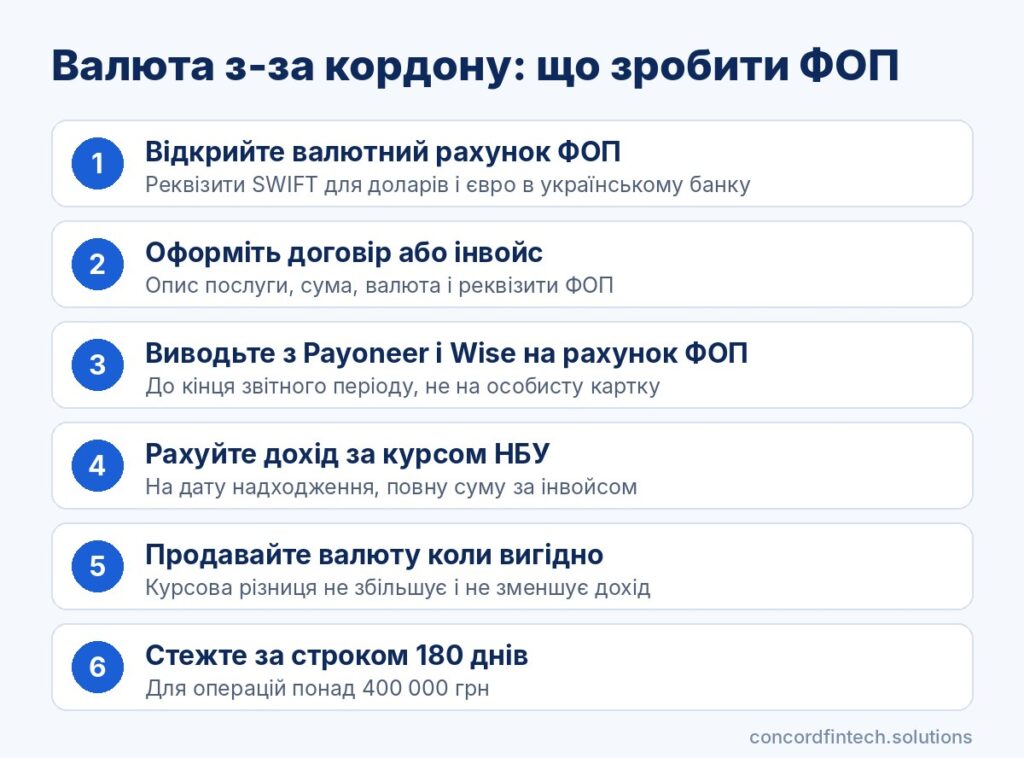
During martial law the NBU Resolution No. 18 sets the maximum settlement period for exports at 180 calendar days. For certain goods the NBU extended the period to 270 days, but for export of services by FOPs the general rule applies.
Deadlines do not apply to transactions under 400 000 hryvnia by the NBU rate if they are not artificially split. For breach of the deadline the Law “On Currency and Currency Transactions” provides a penalty of 0.3% of the unpaid amount for each day, but not more than the amount itself.
When and at what rate income is recognised
Date of crediting to the currency account
Under clause 292.6 of the Tax Code the date of income for a payer of the single tax is the date of receipt of funds. For a direct SWIFT transfer this is the day the funds are credited to the FOP’s currency account.
For Payoneer and Wise the State Tax Service (STS) considers the date of income to be the day the funds are credited to the account in the system, not the day of withdrawal to a Ukrainian bank. The condition is that the money reaches the FOP account within the same reporting period.
NBU rate on the date of receipt
Clause 292.5 of the Code requires converting foreign-currency income into hryvnia at the official NBU exchange rate. You use the rate on the date of receipt, not the day of sale of currency or filing the declaration.
Currency balances on the account at the end of the quarter are not revalued. The income amount is fixed once and does not change even if the rate later rises or falls significantly.
Example calculation for the single tax 5%
Suppose an FOP of group 3 received 2 000 dollars and the NBU rate on the date of receipt was 41.50 hryvnia per dollar. Income equals 83 000 hryvnia, the single tax at 5% is 4 150 hryvnia, and the military levy at 1% adds another 830 hryvnia.
The total payable from this receipt is therefore 4 980 hryvnia. The single social contribution (SSC) does not depend on income and is paid separately, at least 1 902.34 hryvnia per month.
Selling foreign currency and exchange-rate differences
Is sale of foreign currency mandatory?
The mandatory sale of foreign receipts was repealed by the NBU on 20 June 2019 and was not reinstated during martial law. Thus an FOP may keep currency on the account for as long as they consider necessary.
You can sell currency in the bank’s app at its commercial rate, and the hryvnia is credited to the FOP’s current account. Buying currency for business needs, for example to pay for foreign services, is possible within the limits of Resolution No. 18, and the bank may request a letter about your own foreign-currency balances.
Exchange-rate gain is not income
If an FOP sold the same 2 000 dollars at a rate of 42.10 hryvnia, they would receive 84 200 hryvnia. The difference of 1 200 hryvnia is not included in the income of a payer of the single tax, and the STS confirms this in individual consultations.
The reverse rule also applies, so a sale at a lower rate does not reduce declared income. If the rate fell to 41.20 and you received 82 400 hryvnia, the recognised income nevertheless remains 83 000 hryvnia.
Bank commissions for conversion
The bank earns on the spread between buying and selling rates, and some banks additionally charge a percentage of the amount. These expenses do not reduce the base for the single tax, because the single-tax payer pays tax on income, not on profit.
Common mistakes by FOPs with foreign proceeds
Receiving funds to a personal card
The most costly mistake is accepting payment for services to a personal individual’s account. Such income is not treated as FOP activity, and instead of 6% you may have to pay 23% and file an annual declaration.
The same applies to balances in Payoneer or Wise not withdrawn to an FOP account by the end of the period. Plan withdrawals in advance.
Not accounting for intermediary commissions
Payoneer, PayPal and correspondent banks often withhold a commission from the payment, so the account receives less than stated on the invoice. The STS in its electronic information resource regards income as the contractual amount, so it is safer to declare the full invoice amount and keep statements showing withheld commissions.
Exceeding the threshold due to the exchange rate
The turnover limit for group 3 in 2026 is 10 091 049 hryvnia, and foreign proceeds are counted towards it at the rate on the date of each receipt. Due to a rising exchange rate the same dollar amount can bring you closer to the limit, so calculate income in hryvnia after each receipt.
Frequently asked questions
At what rate does an FOP calculate income in foreign currency?
Income is calculated at the official NBU rate on the date funds are received. The bank’s sale rate on the amount of income does not affect it.
Does an FOP have to sell foreign currency?
No, mandatory sale of foreign proceeds has not applied since June 2019. Currency can be held on the account or sold in parts when convenient.
Can you withdraw Payoneer to a personal card?
Technically it is possible, but then the funds are taxed as personal income at 23%. To pay the single tax, withdraw the money to the FOP’s account in a Ukrainian bank within the same reporting period.
Is exchange-rate gain income for an FOP?
No, positive exchange-rate gain from selling currency is not included in the income of a payer of the single tax. A negative difference likewise does not reduce already recognised income.