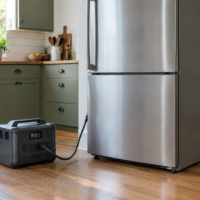


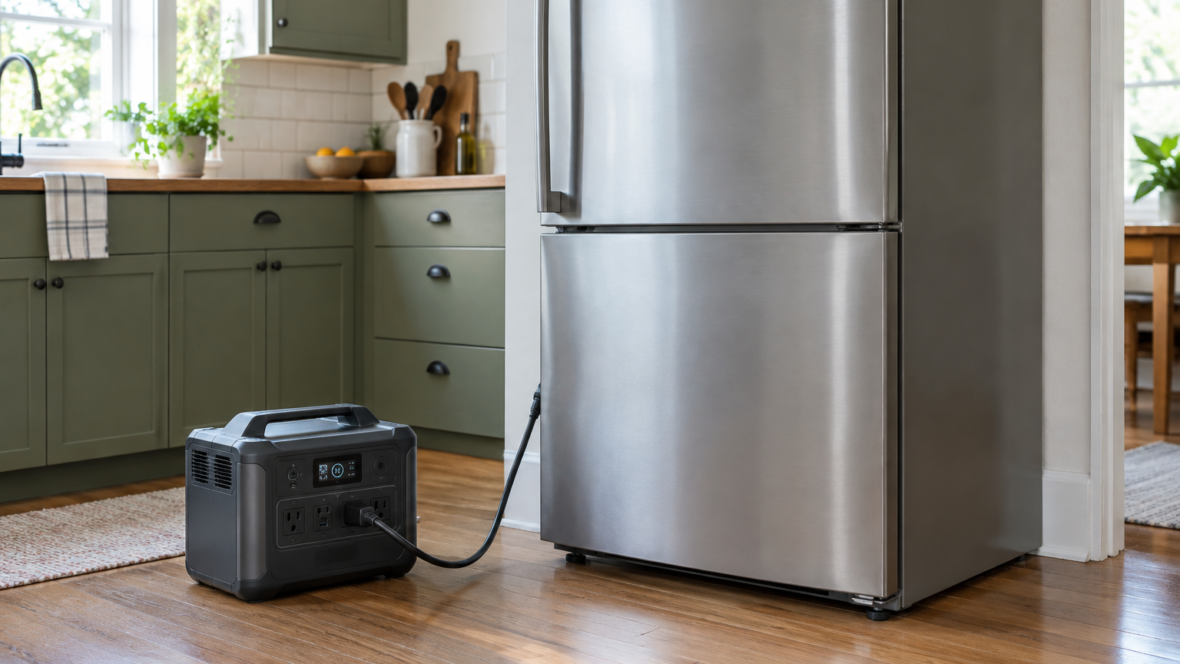
An overview of five portable power stations shows which models can keep a refrigerator running and for how long at different consumption levels. The article lists technical specifications, charging times and approximate autonomy calculations for each model.
Calculating the expected running time of a refrigerator
Run time depends on the refrigerator’s average consumption taking compressor duty cycles into account. Two consumption scenarios are considered: 40 W (watts) and 80 W (watts), which correspond approximately to 0,96 and 1,92 kW·h (kilowatt-hours) per day.
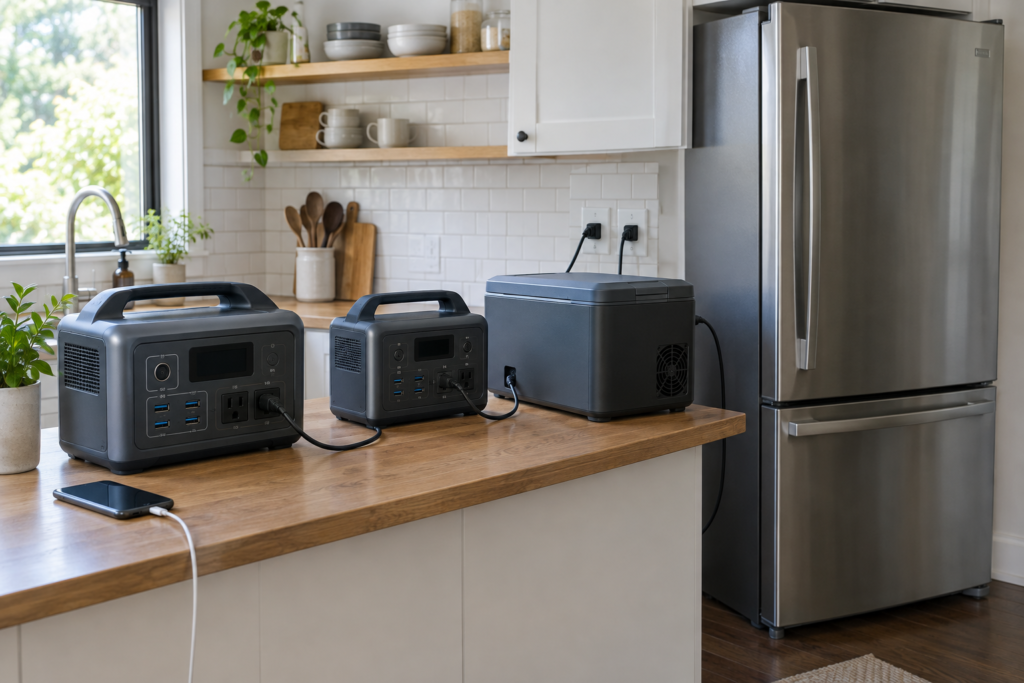
If you subtract 20% of capacity for losses and the station’s own consumption, a battery of 1024 W·h (watt-hours) will provide roughly 20 hours of operation at 40 W (watts) and 10 hours at 80 W (watts). Heating, frequent door openings and defrosting reduce autonomous run time.
Delta 3 and Aferiy P180 Pro — 1024 W·h and up to 20 hours of run time
The EcoFlow Delta 3 has a 1024 W·h battery, a nominal power of 1800 W and a peak of 3600 W, and its LiFePO4 battery is rated for 4000 cycles to 80% remaining capacity. The model weighs 13 kg; a full charge from the mains takes 56 minutes. The station offers 11 outputs: four AC sockets, two USB-A ports at 18 W, two USB-C ports at 100 W, a car socket and two DC5521 ports. For the Delta 3 the calculated refrigerator run time is approximately 10−20 hours.
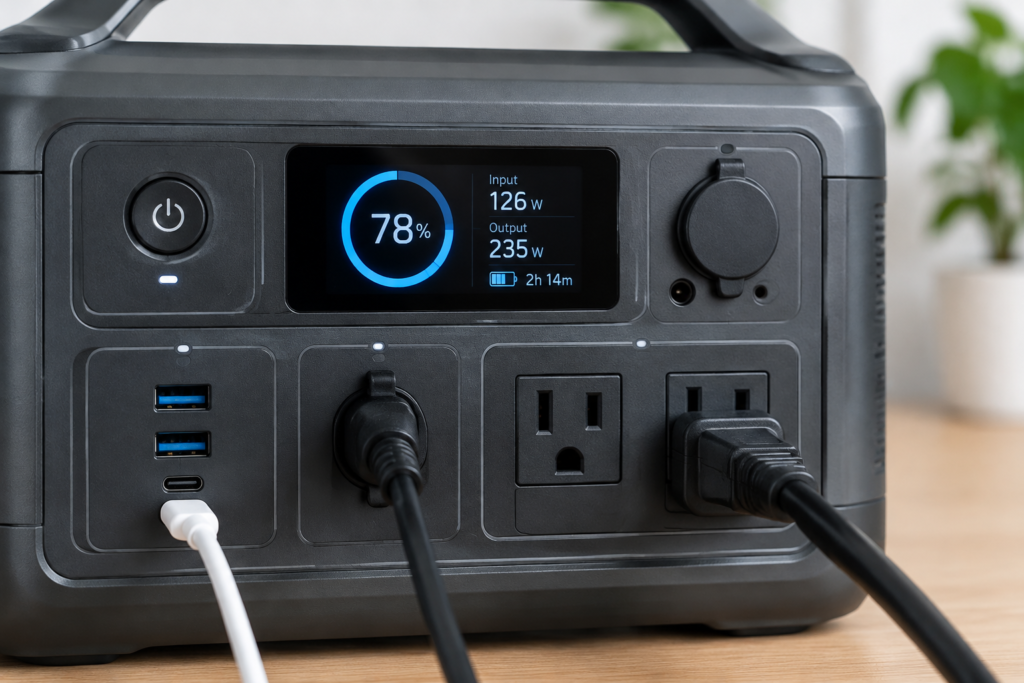
The Aferiy P180 Pro also has a 1024 W·h battery, a nominal power of 1800 W and offers a pure sine-wave output. Weight is 11,64 kg; a full charge from a socket takes about 1,1 hours (66 minutes). Its LiFePO4 battery is claimed to exceed 4000 cycles while retaining 80% capacity. The station has nine outputs, including two AC sockets, USB-A at 18 W, USB-C ports at 20 W and 140 W, a car socket and two DC5521 ports. For the P180 Pro the calculated refrigerator run time is also 10−20 hours.
Jackery Explorer 1000 V2, Vtoman Jump 1500X and Genki GK-800 — different capacities and limitations
The Jackery Explorer 1000 V2 features a 1070 W·h battery, a nominal power of 1500 W and a peak of 3000 W; its weight is 10,8 kg. Charging from the mains takes 1,58 hours (approximately 95 minutes). The LiFePO4 battery is rated for 4000 cycles and is expected to retain around 70% capacity afterwards. Output options include two AC sockets, a USB-A at 18 W, two USB-C ports at 30 W and 100 W, and a car socket. The estimated refrigerator run time is 11−21 hours.
The Vtoman Jump 1500X has a base battery capacity of 828 W·h, a nominal power of 1500 W and a peak of 3000 W; weight — 14 kg. Its LiFePO4 battery is rated for 3100 cycles. With a 180 W adapter, a full charge takes roughly 4−5 hours, so during short power restorations the station may not have time to fully recharge. For the Jump 1500X the calculated refrigerator run time is about 8−17 hours.
The compact Genki GK-800 has a 512 W·h battery and weighs 6,5 kg; nominal power is 800 W. Charging from the mains takes 1,5 hours, and the LiFePO4 battery is claimed at 3000 cycles. Because its nominal power is 800 W you should check the compressor’s starting (inrush) draw — the compressor may fail to start. If the refrigerator does start, the estimated run time is 5−10 hours, while high-power appliances such as microwaves or hairdryers are not suitable for this model.