



According to the National Bank of Ukraine (NBU), inflation in Ukraine in August 2026 was 8.1%, and the key policy rate from 18 September was 16%. Because of this, investors are increasingly comparing commercial real estate and land as options for protecting money from inflation.
Two mechanisms for protecting capital
Commercial real estate protects capital primarily through rental income: rents can be indexed alongside prices, and the owner receives income for as long as they hold the asset. Land mostly protects via appreciation of the asset itself: current rental yields are low, and the main benefit comes from the increase in the price per hectare.
This distinction determines other comparison parameters — liquidity, maintenance costs and the regularity of income. Therefore the choice between the assets depends on whether an investor is aiming for a steady cash flow or capital appreciation.
Entry threshold and investment examples
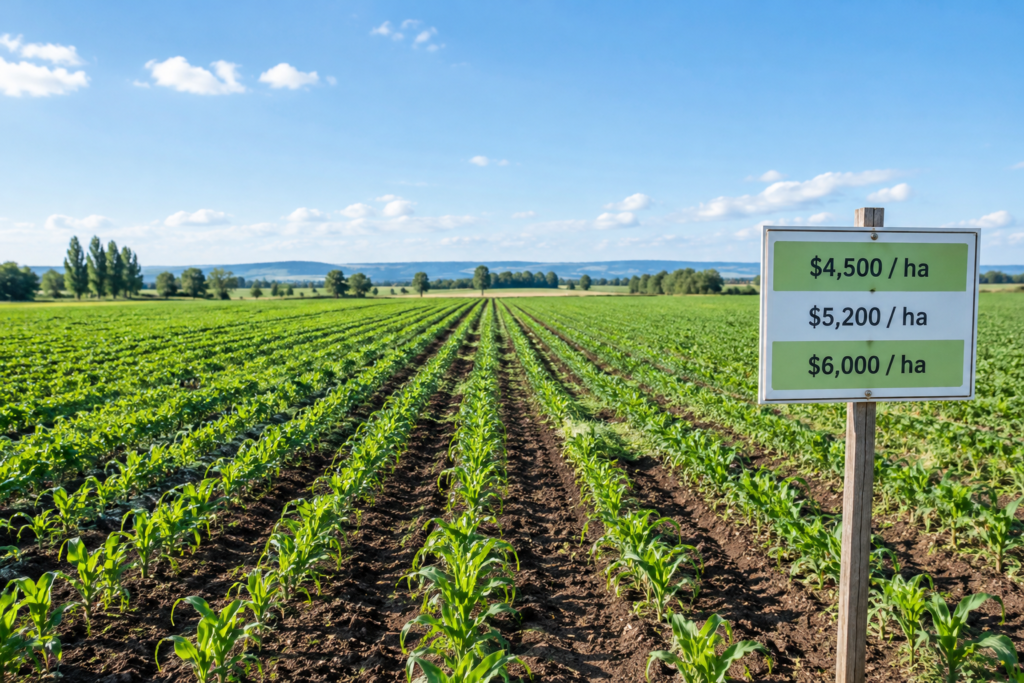
Land has a lower minimum ticket: an individual may buy no more than 100 ha, and for a plot of 5−10 ha you need roughly from 15 to 50 thousand dollars depending on the region, according to an estimate by Latifundist. Commercial real estate requires higher capital — from tens of thousands of dollars for a small unit to hundreds of thousands for a full-scale asset.
A lower ticket in real estate is available through co-investment or REITs. Thus, the minimum investment in the funds S1 Plaza Pozniaky and S1 Pozniaky is from 1,000 UAH, after which certificates can be purchased gradually. “In real estate funds an investor buys a certificate, i.e. a share in the fund’s assets, which already owns large properties and pools money from many people. The investor does not need to have expertise in construction, leasing or operation: they choose a fund with the appropriate strategy and receive reporting on its results,” S1 REIT said.
Yield and liquidity
Yields in commercial real estate vary greatly by segment and depend on location and management. For agricultural land, according to Fortior Capital’s estimate, at the market’s start the rent-to-price ratio gave 7−10% per year; today it is around 5% in hryvnia; figures of 15−30% quoted on platforms refer to projected capitalisation, i.e. expected price growth, not actual rental income.
Liquidity for both assets is lower than for securities, but for different reasons. Class A warehouses and assets with a reliable tenant are the most liquid in the real estate segment; the land market is growing quickly — about 4% of the land bank is sold, 0.7−1% of land changes ownership each year — but demand exceeds supply by 2−3 times.

Taxes, expenses and illustrative scenarios
Maintenance costs for land are minimal: land tax or rental payments and administration, whereas commercial real estate carries operating expenses and repairs, so gross yield is always higher than net. Sales by an individual in 2026 are taxed with personal income tax (PIT) of 5% and a military levy of 5; for residential real estate there are exemptions if held for more than three years and sold no more than once a year.
Illustrative calculations show different scenarios. For example, a 10 ha plot at 3,500 dollars per ha costs 35,000 dollars; rent at 5% gives 1,750 dollars per year; with a price increase of 8% per year the asset would be worth about 75,000 dollars after 10 years, while in a 30% correction it would be roughly 52,000 dollars. A warehouse of 1,000 sq. m with a rental rate of 5 dollars per sq. m per month yields 60,000 dollars of gross income per year, but after vacancy, maintenance costs and taxes the net income will be lower, and indexation of rates by 5−8% allows income to grow with inflation.