


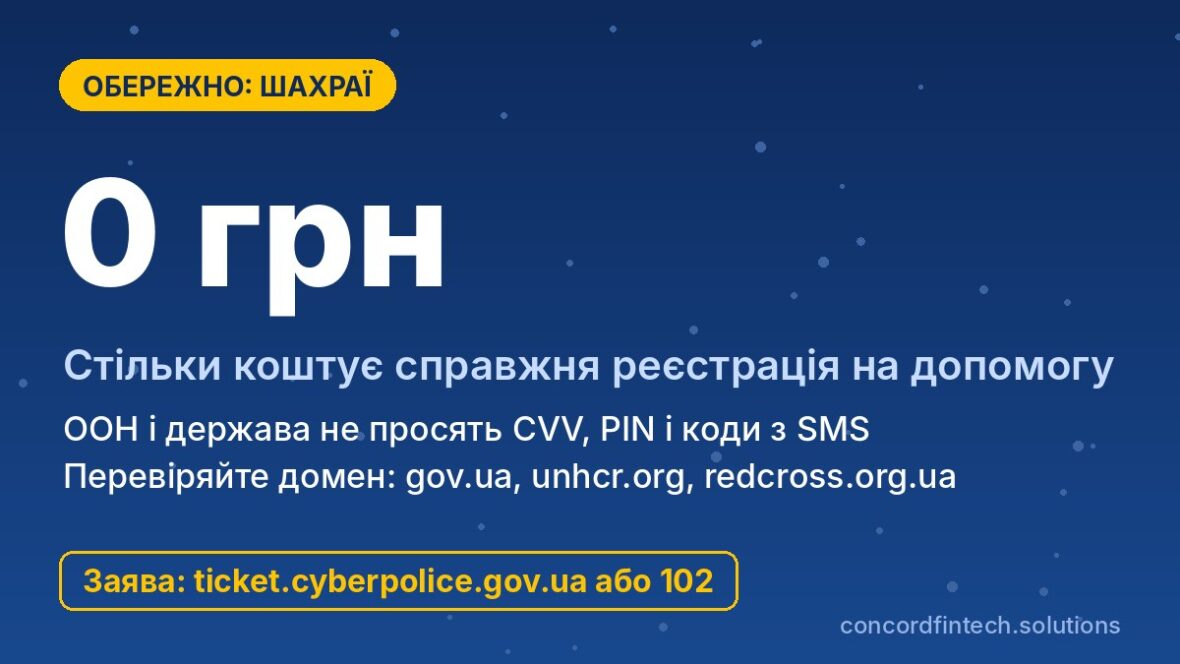
Scammers offering “payments from the UN” or “state aid” send links to websites that look official to obtain card details, SMS codes or access to Diia. Genuine state payments are only processed through Diia, the web portal of the Pension Fund of Ukraine (PFU), a Centre for Administrative Services (CNAP) or local social protection authorities. The United Nations High Commissioner for Refugees (UNHCR) and the Ukrainian Red Cross Society register people free of charge and never ask for CVV, PINs or one‑time passwords.
If you have entered card details on a suspicious site, block the card with your bank immediately and file a report with the cyber police. Below we explain how to recognise a fake and what to do if you have already been defrauded.
Common scams involving payments
Phishing forms for “registering for aid”
The most common scheme comes as a message about a new payment with a link to “register”. The page copies the look of a government site, Diia or an international organisation and, under the guise of a form, asks for the card number, expiry date and the three‑digit security code from the back. The National Bank of Ukraine (NBU), in its warnings, regularly describes such pages under names like “Payment from the UN”, “Payment from international organisations” or “State aid programme”.
Often, beside the card they ask for a code that is said to arrive by SMS for “confirmation”. In reality it is needed by fraudsters to confirm a transfer from your account or to log into online banking.
Demand for payment to register
Another variant asks for a “small payment” before receiving a larger sum. It is called a commission, insurance fee, document‑checking fee or “unblocking” the compensation. After payment the fraudsters invent another fee or disappear, whereas UNHCR and state bodies never charge for assistance.
Fake chatbots and mass messages
Scammers create channels and bots in messengers using the names of well‑known institutions. On 6 October 2026 the Pension Fund of Ukraine warned about fake Telegram channels that, pretending to be the Fund, alarmed people about losing payments and urged them to “choose their length of service”. The Fund stressed that it does not send messages via messengers and that links in such mailings lead to phishing pages.
Similar messages are shared in parent chat groups. In autumn 2025 the PFU debunked a fake “form” for the “Schoolchild’s Package” payment, which also led to a suspicious site.
Signs of a fake aid website
Domain not on gov.ua or other official addresses
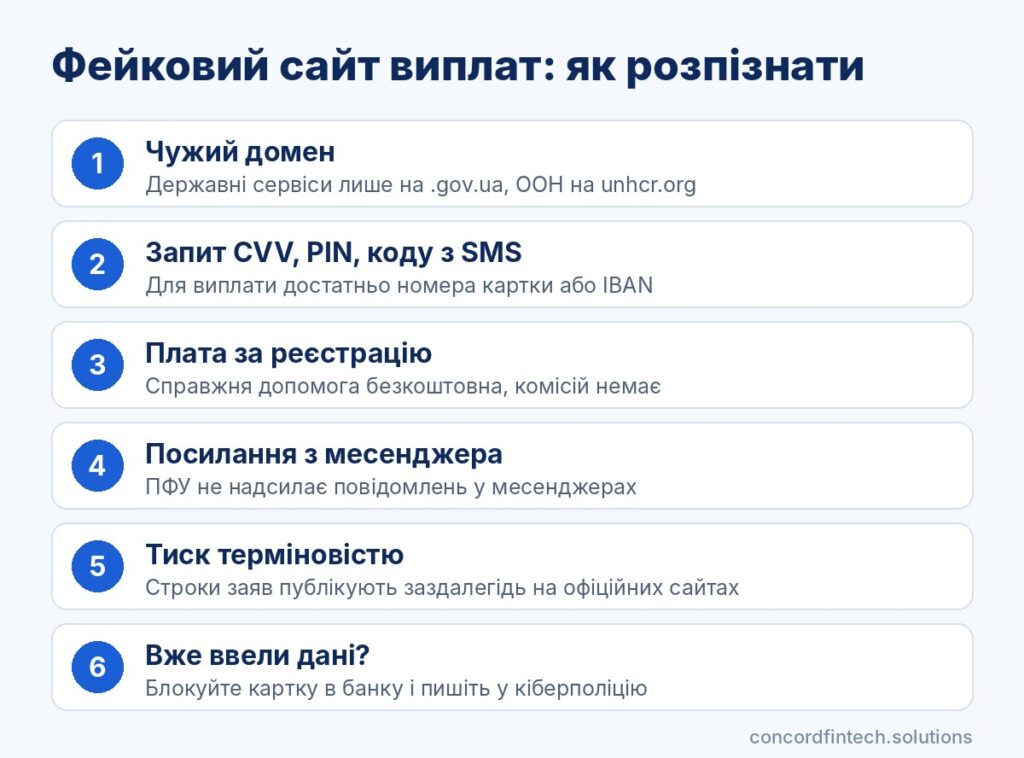
The first thing to check is the browser address bar. Ukrainian state bodies operate on domains ending in “.gov.ua”, and international organisations have their own domains, for example unhcr.org or redcross.org.ua. Fake pages use similar names with hyphens, extra words or different endings such as “.com”, “.online” or “.site”.
Logos and colours are easy to copy, so trust only an address you typed yourself. The main signs of a fake are:
- the address does not end in “.gov.ua” or does not match the organisation’s official domain;
- the link arrived in a messenger, SMS or a comment from an unknown sender;
- the promised amount is large and the conditions for receiving it are vague or “for everyone”;
- the form asks for CVV, PIN, card expiry date, online banking password or an SMS code;
- you are asked to pay a “commission”, “insurance” or “delivery” fee for the funds.
Request for CVV, PIN or SMS code
To credit funds, a card number or IBAN is sufficient. The National Bank of Ukraine (NBU) explains that a PIN, the three‑digit code from the back of the card, payment confirmation codes and online banking passwords must not be requested even by a bank employee. One‑time codes from banks or mobile operators are also not to be passed on to anyone.
If a site asks for these details “for verification” or “validation”, it is phishing. Close the page and do not enter anything, even if it looks convincing.
Pressure through urgency
Scammers almost always create a sense of urgency. Messages claim that applications close today, that without registration you will lose your pension or benefits, or that places are limited. The aim is to prevent people from checking the information.
Official deadlines for submitting applications are published in advance on ministerial websites and the PFU. If a message threatens consequences, check the official resource.
How to verify an official channel
gov.ua domains
State payments in Ukraine are processed through a few verified services: the Diia app and portal at diia.gov.ua, the Pension Fund’s electronic services portal and the PFU website pfu.gov.ua, as well as CNAPs and local social protection offices. Download the Diia app only from official app stores, not from a link in a message.
New programmes are announced on kmu.gov.ua and msp.gov.ua. If there is no mention there of a “new payment”, it most likely does not exist.
Official sites of international organisations
UNHCR publishes current assistance terms at help.unhcr.org/ukraine, and the organisation does not generally run independent online registration for most programmes. Interviews are conducted by partner organisations at registration centres, and they are the ones who contact people. The Red Cross posts information about programmes at redcross.org.ua and icrc.org, and any page bearing their logos on another domain should be treated as suspicious.
Hotlines for the PFU and organisations
Phone only numbers listed on official sites, not those in a message. As of mid‑October 2026 the toll‑free hotlines are: Pension Fund of Ukraine 0 800 503 753, UNHCR 0 800 307 711, Ukrainian Red Cross Society 0 800 332 656. Your bank’s number is printed on the back of your card.
What to do if you were defrauded
Block the card via your bank
Time is critical, so act as soon as you realise you entered details on a fake site. The sequence of actions is:
- Block the card in your bank’s app or by calling the number on its back.
- Notify the bank of any unauthorised transactions and ask them to file a dispute.
- If you disclosed your PIN, change it or request a replacement card.
- File a report with the cyber police online or call 102.
- Change passwords for online banking, email and messengers and check your transaction history in Diia.
- Save screenshots of correspondence, the site address and transaction details.
It is sometimes possible to recover funds through a chargeback procedure initiated by your bank in the payment system. Chances are higher if you contacted the bank quickly and did not confirm the transaction yourself; if you entered an SMS code, banks often refuse to refund.
Reporting to the cyber police
The cyber police department accepts reports of fraud via an online form at ticket.cyberpolice.gov.ua. This same address is recommended by the Pension Fund and the National Bank. If money has already been debited, also contact your local police station or call 102.
Add the site address, screenshots, the sender’s account and a bank statement to your report. The more details you provide, the easier it is to block the resource.
Change passwords and check Diia
If you entered a login or password on a suspicious page, change them on all services where they are the same. Enable two‑factor authentication for email, messengers and banking apps. Check Diia for any applications or services you did not request and, at the first sign of suspicion, contact the app’s support service.
Non‑existent payments used by scammers
1 000 UAH “for everyone” in 2026
In winter 2025-2026 a one‑off “Winter thousand” was paid, and scammers frequently exploit its recognisability. As of mid‑October 2026 the government has not approved a new universal payment of 1 000 UAH. Instead, a targeted “Winter support” of 19 400 UAH per household in frontline communities was introduced, and applications for it were accepted until 30 October 2026. So “continuation of applications” or a “thousand for everyone” via a link is fake.
“Extension” of the National cashback
The “National cashback” programme is active, and from 1 March 2026 it operates at rates of 5% and 15%. According to the Ministry of Economy, participants do not need to re‑register because the new rules apply automatically. Cashback funds cannot be withdrawn in cash or transferred to another card.
Therefore offers to “continue”, “activate” or “withdraw” cashback via a website are fraudulent. The National Bank separately warned about a phishing scheme using the name “National cashback”.
Basic social assistance for everyone
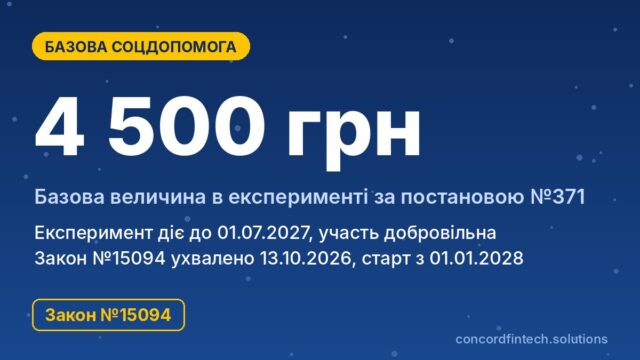
Basic social assistance is currently an experiment under Cabinet of Ministers resolution No. 371, running from 1 July 2025 to 1 July 2027. Draft law No. 15094 on its nationwide introduction was adopted in full by the Verkhovna Rada on 13 October 2026, and the new system is due to come into effect on 1 January 2028. There is no online registration “for everyone” for this aid.
Common fakes and the real situation are summarised in the table below. Data are current as of mid‑October 2026.
| Fake | Reality | Official source |
|---|---|---|
| “1 000 UAH for everyone for winter 2026-2027” | No universal payment has been approved; a targeted “Winter support” of 19 400 UAH for frontline communities was in place | msp.gov.ua |
| “Continue National cashback via this link” | The programme runs automatically; funds are not transferred to other cards | me.gov.ua |
| “Basic assistance for everyone, register now” | Experiment runs until 01.07.2027; nationwide rollout from 01.01.2028 | msp.gov.ua, zakon.rada.gov.ua |
| “Payment from the UN via an online form” | UNHCR registers through partners free of charge, without card details | help.unhcr.org |
| “Social payment from the National Bank” | The NBU does not disburse social payments to citizens and does not call bank clients | bank.gov.ua |
Frequently asked questions
Can the UN charge for registration for assistance?
No. UNHCR and other UN agencies do not charge fees for registration or receipt of aid. Any demand for a commission, insurance fee or prepayment is fraud and should be reported to the cyber police and the organisation itself.
Can money be recovered after fraud?
Sometimes yes, if you quickly block the card and file a dispute with the bank. The bank can initiate a chargeback, but if the cardholder confirmed the transfer with an SMS code, refunds are often refused. File a police report in parallel.
Where to report a fake aid website?
Report phishing sites to the cyber police via the form at ticket.cyberpolice.gov.ua. If a site uses the name of the PFU, UNHCR or the Red Cross, inform those organisations via their hotlines so they can warn others.