




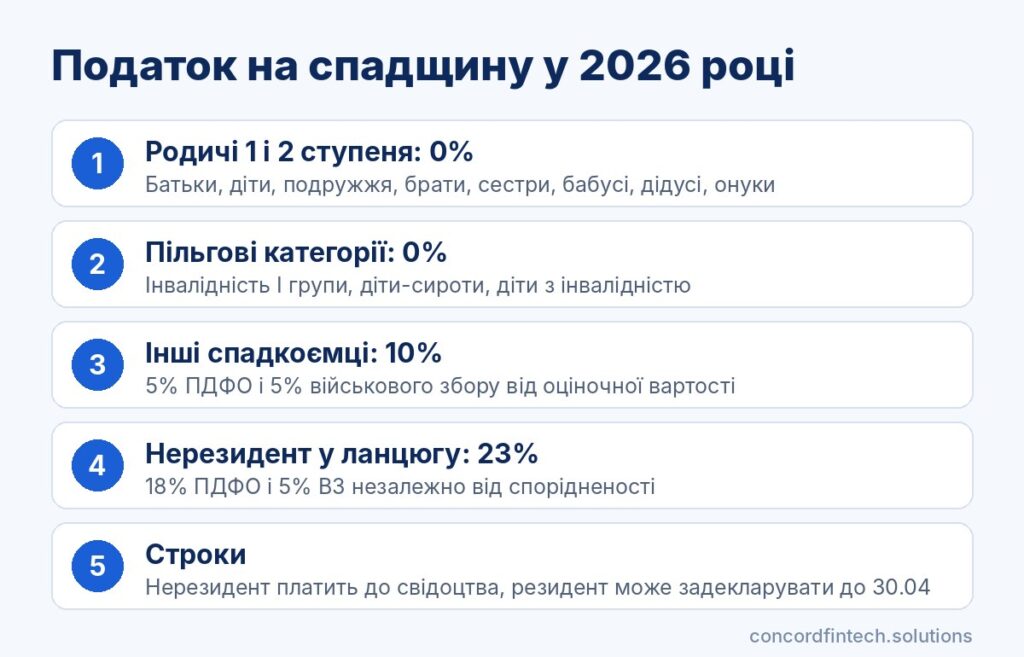
Inheritance tax in 2026 depends on who the heir is to the deceased and whether either party is a non-resident. Relatives of the first and second degree pay nothing; other resident heirs pay 5% personal income tax (PIT) and 5% military tax (MT), i.e. a total of 10% of the appraised value of the property. If the testator or the heir is a non-resident, the PIT rate is 18%, and together with the military tax the total is 23%.
A resident who receives a taxable inheritance usually declares it in the year-end tax return, while a non-resident must pay the tax before the issuance of the certificate of inheritance rights. Below we explain degrees of kinship, special cases and calculations with examples.
Inheritance tax rates in 2026
0% for first- and second-degree relatives
The rates are set by Article 174 of the Tax Code of Ukraine. Under subparagraph 174.2.1 a zero rate applies to any property inherited by members of the deceased’s family of the first and second degree of kinship. Such income is not subject to military tax either, and it does not need to be declared.
The zero rate also applies to certain categories regardless of kinship. A person with a Group I disability, an orphan and a child deprived of parental care do not pay tax on inherited real estate, movable property, cash and account balances. A child with a disability has this exemption in respect of real estate and movable property, and deposits placed before 1992 in Oschadbank and Ukrderzhstrakh are exempt from tax for any heir.
5% PIT and 5% MT for other heirs
If an heir does not fall under any exemption, subparagraph 174.2.2 sets a rate of 5% PIT. This is how inheritances received by nephews and nieces, uncles and aunts, great-grandchildren, sons- and daughters-in-law, stepchildren, and unrelated persons named in a will are taxed. A military tax of 5% is added to this income, as explained by State Tax Service, so the total burden is 10%.
18% PIT and 5% MT for inheritance from a non-resident
Subparagraph 174.2.3 applies a rate of 18% to any property that a resident inherits from a non-resident, as well as to inheritance that a non-resident receives from a resident. Degree of kinship does not matter here, so even a son inheriting from a non-resident father will pay 18% PIT and 5% military tax. The total rate in such cases is 23% of the property’s value.
| Heir | PIT | MT | Is a declaration required |
|---|---|---|---|
| First-degree family member (parents, children, spouse) | 0% | 0% | No |
| Second-degree family member (brothers, sisters, grandparents, grandchildren) | 0% | 0% | No |
| Person with a Group I disability, orphan (real estate, movable property, funds) | 0% | 0% | No |
| Other heir — resident | 5% | 5% | Yes, if the tax has not been paid before the certificate is issued |
| Resident inheriting from a non-resident | 18% | 5% | Yes, if the tax has not been paid before the certificate is issued |
| Heir — non-resident | 18% | 5% | No, the tax is paid before the certificate is issued |
Degrees of kinship for tax purposes
First degree: parents, children, spouse
The circle of close relatives is fixed by subparagraph 14.1.263 of the Tax Code. The first and second degrees include the following people:
- the deceased’s parents;
- husband or wife;
- children, including adopted children;
- blood brothers and sisters;
- grandmother and grandfather from the mother’s and father’s side;
- grandchildren.
Second degree: brothers, sisters, grandparents, grandchildren
A grandchild inheriting an apartment from a grandmother belongs to the second degree and does not pay tax. Similarly, grandparents who inherit property from a grandchild, and blood brothers and sisters, are exempt from tax.
Other heirs and heirs named in a will
Stepfathers, stepmothers, stepchildren, fathers-in-law, mothers-in-law, nephews and great-grandchildren are not included in the list, so they pay 5% PIT and 5% MT. If a son is named in the will, he still has the right to 0%, while a neighbour named in the same will will pay 10%.
Special cases of inheritance taxation
Inheritance from a fallen serviceman
Article 174 does not establish a separate rate for inheritances of fallen defenders, so the general rules apply. Parents, spouse, children, brothers, sisters and other close relatives receive property at the 0% rate, while distant relatives and unrelated persons pay 5% PIT and 5% MT. One-off monetary assistance to the family of the fallen is not inheritance; it is paid under separate laws without PIT and military tax.
Inheritance in the form of a deposit or insurance payment
Money in bank accounts and deposits is taxed the same as other property, so for close relatives it is 0% and for other heirs 10%. The bank does not withhold the tax, so an heir who is not exempt pays it themselves or declares it in the annual return. For life insurance payments, the tax agent is the insurance company, which withholds the tax at the time of payment at the rate corresponding to the heir’s status.
Inheriting a share in a business
Corporate rights and securities fall under commercial property by subparagraph 'v' of paragraph 174.1. For members of the first and second degree the rate is also 0%, while other heirs pay 10% of the appraised value of the share; the exemption for persons with Group I disability and orphans does not extend to commercial property.
The tax is calculated from the appraised value by applying the PIT rate and the MT rate separately. A nephew who inherited an apartment from his aunt with an appraised value of 1 500 000 UAH will pay 75 000 UAH PIT and 75 000 UAH military tax, a total of 150 000 UAH. A son who received a car worth 400 000 UAH from a non-resident father will pay 72 000 UAH PIT and 20 000 UAH MT, i.e. 92 000 UAH, while a granddaughter who inherited a deposit of 300 000 UAH from her grandmother will pay nothing.
Tax payment and declaration
Payment before issuance of the certificate of inheritance rights
According to paragraph 174.4, a notary issues the certificate of inheritance rights to a non-resident heir only if there is a document proving payment of the tax. A resident does not have this obligation, but may choose to pay the tax before obtaining the certificate, in which case no declaration is required. The procedure for taxable inheritance looks like this:
- Order a valuation of the property, because the tax base is the appraised value; for property taxed at 0% an appraisal for tax purposes is not required.
- Pay 5% or 18% PIT and 5% MT through a bank if you are a non-resident or want to close the matter immediately.
- Obtain the certificate of inheritance rights from the notary and register ownership rights.
- If the tax was not paid earlier, declare the inheritance in the annual return and pay the tax by the established deadline.
When an annual declaration is required
Paragraph 174.3 obliges heirs to report the value of the inheritance in the annual declaration but makes three exceptions. Those who received property at the 0% rate, non-residents who paid the tax before the certificate was issued, and residents who also paid in advance do not submit the declaration. For inheritances received in 2026, the declaration must be submitted by 30 April 2027, and the tax paid by 31 July 2027.
Documents for the notary
To formalise the inheritance you will need a passport, taxpayer identification number (RNOKPP), death certificate and documents for the property. Kinship is confirmed by birth and marriage certificates, and for a grandchild you need documents for both generations. The notary transmits data on issued certificates to the tax office quarterly, so unpaid tax is easy to detect.
Inheritance from a non-resident and from abroad
Who is considered a non-resident
Status is determined by subparagraph 14.1.213 of the Tax Code, and citizenship is not decisive. A resident is a person who has a place of residence in Ukraine or a centre of vital interests here, and in doubtful cases presence of more than 183 days in a year is taken into account. A Ukrainian citizen who has lived abroad for years may be a non-resident.
Credit for foreign tax
If inheritance tax has already been paid in another country, it can be credited in Ukraine only under the conditions of Article 13 of the Tax Code. For this you need an effective double tax treaty and a certificate from the foreign tax authority about the amount paid. Many such treaties cover only taxes on income and do not include inheritance taxes, so crediting is not guaranteed.
Valuation of foreign property
The tax is calculated from the appraised value determined according to the legislation, so for foreign real estate or a car a valuer’s report is required. The value in foreign currency is converted into hryvnia at the exchange rate of the National Bank of Ukraine (NBU) on the date the income is received.
Penalties in inheritance matters and how to avoid them
Failure to submit a declaration
Failure to submit a declaration carries a fine of 340 UAH, and for a repeated offence within a year 1 020 UAH. The declaration is most often missed by distant relatives and heirs named in a will. They mistakenly believe that the notary pays the tax for them.
Understatement of property valuation
If the tax authority determines that the tax base has been understated, it will recalculate the tax and apply a fine of 10% of the underpaid amount, 25% for deliberate understatement, and 50% for a repeated deliberate offence within 1 095 days. Therefore, for taxable inheritances it is worth ordering a valuation from an appraiser registered in the Unified database of valuation reports.
Missing the payment deadline
If a declared tax is paid late, the fine is 5% of the amount for a delay of up to 30 days and 10% for a longer delay. Penalty interest is charged after 90 days of arrears, so it is better to pay the tax by 31 July of the following year or even before obtaining the certificate.
Gifts are taxed at the same rates as inheritances, since paragraph 174.6 directly refers to the rules of Article 174. There is a separate article on the website titled 'Taxation of gifts'.
Frequently asked questions
Does a grandchild pay tax if they inherit from a grandmother?
No, grandchildren belong to the family’s second degree of kinship, so a 0% rate applies. They also do not pay the military tax and do not need to submit a declaration.
Is a declaration required at a 0% rate?
No, paragraph 174.3 explicitly exempts those who received an inheritance at the zero rate from declaring it. The notary will transmit data about the issued certificate to the tax office.
When is inheritance tax payable?
A non-resident pays the tax before the issuance of the certificate of inheritance rights; otherwise the notary will not issue it. A resident may also pay in advance or declare the inheritance by 30 April and pay the tax by 31 July of the following year.
How is inheritance from a fallen serviceman taxed?
Under the general rules of Article 174 there is no separate exemption for such inheritance. Close relatives of the first and second degree receive property tax-free, while other heirs pay 5% PIT and 5% MT.