

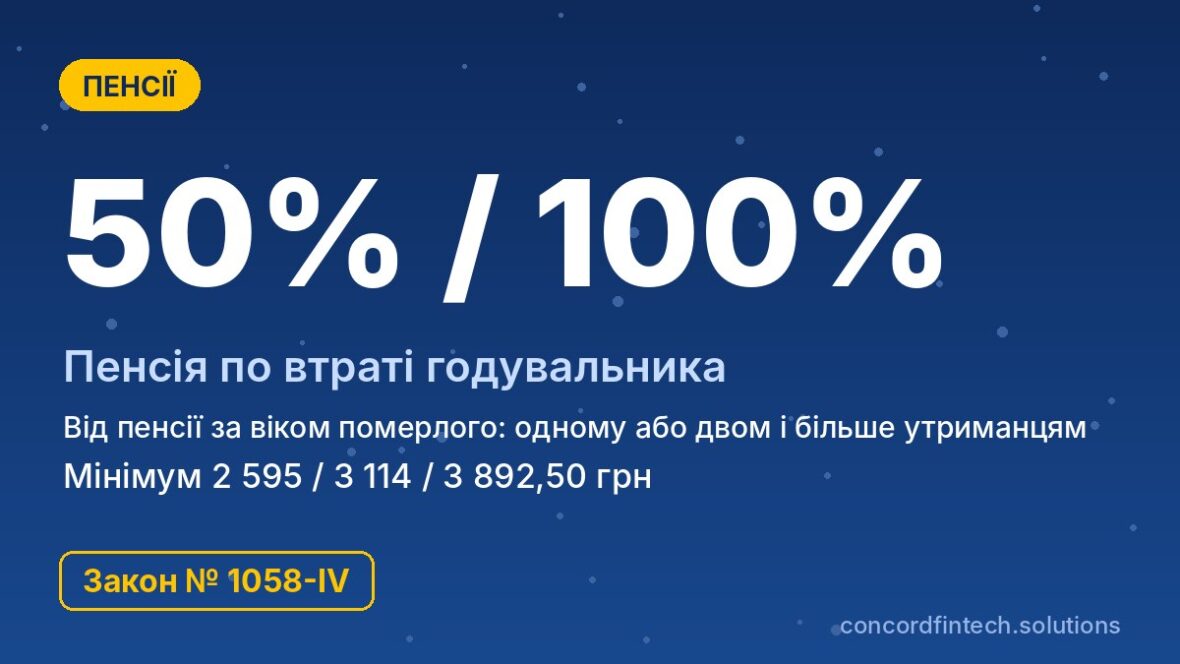
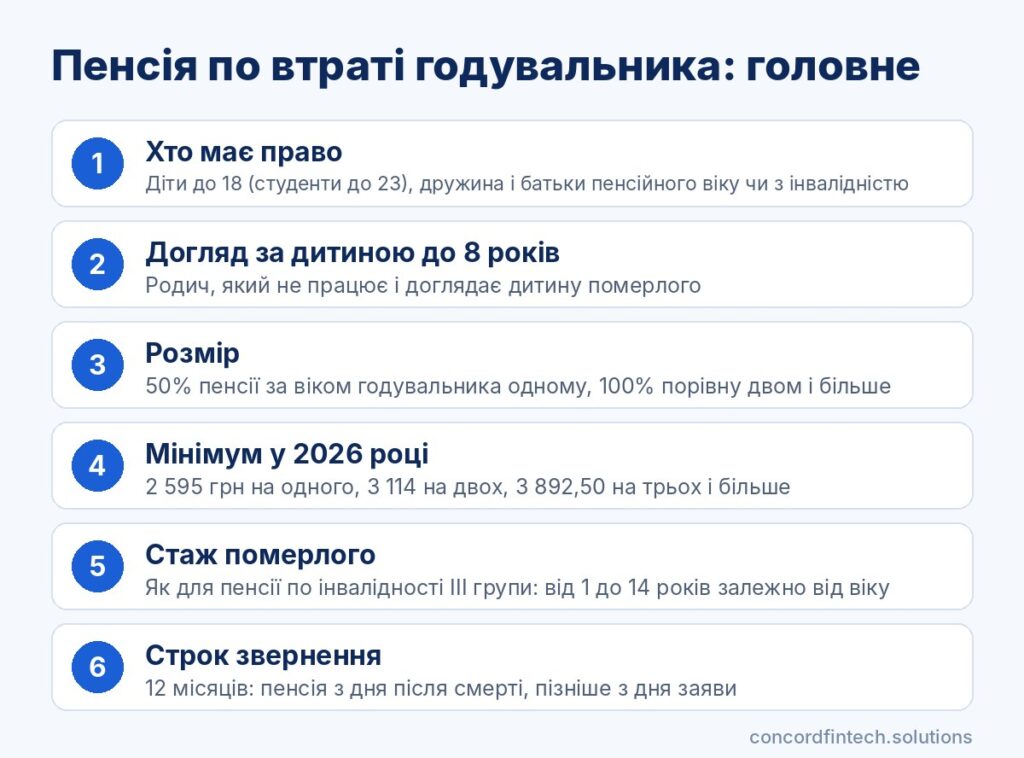
The survivor’s pension is granted to non-working dependants of the deceased who were financially supported by them: children under 18, full-time students up to 23, and a wife (husband) and parents who are of pension age or have a disability. A single dependant receives 50% of the old-age pension the breadwinner had or could have received; two or more dependants share 100% between them equally. The minimum in 2026 is 2 595 UAH for one family member, 3 114 UAH for two and 3 892,50 UAH for three or more.
The key condition concerns the deceased’s insurance record: on the date of death they must have accrued as much insurance service as required for an invalidity (disability) pension of group III at their age. These are rules for civil pensions under Law No. 1058-IV “On Compulsory State Pension Insurance”. For families of killed or missing military personnel a different law applies - Law No. 2262-XII - where the pension is calculated from monetary provision.
Who is entitled to a survivor’s pension
The list of recipients is set out in Article 36 of Law No. 1058-IV. Only non-working members of the family have the right, and this is a legal status: determined by age, disability or caring for a small child.
Children under 18
The deceased’s children receive the pension until age 18 regardless of whether they were formally dependent on them. This includes children born within ten months after the breadwinner’s death, adopted children, stepsons and stepdaughters. Children who became persons with a disability before reaching 18 retain the right after reaching adulthood.
Students up to 23
If the child is studying full time at school, college or university, the payment continues until the end of the course of study but not later than their 23rd birthday. Orphans receive the pension until 23 regardless of whether they study.
Non-working family members
The wife (husband) and parents of the deceased receive a pension if they have a disability or have reached pension age under Article 26 of Law No. 1058-IV. There is a separate ground related to child care: the wife (husband), and if absent one of the parents, a brother, sister, grandfather or grandmother of the deceased is entitled to a pension regardless of age if they are not employed and care for the breadwinner’s child up to 8 years old. Adult relatives, unlike children, must prove they were dependent on the deceased.
Amount of the pension depending on the number of dependants
The amount is determined by Article 37 of Law No. 1058-IV, and the basis for calculation is the deceased’s old-age pension. If the breadwinner was a pensioner, their actual pension is used; if not, the Pension Fund of Ukraine (PFU) calculates the pension as if it had been granted on the date of death, taking account of insurance record and earnings.
One dependant
A single non-working family member is granted 50% of the breadwinner’s old-age pension. If this sum is less than the subsistence minimum for persons who have lost their capacity to work (2 595 UAH in 2026), the difference is covered by monthly state targeted assistance under the Cabinet of Ministers’ resolution No. 265. For example, if the deceased’s pension was 4 000 UAH, the child would receive 2 000 UAH plus a top-up of 595 UAH.
Two dependants
Two or more family members are granted 100% of the breadwinner’s old-age pension, divided equally between them. The guaranteed minimum for two is 120% of the subsistence minimum, or 3 114 UAH. If the deceased’s pension was 8 000 UAH, each would receive 4 000 UAH.
Three or more
For three or more dependants the total amount is also 100% of the breadwinner’s pension, and the minimum increases to 150% of the subsistence minimum, or 3 892,50 UAH. For orphaned children the pension is calculated based on the pension of each parent.
| Number of dependants | Amount | Distribution |
|---|---|---|
| One | 50% of the breadwinner’s old-age pension, not less than 2 595 UAH | The whole amount to one recipient |
| Two | 100% of the breadwinner’s pension, not less than 3 114 UAH | Equally, at least 1 557 UAH each |
| Three or more | 100% of the breadwinner’s pension, not less than 3 892,50 UAH | Equally, for three at least 1 297,50 UAH each |
Requirements for the deceased’s insurance record
The survivor’s pension is an insurance payment, so entitlement depends on the deceased’s insurance record, not the family members’. The requirement is assessed on the date of death.
Service required for entitlement
The breadwinner must have accrued the insurance service required for an invalidity (disability) pension of group III at their age under Article 32 of Law No. 1058-IV. This requirement is significantly less stringent than for an old-age pension and increases with age. Benchmarks are as follows:
- up to and including 23 years: 1 year of service;
- 24-26 years: 2 years; 29-31 years: 4 years;
- 36-37 years: 7 years; 43-45 years: 10 years;
- 52-55 years: 13 years; 56-59 years: 14 years.
If the deceased was already receiving any pension, their length of service is not checked. Service is also not required in cases listed in part 2 of Article 32 (including conscript military service) and when the breadwinner disappeared without trace under special circumstances.
If the required service is lacking
When the insurance record is insufficient, the pension will be denied. However, it is worth first checking whether all periods of service have been counted. Periods before 2004 are confirmed by the employment record book, archival certificates or through court.
Social assistance
Children of a deceased who did not qualify for a pension are entitled to state social assistance under Law No. 1727-IV. Its amount is 100% of the subsistence minimum for persons who have lost capacity to work for one child, 120% for two, and 150% for three or more, and the family’s income is not taken into account. Adult family members may receive social assistance only on general grounds, for example after age 65.
Choosing between one’s own pension and the survivor’s pension
Widows, widowers and elderly parents often already receive their own pension. Receiving two pensions simultaneously in the pay-as-you-go system is not possible, but one may choose the more favourable option.
Right to choose
Article 10 of Law No. 1058-IV provides that a person entitled to several types of pension is granted one of them at their choice. Thus a wife of pension age may keep her own pension or switch to the survivor’s pension.
Calculation
You should compare amounts taking into account other dependants. Suppose a 64-year-old widow receives her own pension of 3 900 UAH, while her husband’s pension was 9 000 UAH. If she is the only dependant, the survivor’s pension would be 4 500 UAH, so switching would be beneficial. If, however, two students also have a claim, the 9 000 UAH would be divided among three at 3 000 UAH each, and her own pension would be higher.
How to change the choice
To switch to another type of pension, submit an application to the Pension Fund of Ukraine (PFU) in person or online. The new pension is usually paid from the first day of the month after submission of the application with all documents, so it is advisable not to delay.
Documents and submitting an application
The application is submitted at any PFU service centre, via the web portal of electronic services or the Diia portal. If you apply within 12 months from the date of death, the pension is granted from the day following the breadwinner’s death; if you apply later, it is granted from the date of application.
Death certificate
The primary document is the breadwinner’s death certificate or a court decision recognising them as missing or declaring them dead. For those missing without trace under special circumstances, instead of a court decision provide an extract from the Unified Register of such persons.
Documents proving dependency
Children do not need to prove dependency. Adult family members must provide evidence that the deceased’s support was their main source of livelihood; the full package looks as follows:
- application for pension award;
- passport or birth certificate of the applicant, RNOKPP (tax identification number) of the applicant and of the deceased;
- death certificate or court decision, documents proving family ties;
- certificate of the deceased’s household composition (if available) and documents proving dependency;
- documents on periods of service where there is no employment record book or records are incomplete;
- certificate of childcare for a child under 8 years old if the pension is claimed by a relative who is the carer.
Certificate from the educational institution
Students aged 18 to 23 must submit a certificate proving full-time enrolment with the expected completion date; without it payments after the 18th birthday are suspended. A new certificate must be provided if the student enrols in another institution or changes the form of study.
Grounds for suspension and resumption of payments
The pension is paid as long as the family member is considered non-working under Article 36 of Law No. 1058-IV. For those who have reached pension age, it is granted for life.
Reaching the age limit
A child’s pension is stopped after 18 if they are not studying full time, and a student’s when studies end or at 23, whichever comes first. When one of several dependants loses the right, the share is not lost: the 100% of the breadwinner’s pension is redistributed among the rest. If only one dependant remains, the amount is reduced to 50%, but not below the minimum of 2 595 UAH.
Employment
According to PFU guidance, a full-time student’s employment does not affect their right to a pension until age 23. The situation is different for the relative caring for a child under 8: if they take up employment or the child reaches 8, the right ceases. Such changes must be reported to the Pension Fund, otherwise overpayments must be repaid.
Resumption
Payments are retained between finishing school and entering higher education if the gap does not exceed four months. If a child under 23 returns to full-time study, the pension is resumed upon application and submission of a new certificate.
Common mistakes when applying
Families most often lose money because of missed deadlines and incomplete documents. Both mistakes are easily avoided.
Missing the 12-month deadline
If you apply later than a year after the death, the pension will be granted only from the date of the application and payments for past months will not be recovered. Therefore it is better to submit the application immediately and provide service certificates later.
Uncounted service of the deceased
Families often do not know where the breadwinner worked before 2004 and accept a refusal. It is worth requesting individual records about the insured person from the PFU (form OK-5) and checking enterprise archives. For queries you can contact the Pension Fund hotline at 0 800 503 753.
Frequently asked questions
Does a student receive the pension after 23?
No, after 23 the right to a survivor’s pension ceases even if studies continue. The exception is for those who became persons with a disability before age 18.
Can you receive two pensions?
Under Law No. 1058-IV no - only one pension is granted at the recipient’s choice. However, you can compare your own pension with the survivor’s pension and switch to the more favourable option at any time by application.
What if the breadwinner had no insurance record?
In that case children are awarded state social assistance equal to 100-150% of the subsistence minimum regardless of family income. Adult family members should check whether additional service of the deceased can be confirmed by archival documents.