


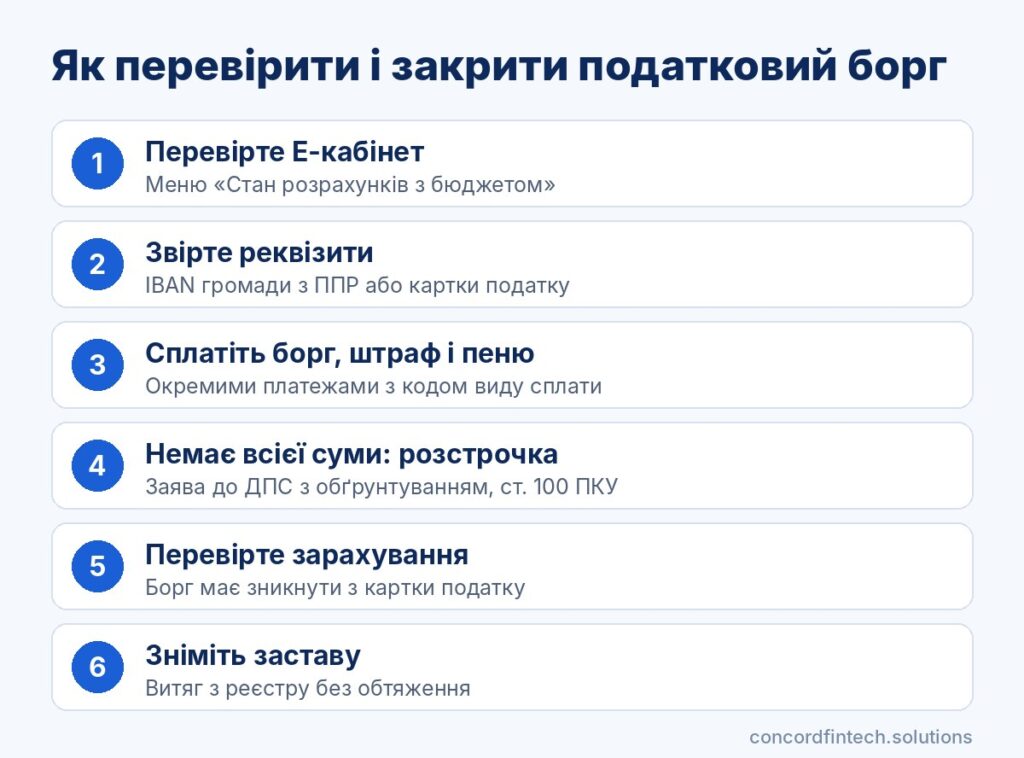
An individual can check their tax debt independently in the Electronic Cabinet of the Taxpayer, in the “Status of settlements with the budget” menu, or by written request to the State Tax Service (DPS) at their place of residence. If a debt exists, it is paid using the details shown in the cabinet or in the tax notice-decision (PPR); after payment the tax authority withdraws the demand and removes the tax lien from the property. For those who cannot pay the full amount at once, Article 100 of the Tax Code of Ukraine (TCU) allows an application for an instalment plan or deferment.
How to check whether a tax debt exists
Electronic Cabinet: the “Status of settlements with the budget” section
The most accurate information is shown in the private section of the Electronic Cabinet. You can sign in with a qualified electronic signature, Diia.Signature or BankID, and assessments, payments and debts are visible by each tax there. The steps are as follows:
- sign in to the private section of the cabinet with any available key;
- open the “Status of settlements with the budget” menu and select the required year;
- review the tax cards: property tax, land fee, personal income tax (PIT) and the military levy;
- pay attention to the debt column, accrued penalty interest and fines;
- in the “Incoming/Outgoing documents” section check whether a tax notice-decision (PPR) or a tax demand has been issued;
- for discrepancies write to the State Tax Service (DPS) via “Correspondence with the DPS”.
Data in the cabinet are updated with a delay, so a payment made just now may appear only after a few days. Therefore keep the payment receipt until the payment is shown in the records.
Check via Diia
As of mid-October 2026 there is no separate tax service for citizens in Diia, although the DPS and the Ministry of Digital Transformation announced its development. Diia.Signature can only be used to log in to the Electronic Cabinet.
Diia shows a different type of debt: those already transferred to the enforcement service and entered in the Unified Register of Debtors. If a tax debt appears there, it means the tax authority has already won in court and enforcement proceedings have been opened.
Request to the DPS at your place of residence
Those without an electronic key can submit a written application to the tax office at their place of registration or visit a taxpayer service centre. Bring your passport and taxpayer registration number (RNOKPP); the response on the status of settlements is provided within the statutory response times.
Where an individual’s tax debt comes from
Unpaid tax notice-decisions (PPR) for property and land
Property tax and the land fee for citizens are calculated by the tax authority itself, and tax notice-decisions (PPR) for 2025 should have been received by owners by 1 July 2026. Sixty days are granted for payment from the date of delivery of the notice, and if that period has passed the amount becomes a debt. The most common reasons for a debt are:
- the tax was paid with an incorrect IBAN, payment code or RNOKPP;
- the property was sold but the tax authority has not yet received data on the new owner;
- the assessment was issued for inherited property that has not yet been formalised;
- a declared tax was not paid by 1 August.
Not receiving the notice does not absolve the obligation to pay if the PPR is considered delivered under the law. If the amount in a PPR is incorrect, it should be disputed before it becomes agreed.
Unpaid declared tax
Anyone who submits a declaration of property status and income pays PIT and the military levy themselves by 1 August of the following year. For 2026 income the last convenient day to pay is 31 July 2027 because 1 August falls on a Sunday.
Fines and penalty interest
For late payment of an agreed liability paragraph 126.1 of the Tax Code of Ukraine provides a fine of 5% for delay up to 30 days and 10% for delay over 30 days. After 90 days of arrears penalty interest is charged at 100% of the discount rate of the National Bank of Ukraine (NBU) per annum, and the rate as of mid-October 2026 is 16%.
How to pay a debt and check allocation
Payment details
Accounts are opened separately for each community and for each tax, so use the payment details from the PPR, the tax demand or from the tax card in the cabinet. Fines and penalty interest are paid as separate payments.
From 1 July to 31 December 2026 the military levy is paid only to new accounts opened after budget changes under Law No. 4908-IX. Accounts for PIT and property taxes have not changed, but verify them in the cabinet before payment.
Payment through the bank and the Electronic Cabinet
In the cabinet you can pay the debt by card directly from the tax card, and the details are filled in automatically. In banking apps payments are made in the budget payments section by entering the IBAN from the PPR or by scanning a QR code, if present.
Checking allocation
A few working days after payment check the tax card in the cabinet. The debt should be reduced by the amount paid, and if not, submit a statement via “Correspondence with the DPS” with a copy of the receipt.
Instalments and deferment of tax debt
Who is entitled to an instalment plan or deferment
Any taxpayer has the right to request instalment or deferment, including an individual who is not an individual entrepreneur (FOP). An instalment plan splits the debt into equal monthly payments, while a deferment postpones payment to a later date.
The main condition under Article 100 of the Tax Code of Ukraine is that the person must demonstrate temporary financial difficulties and a realistic ability to repay the debt according to the schedule. Interest on the instalment amount is charged at 120% of the discount rate of the National Bank of Ukraine (NBU), that is about 19.2% per annum at a rate of 16%.
Application and documents on financial situation
The application is submitted to the tax office at the place of registration, including via “Correspondence with the DPS” in the cabinet with a PDF file up to 5 MB. It should include an economic justification: a description of the circumstances that prevented payment, income data, a repayment schedule and a forecast of receipts that guarantee it.
Maximum terms and payment schedule
Typically an instalment plan is granted within a single budget year, and the territorial tax office decides. If the schedule extends beyond the year, the decision is made by the State Tax Service (DPS) of Ukraine. If a payment under the schedule is missed the agreement may be terminated and the remainder of the debt collected.
Tax lien and other encumbrances
When the tax authority gets the right to a tax lien
Under Article 89 of the Tax Code of Ukraine the right to a tax lien on a declared but unpaid tax arises from the day following the last day of the payment deadline. For amounts assessed by the tax authority it arises from the day the tax debt appears, and also on conclusion of an instalment agreement.
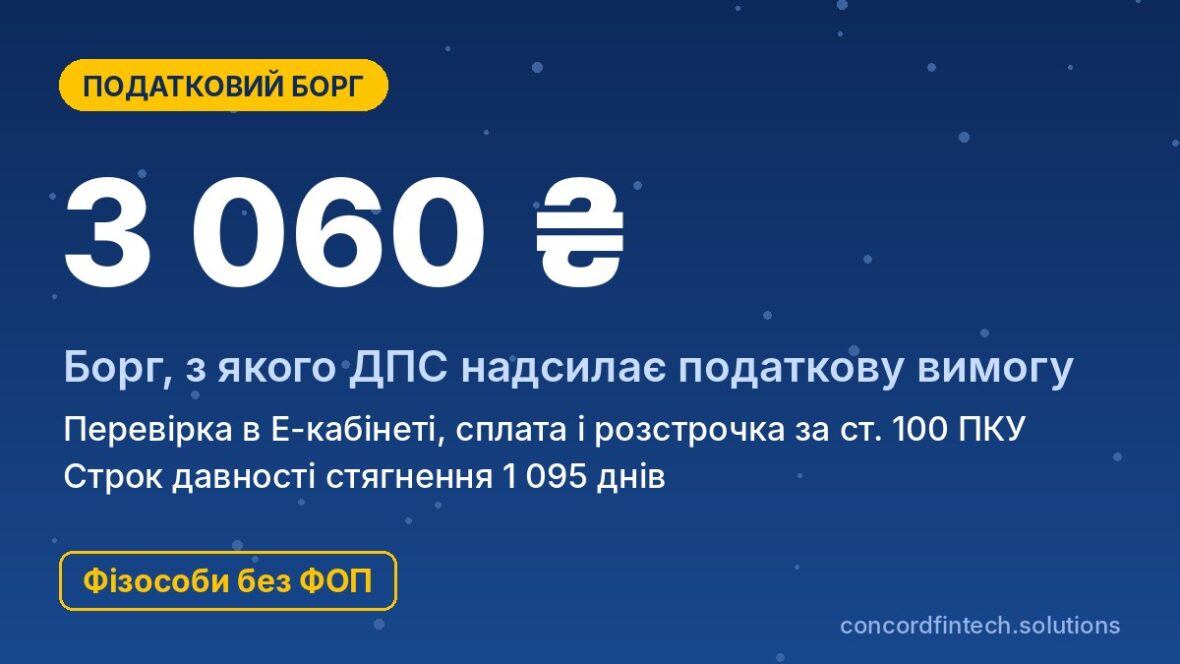
If the debt exceeds 3 060 UAH, i.e. 180 non-taxable minimums, the DPS sends a tax demand. It specifies the amount, the right of lien and a warning about possible inventorying of assets.
Inventorying assets and prohibition on disposal
By order of the head of the tax office an inventory act of assets is drawn up, which includes only liquid assets sufficient to repay the debt. If the debtor refuses to sign the act, the inventory is carried out in the presence of two witnesses.
The lien is registered in state registers: for movable property in the register of encumbrances and for immovable property in the State Register of Property Rights. After that a notary will not certify a sale or gift of such property until the encumbrance is removed.
How to lift the lien after paying the debt
After full payment of the debt together with fines and penalty interest the tax demand is withdrawn, the lien decision loses force and the property is released from the lien. The removal of the entry in the register is initiated by the DPS itself after the payment is reflected in its records.
If after several weeks the encumbrance still appears in the register, submit an application to the tax office with copies of the receipts and ask them to send a document confirming termination of the lien. Before a real estate transaction order a fresh extract from the register.
Consequences of debt: travel abroad and enforcement
Enforcement through the courts
The tax authority can only withdraw funds from accounts or sell an individual’s property by a court decision. After the decision the debt is enforced by the State Enforcement Service, which can freeze accounts. From a frozen account the person may spend up to two minimum wages per month, that is 17 294 UAH in 2026.
Restriction on leaving the country
The tax authority cannot itself ban travel abroad because of a debt. A temporary travel restriction can be imposed only by a court decision, at the request submitted by an enforcement officer within the enforcement proceedings if the debtor evades compliance with the decision.
Limitation period of 1 095 days
Under Article 102 of the Tax Code of Ukraine a tax debt can be collected for 1 095 days from the date it arises, after which it is considered hopeless and subject to write-off. However, if the tax authority applied to the court before the expiry of the period, the debt is collected by court decision.
During quarantine and martial law time limits under the TCU were partially suspended, so do not rely on automatic write-off of old debts. The consequences of debt are summarised in the table.
| Amount / term | Consequence | How to avoid |
|---|---|---|
| Delay in payment up to 30 days | Fine of 5% of the amount (p. 126.1 TCU) | Pay by the deadline |
| Delay over 30 days | Fine of 10% of the amount | Pay or dispute the PPR in time |
| Over 90 days | Penalty interest at 100% of the National Bank of Ukraine (NBU) discount rate per annum | Repay the debt or arrange an instalment plan |
| Debt over 3 060 UAH | Tax demand, lien, inventorying of assets | Pay after demand, remove the lien |
| Non-payment after demand | Court, State Enforcement Service, account arrest, possible travel restriction | Instalment plan under Article 100 of the TCU |
Common mistakes when repaying tax debt
Paying to the wrong account
The most frequent mistake is paying to another community’s account or to an old military levy account. In that case the debt remains while the paid amount is recorded as an overpayment that must be reallocated by application.
Ignoring a PPR and a tax demand
If the amount in a PPR seems incorrect, simply not paying it is not enough. You must submit a reconciliation request or complaint within the established time, otherwise the amount becomes agreed and fines will be applied.
Frequently asked questions
Can travel abroad be banned because of tax debt?
The tax authority itself cannot impose such a ban. A restriction is possible only by court decision at the request of an enforcement officer when the debtor evades payment.
How can I find out about a debt if I did not receive a bill?
Open the “Status of settlements with the budget” menu in the Electronic Cabinet or submit a request to the tax office at your place of residence. The cabinet shows all sent PPRs and tax demands.
Is a debt written off after 3 years?
A debt that the tax authority has not collected within 1 095 days becomes hopeless and is written off. However, if the DPS applied to the court in time, and because time limits were suspended during quarantine and martial law, do not count on write-off.
How to lift a tax lien after payment?
After full repayment the tax authority withdraws the demand and initiates removal of the entry in the register. If the encumbrance remains, submit an application with copies of the receipts to your tax office and, after removal, order a fresh extract from the register.