

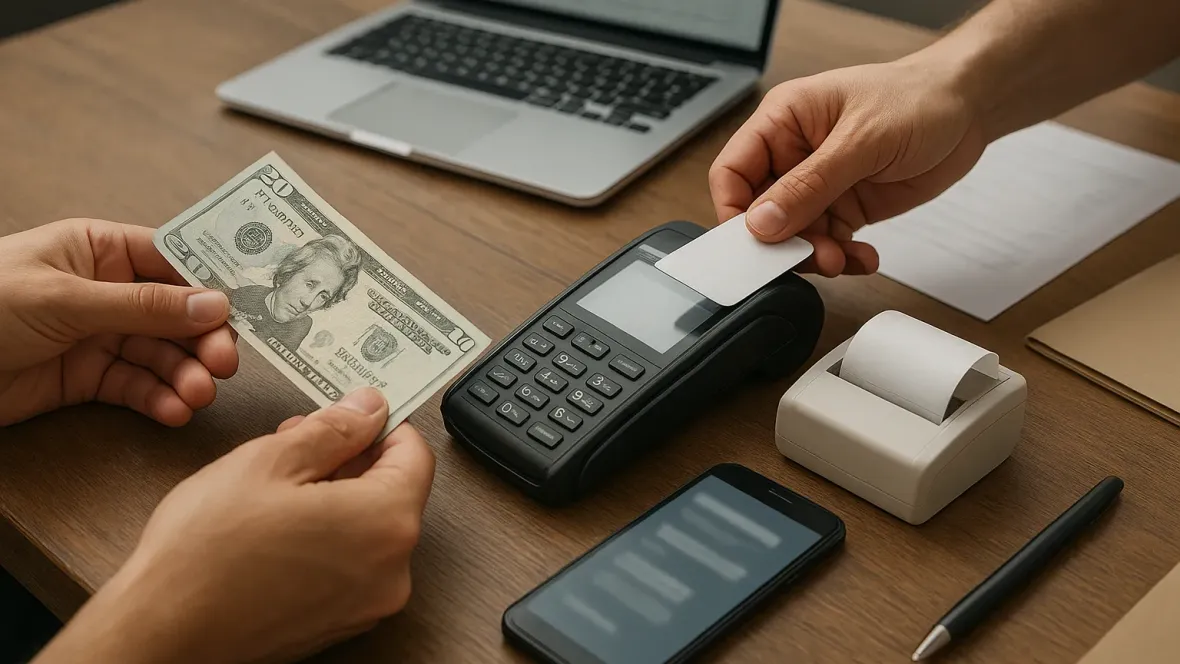
An individual entrepreneur (FOP) in the second group who provides services generally needs an RRO or PRRO if clients pay in cash or by card via a terminal. If a client makes a bank transfer by IBAN to the business account, a fiscal receipt is not required for that payment. There is a separate exception for payments made via a payment link if all payments for services are processed exclusively through the remote services specified by law. For standard annual reporting, the declaration for 2026 must be filed by 1 March 2027 inclusive.
| How the client pays for the service | Is an RRO or PRRO required |
|---|---|
| Gives cash to the practitioner or receptionist | Yes, as a general rule |
| Taps a card or phone on a POS terminal | Yes, as a general rule |
| Transfers funds to the FOP’s account by IBAN via a banking app | No |
| Scans a QR code that supplies the FOP’s IBAN for a bank transfer | No |
| Pays for the service via a payment link | Can operate without an RRO if all payments for services are accepted exclusively through bank remote-service systems and/or money‑transfer services |
How to check whether you must issue a fiscal receipt
An RRO is a registrar of settlement transactions (RRO), and a PRRO is its software version (PRRO). Either is sufficient to fiscalise a payment. The obligation to issue a receipt depends on the payment method and whether a statutory exception applies to that method.
How to accept payment by IBAN
Give the client the full details of your current account. For example, a tutor issues an invoice for 800 UAH, and the client in Privat24 chooses “payment by details” and enters the IBAN. The tutor checks the incoming payment in the statement and recognises 800 UAH as income. She does not generate a fiscal receipt for that transfer.
A QR code works the same way if, after scanning, the client sees the IBAN details for a transfer. If the code opens a card‑payment page, check the rules of that payment service.
Can you accept payments via WayForPay without a cash register?
Clause 14 of Article 9 of Law No. 265 allows not using an RRO or PRRO if all payments for services are processed exclusively through bank remote‑service systems and/or money‑transfer services. If clients pay for consultations via WayForPay, check exactly how the service processes payments under your contract.
If you also accept cash or card payments via a POS terminal for the same services, the condition of exclusively remote payments is not met. In that case cash and card settlement operations, including those via a payment link, must be fiscalised under the general rules. Direct IBAN transfers may still be accepted without a fiscal receipt.
How to take payment when you sell goods together with a service
A salon can accept a direct IBAN transfer for a haircut and sell a shampoo via a POS terminal with a fiscal receipt. If the client pays for the haircut and shampoo in a single card transaction on the terminal, process the entire amount through the cash register. The exception for service payments via remote services does not apply to the sale of goods.
Can you work without a cash register if you provide household services in a village?
There is a separate exception for household services in a village or settlement, such as shoe repair or appliance repair. Under clause 11 of the list approved by Cabinet Resolution No. 1336, settlements may be made without an RRO or PRRO if you use a registered cashbook and a book of settlement operations.
How to keep records if clients pay in different ways
Record income received at the end of each month. Reconcile the bank statement, payment‑service data and cash reports. If a card payment is already included in the cash report, its subsequent crediting by the bank to the account does not create a second income entry.
Suppose a workshop received three payments for repairs in one day. For the example all funds were credited the same day, with no fees or refunds.
| Payment at the workshop | Amount | Included in the Z‑report | Included in the FOP’s income |
|---|---|---|---|
| Cash for repair | 600 UAH | 600 UAH | 600 UAH |
| Card via terminal | 900 UAH | 900 UAH | 900 UAH |
| Direct transfer by IBAN | 1 200 UAH | - | 1 200 UAH |
| Total | 2 700 UAH | 1 500 UAH | 2 700 UAH |
How to register a PRRO and close a cash shift
You can use the free PRRO of the State Tax Service (DPS). If the business unit has not yet been registered, submit Form No. 20‑OPP. Then, via the Electronic Cabinet of the State Tax Service (DPS), submit application No. 1‑PRRO and report the certificates of keys that will be used in the cash register using Form No. 5‑PRRO. Register the cash register before the first payment that must be fiscalised.
When to generate the Z‑report?
On any day when settlement operations are conducted, generate the Z‑report when closing the shift. The PRRO sends it to the fiscal server of the State Tax Service (DPS). Issue the fiscal receipt for an individual payment to the client either on paper or electronically.
Do you have to submit ZVR‑1 every month?
In normal operation of an RRO or PRRO, when data is transmitted to the State Tax Service (DPS) electronically, a separate monthly ZVR‑1 is not required. That form relates to statutory cases of using books of settlement operations and cashbooks. If there is an obligation to submit ZVR‑1, the general deadline is no later than the 15th day of the following month.
Which reports does a second‑group FOP file for 2026?
If during the year you received funds only by IBAN, you still need to report that income in the declaration. The annual turnover limit for the second group in 2026 is 7 211 598 UAH. On this group you may provide services to the public and to single‑tax payers. If the contract specifies the client as a company on the general tax system, that contract does not meet the conditions of the second group even if payments are made by IBAN.
| Document | Who files it | When to file |
|---|---|---|
| Single‑tax payer declaration | Second‑group FOP under standard annual reporting | For 2026 - by 1 March 2027 inclusive |
| Appendix 1 on the single social contribution (ESV) for oneself | FOP who must report their own ESV | Together with the declaration |
| Consolidated calculation of personal income tax (PIT), military levy and ESV | FOP who must report as a tax agent, including for employed staff | Within 40 calendar days after the end of the quarter |
If there was no income during the year but you were charged advance payments of the single tax or the military levy, these must still be shown in the declaration. If you exceeded the limit, moved to the third group or withdrew from the simplified system, the declaration deadlines follow the quarterly period rules.
If you are lawfully exempt from paying ESV for yourself for the whole reporting year, Appendix 1 is generally not submitted. For example, this applies where an employer paid at least the minimum insurance contribution on the individual’s behalf for all months.
How to file the declaration via the Electronic Cabinet of the State Tax Service (DPS)
- Log in with a qualified electronic signature. In the “Submission of reports” section select 2026, the annual period and form F0103407.
- Enter the income received and the accrued advance payments of the single tax and the military levy. If necessary, add Appendix 1 on ESV for yourself.
- Check and sign the declaration and the appendix if you are submitting it. Send the report and check receipt No. 2. It should state that the declaration has been accepted. If it was rejected, correct the indicated errors and submit the report again.