


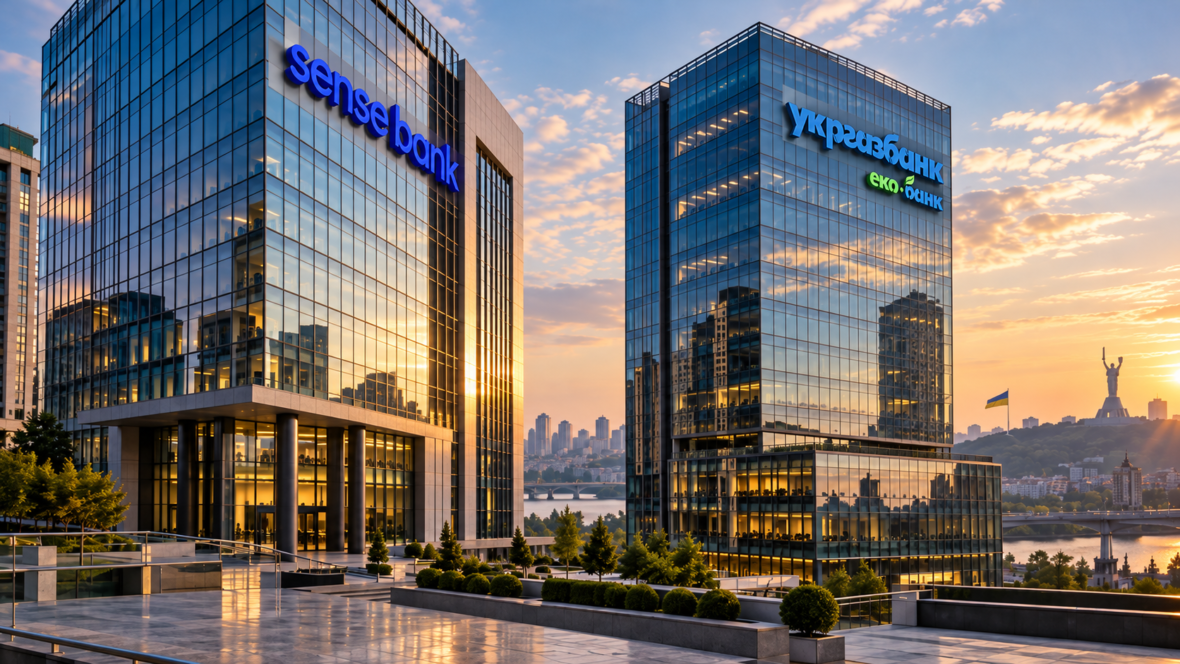
The state is preparing to hand two large banks over to private owners — Sens Bank and Ukrgasbank. The government has already set up a special commission for this, and the Ministry of Finance (Minfin) said advisors for the transactions have been selected. But the most interesting question remains unanswered: who will dare to buy a Ukrainian bank in the middle of a war?
Investment banker and FinPoint co‑founder Serhiy Budkin believes the most realistic buyers are large international banking groups. But it will not be easy. Some European banks are not planning to expand in Ukraine, and requirements for future owners of state assets will be strict.
How the state is preparing the sale
New commission
On 18 October 2026 the Cabinet of Ministers (Cabmin) announced the creation of a commission to sell the state share packages in both banks. This is another step in the privatisation the government officially launched in autumn 2025.
The commission will organise tenders, decide who is allowed to participate and agree the starting price. The government will have the final say on the winner and the price. Representatives of international financial organisations and EU institutions may join the work.
Advisors already appointed
Minfin has confirmed that advisors for the sale of both banks have already been chosen. They will value the assets, look for investors and support the transactions through to completion.
When they might be sold
In August 2026 the government said it wanted to start the sale itself in 2027. But preparations are already under way in full.
As early as 31 March the Ministry of Finance announced a tender for an international financial adviser, who, under the initial terms, was to support the process until 1 March 2029. That does not mean the banks will be sold on that date. The date refers to the advisory period; when ownership changes will depend on the tender, approvals and investor readiness.
Who could realistically buy them
Large international groups
Budkin believes buyers should first be sought among large banking groups. They have the capital, experience of running banks and a chance to pass regulator checks.
But size does not automatically mean an interest in Ukraine. The main question is whether the new bank fits into a group’s long‑term strategy. Budkin therefore sees as more promising those institutions already operating in Central and Eastern Europe or seeking to strengthen their presence there.
Experience selling Bank Lviv
Budkin draws his conclusions from his own experience. When he was looking for a buyer for Bank Lviv, he spoke with many European and Asian groups. It turned out that most banks from Northern and Western Europe are not even considering large investments in Ukraine at the moment.
Which European banks might be interested
Market reshuffle
Banks in Europe are actively reshuffling assets. Some are winding down their foreign presence, others are buying banks in neighbouring countries.
As an example, Budkin pointed to the deal where Austria’s Erste is buying Santander’s Polish business. For Erste, Central and Eastern Europe is a priority, and such groups, he believes, are more likely to be interested in new assets in the region.
No official bidders yet
However, that does not mean Erste or anyone else has already filed an application for Sens Bank or Ukrgasbank. There is no official list of bidders yet.
Why investors are cautious
Buying is more than one payment
The war, of course, is the main deterrent. Buying a bank is not just a one‑off payment. The new owner must assess how much the bank will earn, how risky the loans are, how much additional capital will be needed and whether there is room for growth.
Investors weigh wartime risks to the economy, the quality of the loan portfolio and potential losses from non‑performing loans. They look at capital adequacy, prospects for lending to businesses and individuals, regulatory procedures and whether the purchase price can be recouped.
But interest is possible
For groups already operating in the region, a Ukrainian bank can be an attractive long‑term move. The final decision will depend on the metrics of a specific institution and the terms of sale.
A Russian footprint could rule out buyers
Not everyone managed to leave Russia
Budkin separately drew attention to foreign groups that still have business in Russia. After the invasion some European banks tried to exit — some scaled back operations, others began selling subsidiaries.
But not everyone managed to complete their exit, in particular because of obstacles from Russian authorities.
A dilemma for the state
So Ukraine will have to decide how to take this factor into account during privatisation. If the eligibility rules are too strict, the number of prospective buyers could fall significantly.
What checks the new owner will undergo
Not an ordinary company
Buying a large bank is much more complicated than acquiring any other business. A bank holds people’s deposits, companies’ funds and payment infrastructure, so buyers are scrutinised closely.
As Budkin recalled, an investor will have to obtain approvals from the Anti‑Monopoly Committee of Ukraine (AMCU) and the banking regulator. When state banks are sold, the government and international partners will also play a role.
More than price
The buyer must prove financial capacity and compliance with requirements. They will check the source of funds, ownership structure, reputation, financial condition and the ability to ensure the bank’s stable operation, as well as how the deal will affect competition.
So the winner will not automatically be the highest bidder. The state and regulators must be convinced that the deal can actually be completed and that the new owner meets all requirements.
How much they might sell for
No price yet
As of 20 October 2026 the starting price for the banks’ shares has not been announced. It will be determined during tender preparation taking advisors’ recommendations into account.
The price depends on assets, capital, profitability, the loan portfolio, the client base and forecasts. A buyer is interested not only in the bank’s current condition but also in how much it will need to invest and how quickly the business can be scaled.
Competition drives up the price
Budkin emphasised that the more strong participants compete for a bank, the better the offer the state may receive. If the pool of buyers is restricted too much, there will be fewer bids and that will hit the price. Therefore the tender rules must combine requirements for investor reliability with genuine competition.
Why the state is selling banks
Less state in the banking system
The sale of Sens Bank and Ukrgasbank is part of a policy under which the state gradually reduces its presence in the banking sector. Minfin names budget revenues, greater competition and sounder bank operations among the goals.
Already in August 2025 the Council on Financial Stability supported preparing these banks for sale. In its view, if procedures are followed, system stability will not be harmed.
Systemically important banks
Sens Bank became state‑owned in 2023 after nationalisation, while Ukrgasbank has been under state control for much longer. Both are systemically important, so regulators will watch ownership changes especially closely.
What this means for clients
Banks operate as usual
News of a sale may alarm depositors and borrowers. But preparations for privatisation do not stop the banks’ operations. Until the deal is completed they will continue to serve clients under existing contracts.
A new shareholder does not cancel loans and deposits. The bank remains a party to agreements and all obligations to clients are preserved.
Changes possible later
In the future a new owner may change strategy, develop digital services, update products or downsize the branch network. But those are decisions for the specific buyer. For now, there is no need to re‑register accounts because of the sale news.
Next steps in privatisation
Next will be valuation of the state share packages, preparation of tender documentation, investor search and participant checks. After receiving proposals the commission will select winners and submit decisions for Cabmin approval, and deal completion will depend on regulatory clearances.
As of 20 October both banks remain state‑owned. Who will become the new owner, for how much and when is still unknown. But in Budkin’s view, the greatest chances are held by international banking groups for whom Central and Eastern Europe is a strategic market.
| Criterion | Sens Bank | Ukrgasbank |
|---|---|---|
| Form of ownership | State bank | State bank |
| Taken under state control | 2023 | 2009 |
| Privatisation status | Preparing for sale | Preparing for sale |
| Potential buyers | International banking groups | International banking groups |
| Starting sale price | Not announced | Not announced |
| Possible start of sale | 2027 | 2027 |
| Deal completion date | Not determined | Not determined |