


The size of the housing subsidy in 2026 is determined by a simple principle: the state pays the difference between the cost of housing and communal services within the social norms and the household’s compulsory payment. The compulsory payment depends on the income per person, which is compared with the subsistence minimum of 3 209 UAH, effective from 1 January 2026.
For the 2026–2027 heating season authorities use the average monthly incomes for Q1 and Q2 2026. Below we explain the components of the formula, the norms that apply and roughly how much four example households would receive.
The subsidy calculation in plain language
Cost of utilities within social norms
The first part of the calculation is the amount the household would pay for services if it consumed them within the state-established norms. If actual floor area or consumption exceeds the norm, the excess is not covered by the subsidy. If the area is smaller, the actual area is used, since the bill is calculated on that.
The household’s compulsory payment
The second part is the amount the family pays itself regardless of the subsidy. It is calculated as a percentage of the household’s total average monthly income. The higher the income per person, the higher that percentage.
How the final subsidy amount is obtained
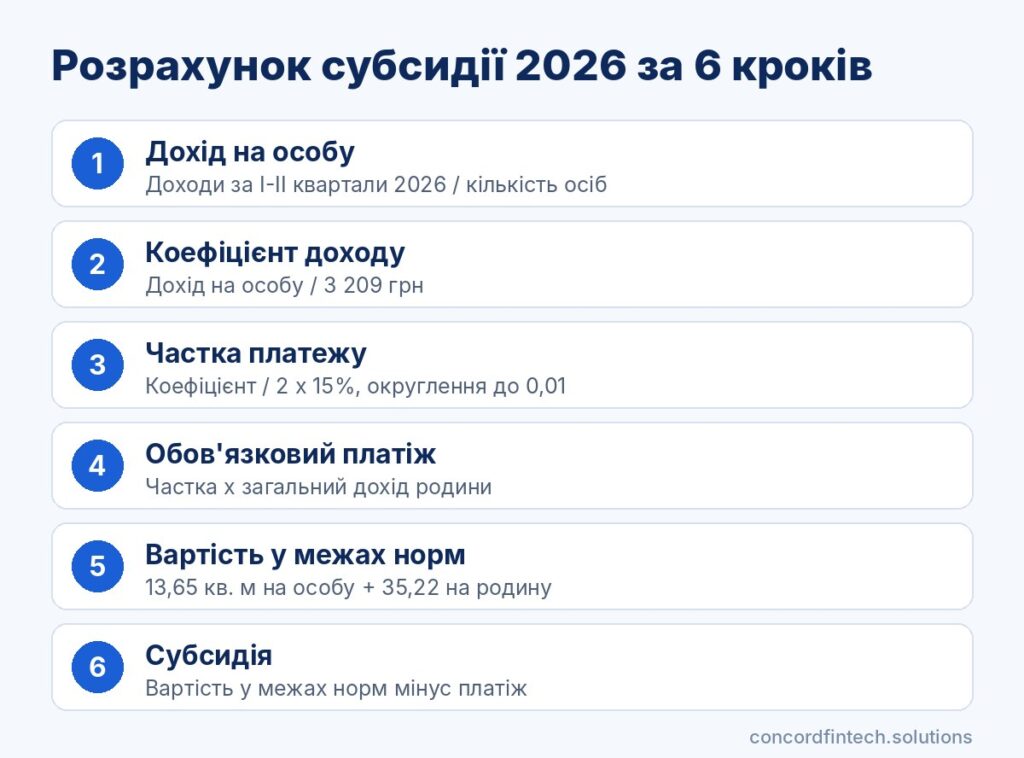
You can estimate your subsidy using the same logic the Pension Fund of Ukraine (PFU) uses. The calculation consists of several sequential steps:
- Determine the household composition and sum the incomes of all its members for the calculation period.
- Divide the total income by the number of people to get the average monthly income per person.
- Compare that income with the subsistence minimum and determine the percentage of the compulsory payment.
- Multiply the percentage by the household’s total income to get the compulsory payment in UAH.
- Calculate the cost of services within the social norms and subtract the compulsory payment from it.
If the compulsory payment is greater than the cost of services within the norms, the subsidy is 0.00 UAH. Such a “zero” subsidy preserves the right to assistance, and in winter, when heating bills increase, the amount often becomes non-zero.
Which incomes are taken into account in 2026
Incomes for Q1–Q2 2026
For the 2026–2027 heating season the Pension Fund of Ukraine (PFU) takes the household’s average monthly total income for Q1 and Q2 2026, i.e. for January through June. This rule applies both to automatic recalculations and to new applications submitted in autumn. The total sum for the six months is divided by six and then by the number of household members.
Pensions for August for pensioners
Pensions are not counted over half a year but as the amount accrued for a specific month. According to the Pension Fund of Ukraine’s announcement, when recalculating in October for the 2026–2027 heating season the pension is taken at the amount accrued for August 2026. Thus the pension included in the calculation reflects all adjustments made up to August.
Payments that are not included in income
Most regular receipts are included in total income, while some payments are explicitly excluded by law. The main guidelines are:
- wages, pensions, scholarships, social benefits, unemployment benefits and alimony are included;
- military pay is included after deduction of the military levy;
- income from land or property rent, dividends and money transfers from abroad are included;
- social scholarships for orphans and children deprived of parental care are not included;
- the housing rental subsidy for internally displaced persons is not included;
- a one-off payment “Winter Support” of 19 400 UAH does not affect the calculation, as it is received after the calculation period.
There is a separate rule for able-bodied household members. If an adult had no official income, earned less than the minimum wage (8 647 UAH in 2026) and no Unified Social Contribution (USC) was paid for them at least in the minimum amount, the subsidy may be denied except in cases specified by the Regulation.
Social norms for area and consumption
Area norm per person and per household
The norms are established by Cabinet of Ministers of Ukraine (CMU) resolution No. 409 of 6 August 2014. For heating and building management the norm is 13.65 sq. m per person plus 35.22 sq. m per household. That means 48.87 sq. m for one person, 62.52 sq. m for two, 76.17 sq. m for three and 89.82 sq. m for four.
Norms for gas, electricity and heat
According to the Government Contact Centre, consumption norms are applied in the following volumes. The heating calculation period runs from 16 October to 15 April inclusive.
| Service | Social norm | Note |
|---|---|---|
| Centralised heating | 0.0383 Gcal per 1 sq. m per month | Only in the heating period |
| Gas for individual heating | 4 cu. m per 1 sq. m per month | Only in the heating period |
| Electric heating | 30 kWh per 1 sq. m per month | Only in the heating period |
| Gas for cooking | 3.3–10.5 cu. m per person per month | Depends on hot water and the gas water heater |
| Electricity | 70 kWh plus 30 kWh for each additional person | Without an electric cooker no more than 190 kWh |
| Cold and hot water | 2 and 1.6 cu. m per person per month | Without hot water: 3.6 cu. m cold water |
| Sewage | 3.6 cu. m per person per month | Where centralised sewerage is available |
Particulars for buildings with individual heating
In private houses and flats with an individual boiler the norm is calculated per square metre of heated area, but only within the area norm. So for a married couple in a 70 sq. m house gas for heating will be considered only for 62.52 sq. m. For flats with individual heating a small share for heating common areas is added to the norm with a coefficient of 0.1.
How the compulsory payment is determined
Income per person and the subsistence minimum
The formula is set out in CMU resolution No. 1156, and the procedure for granting subsidies is defined by the Regulation approved by CMU resolution No. 848. First a income coefficient is calculated: the average monthly income per person is divided by the subsistence minimum. According to the PFU clarification, the subsistence minimum per person established on 1 January of the year the subsidy is granted is used; for 2026 it is 3 209 UAH.
The coefficient is then divided by 2, i.e. by the base coefficient, and multiplied by the base rate of 15%. The result is rounded to two decimal places and multiplied by the household’s total income.
How the share changes depending on income level
There are no separate thresholds or “steps” in the formula, and the share rises steadily as income increases. If income per person equals two subsistence minimums, i.e. 6 418 UAH, the family pays exactly 15% of its income. At one minimum the share is 7.5%, and at three minimums it reaches 22.5%.
The compulsory payment for pensioners and non-working people
There is no separate formula for pensioners, but small pensions automatically produce a low percentage. For example, with a pension of 4 500 UAH the share is 10.52%, so the person pays only 473.40 UAH per month. For able-bodied household members without income the minimum wage or USC payment requirement described above applies.
Examples of calculations for different families
Single pensioner
A pensioner lives alone in a 45 sq. m flat with central heating and hot water; the pension is 4 500 UAH. The area is below the norm of 48.87 sq. m, so heating is calculated on the actual 45 sq. m: at an assumed tariff of 1 650 UAH per Gcal this is 2 843.78 UAH. Together with electricity, water and sewage the cost within the norms is 3 456.18 UAH, the compulsory payment is 473.40 UAH, and the subsidy is about 2 982.78 UAH.
Pensioner couple
A couple with pensions of 5 200 and 4 800 UAH live in a 70 sq. m house with a gas boiler. An income per person of 5 000 UAH yields a share of 11.69%, so the compulsory payment is 1 169 UAH. Gas for heating is counted only for 62.52 sq. m, and together with gas for cooking, electricity and water at assumed tariffs the cost within norms is 2 904.60 UAH, so the subsidy is about 1 735.60 UAH.
Three-person family with a child
Parents earn 15 000 and 7 000 UAH, totalling 22 000 UAH, so each of the three family members has 7 333.33 UAH. The share is 17.14%, and the compulsory payment is 3 770.80 UAH. For a 60 sq. m flat with central heating the cost within norms equals 5 283.30 UAH, so the subsidy will be about 1 512.50 UAH.
Four-person family with one earner
In the family only the father works, earning 17 000 UAH; there is also a grandmother receiving a 4 600 UAH pension and two children. Income per person of 5 400 UAH results in a share of 12.62% and a compulsory payment of 2 725.92 UAH. For a 75 sq. m flat the cost within norms is 6 670.82 UAH, and the subsidy is about 3 944.90 UAH.
Calculations are done using assumed tariffs: heat 1 650 UAH per Gcal, gas 7.96 UAH per cu. m, electricity 4.32 UAH per kWh, cold water 30 UAH, hot water 100 UAH and sewage 25 UAH per cu. m. Actual prices in your community may differ, so these results should be treated as indicative.
| Household composition | Total income/month | Cost of utilities within norms | Compulsory payment | Approximate subsidy |
|---|---|---|---|---|
| Single pensioner, 45 sq. m | 4 500 UAH | 3 456.18 UAH | 473.40 UAH (10.52%) | 2 982.78 UAH |
| Pensioner couple, house 70 sq. m | 10 000 UAH | 2 904.60 UAH | 1 169.00 UAH (11.69%) | 1 735.60 UAH |
| Three people with a child, 60 sq. m | 22 000 UAH | 5 283.30 UAH | 3 770.80 UAH (17.14%) | 1 512.50 UAH |
| Four people, one earner, 75 sq. m | 21 600 UAH | 6 670.82 UAH | 2 725.92 UAH (12.62%) | 3 944.90 UAH |
Why the actual amount differs from the calculated one
Difference between actual and normative consumption
The subsidy covers only the normative volume, while the bill is charged on actual meter readings. If the family consumed more than the norm, they pay the difference themselves on top of the compulsory payment. If they consumed less than the norm, the subsidy is calculated on the actual bill and its amount in a particular month will be smaller.
Tariff changes during the season
Costs within the norms are recalculated at the prices actually charged by your supplier. Therefore a calculator using assumed tariffs shows only the scale of numbers, not the exact amount on the bill. Use prices from your own heat, gas and water bills to get a calculation closer to the PFU decision.
Recalculation after a change in income or household composition
You must inform the PFU of changes affecting the subsidy within 30 calendar days. A new household member, a change of registration or the list of services alters both the area norm and total income, so the subsidy is recalculated. If a change is concealed, any overpayment will have to be repaid later.
Frequently asked questions
Which months’ income are taken to calculate the subsidy for winter 2026–2027?
They take the average monthly total income for Q1 and Q2 2026, i.e. January through June. Pensions are taken at the amount accrued for August 2026.
Is the August pension included in the calculation?
Yes, in the October recalculation for the heating season the PFU uses the pension amount accrued for August. Other incomes, such as wages, are counted for the first half of the year.
Can you get a subsidy if income slightly exceeds the limit?
There is no single income cap for subsidies because everything depends on the relationship between the compulsory payment and the cost of services. Even a family with a mid-level income can receive a subsidy in winter when heating bills are high, while in summer they may have a “zero” amount.
How can I find out my area social norm?
The area norm is easy to calculate yourself: 13.65 sq. m per registered person plus 35.22 sq. m per household. Consumption norms are shown in the table above, and the exact calculation appears in the subsidy assignment decision in your account on the PFU web portal.