


The Zhytomyr Regional Territorial Recruitment and Social Support Centre reported that service members with the status of combatant (UBD) can continue to receive statutory benefits after leaving military service. However, certain payments and guarantees directly linked to active military service will end. This raises practical questions: which benefits remain after demobilization, what documents are required, and where can veterans turn if a benefit is not granted?
Leaving the Armed Forces does not, by itself, cancel combatant status. The main social protections are established by the Law of Ukraine “On the Status of War Veterans and Guarantees of Their Social Protection”, particularly Article 12. Different benefits are administered by different institutions, and some programs have additional eligibility conditions.

Benefits retained by combatant-status holders
Benefits tied to officially recognized combatant status remain available after discharge. This status provides a legal basis for government guarantees regardless of whether a person continues serving. They cover housing and utilities, healthcare, transportation, employment, education, and certain taxes.
Combatant status should not be confused with other veteran categories. For example, people with disabilities caused by the war may qualify for separate, and sometimes more extensive, protections. The exact discount or compensation therefore depends on the status confirmed by the person’s documents.
75% discount on housing and utility costs
One of the most substantial benefits is a 75% discount on housing and utility payments, subject to statutory limits. It covers eligible housing charges, electricity, gas, water supply, wastewater disposal, heating, and other qualifying services. Under relevant conditions, households without central heating may also receive benefits for fuel.
The discount does not necessarily equal 75% of the entire bill. Housing-area limits include 21 square meters per eligible person plus an additional 10.5 square meters per family; separate consumption limits apply to utilities. Charges above those limits must be paid under standard rules. Certain family members living with the combatant may also be included, as provided by law.
Responsible authority: the Pension Fund of Ukraine. Applications can be made through a Pension Fund service center, an authorized local-community body, or an Administrative Services Centre (CNAP). Online applications are available through the Pension Fund’s electronic services portal. The official Pension Fund website explains the document submission process.
Healthcare and rehabilitation
Combatant-status holders retain statutory rights to free prescription medicines and medical products, priority free dental prosthetics (excluding prostheses made from precious metals), annual medical examinations, and priority healthcare services in cases specified by law. Individual rehabilitation services and programs have their own funding and delivery rules.
This does not mean that any medicine can be obtained free of charge at any pharmacy, or that the state automatically covers all dental treatment. The prescription, availability of the program, a provider’s contract with the relevant payer, and applicable service rules all matter.
Responsible bodies: the family doctor, healthcare providers, the National Health Service of Ukraine, and public health authorities within their respective powers. Information is available from the National Health Service of Ukraine and the Ministry of Health.
Free and discounted transportation
Ukrainian law provides combatant-status holders with free travel on specified forms of urban public transport, suburban rail and water transport, and suburban and intercity bus routes, subject to applicable conditions. It also provides for a free round trip once every two years, or one trip per year at a 50% discount, on certain forms of intercity transport.
A combatant-status certificate is needed to use these benefits. Where automated fare payment is in place, a concessionary electronic ticket may also be required. The procedure for a particular journey should be confirmed with the carrier before buying a ticket.
Responsible bodies: transport operators, transportation companies, and relevant local authorities. The legal basis is summarized in the Ministry for Veterans Affairs guidance.
Employment, leave, and temporary disability benefits
Once employed, a veteran with combatant status is entitled to take annual leave at a convenient time and to receive 14 calendar days of additional paid leave each year. Legislation also provides special rules on temporary disability payments and preferential retention rights in certain redundancy situations.
A preferential right to remain employed does not amount to an absolute ban on dismissal, and additional paid leave applies in an employment relationship. After demobilization, it is important to distinguish the rights of an employed veteran from payments available only to active-duty service members.
Responsible bodies: the employer and its HR department. For labor-law guidance, contact the State Labor Service of Ukraine. The State Employment Service can assist with vacancies, training, or changing careers.
Housing, waiting lists, and land matters
Combatant status gives preferential rights in certain housing matters, including for people who need improved housing conditions, alongside some guarantees related to home repairs and allocation of land plots. This does not mean the state automatically provides an apartment or land plot when a person leaves the military.
In practice, eligibility depends on registration on the housing waiting list, evidence of housing circumstances, available housing stock, legal restrictions, and procedures adopted by the local community. Land issues must also take account of restrictions on the disposal of state and communal land during martial law.
Responsible bodies: executive offices of city, town, and village councils, housing commissions, and land authorities within their respective powers. Veterans can start by contacting their local council or CNAP.
Education support for veterans and their children
The state provides targeted support for combatant-status holders and their children pursuing vocational, professional pre-higher, and higher education. Depending on the scheme, support may cover tuition, social scholarships, textbooks, or other measures. Age and education requirements apply to children, including an age limit of 23 in certain cases.
Funding is not automatically transferred to every veteran. Applicants should contact the admissions office or designated department of their educational institution and ask which forms of targeted state support are available.
Responsible bodies: educational institutions, the Ministry of Education and Science, and other education authorities. Details are available on the Ministry of Education and Science website.
Tax relief
Combatant-status holders may qualify for Tax Code benefits, including exemptions from land tax for plots within established limits. However, combatant status does not automatically eliminate all taxes. Land-tax relief, for instance, depends on the plot’s purpose, area, and other requirements.
If tax is still being assessed, check whether the tax authority has the necessary evidence of combatant status and details of the land plot. Supporting records may need to be submitted for reconciliation.
Responsible authority: the State Tax Service of Ukraine, its regional offices, and the taxpayer’s online account.
Pension-related guarantees and other payments
Combatant-status holders who are entitled to an applicable pension, or to the legally specified social assistance provided instead, receive an increase equivalent to 25% of the subsistence minimum for people who have lost the capacity to work. This is not a universal monthly payment for every demobilized combatant: it applies to particular pension or social assistance arrangements.
Legislation and annual budget decisions may also provide one-off assistance to veterans. Amounts, deadlines, and eligibility conditions should be checked for the relevant year rather than taken from outdated reports.
Responsible bodies: the Pension Fund of Ukraine and other authorized agencies, depending on the type of assistance.

Benefits and payments that may end
Payments linked directly to military service or the performance of specific combat duties generally end when service ends. These include salary and allowances attached to a military post and additional remuneration payable to active-duty service members under the relevant conditions. Their termination does not cancel combatant status.
At discharge, a service member may also become entitled to final settlement payments, compensation, and other amounts under special rules. Entitlements depend on the grounds for discharge, length of service, unused leave, outstanding pay, and other circumstances. There is no universal amount paid to every discharged service member.
Where to apply: the military unit’s finance office, the relevant military command authority, or the Territorial Recruitment and Social Support Centre (TCC) within its competence. Request written calculations and an explanation of the amounts paid.
How to apply for combatant benefits after demobilization: step by step
- Check your documents. Have your combatant-status certificate or another qualifying status document, passport, taxpayer identification number (if applicable), and any documents required for the particular service.
- Identify the benefit you need. The Pension Fund administers utility benefits, the employment service handles employment support, healthcare providers handle medical services, and local authorities manage housing matters.
- Submit an application where required. Utility benefits may require registration in the national benefits registry and an application for the benefit. Check online submission options through the Pension Fund portal.
- Keep evidence of submission. Record the application date and registration number or save your electronic receipt. These may be useful if the benefit is delayed.
- Check the outcome. Compare the authority’s decision and your online account with actual payments or services. Submit corrections or an appeal if there is an error.
What documents might be needed?
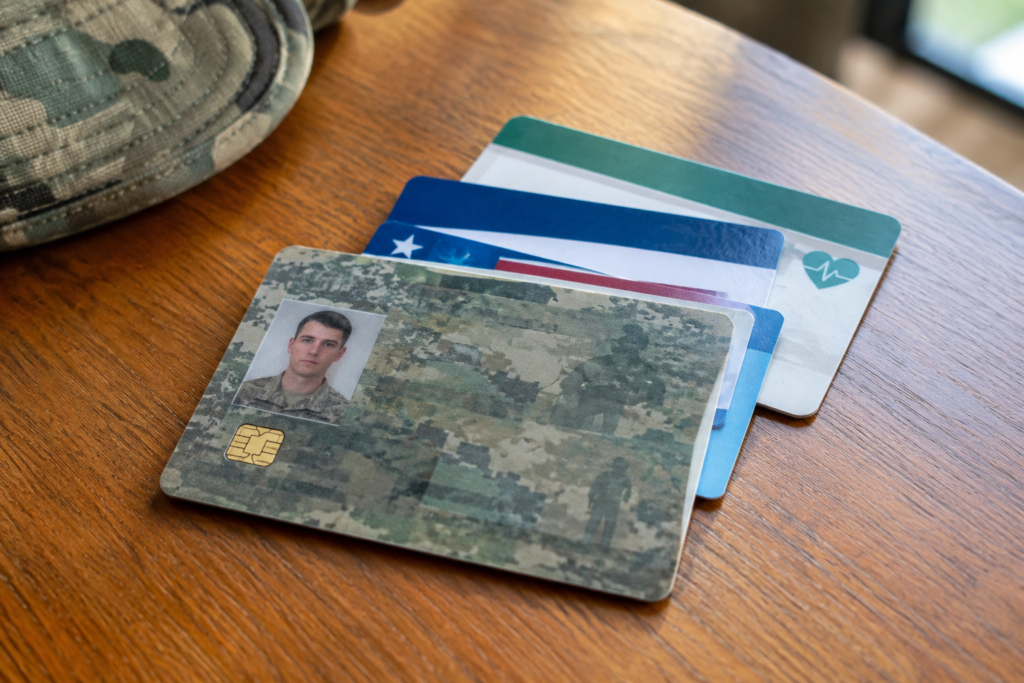
There is no single document package for all benefits. Most often, applicants need a combatant-status certificate, passport or ID card, taxpayer number, and an application. Utility benefits may require household and service-provider information; housing applications may require family, property, and housing-condition records; education support is subject to the institution’s documentation rules.
There is no need to collect every possible certificate in advance. Check the specific authority’s requirements first, as some details can be obtained directly from government registers.
Where to turn if a benefit has not been granted
If a benefit is missing after discharge, check not only your combatant-status certificate but also government-register records and submitted applications. The body that grants the benefit is usually the best first point of contact. If a decision is missing or unclear, request a written explanation of the refusal or delay.
- Utility payments and pensions: Pension Fund of Ukraine.
- Healthcare: your healthcare provider, the National Health Service or the Ministry of Health, depending on the issue.
- Employment and vocational training: State Employment Service.
- Violations of employment rights: your employer and the State Labor Service.
- Tax assessments: State Tax Service.
- Housing programs: the local council, its relevant department, or CNAP.
- Veterans’ rights and support programs: Ministry for Veterans Affairs of Ukraine.
- Free legal assistance: the Free Legal Aid system for challenging decisions and protecting rights.
Must all benefits be reapplied for after discharge?
Not necessarily. If a benefit has already been granted and the relevant details remain current, discharge alone does not mean a status-based benefit must be reapplied for. However, a change of address, household composition, utility provider, or other important circumstances may require updating records.
After demobilization, it is worth checking your Pension Fund records, confirming access to healthcare services, and assessing whether you need help with employment or education. This can prevent situations where a person qualifies for support but does not receive it because information is missing.
Frequently asked questions about combatant benefits
Does combatant status expire after demobilization?
No. Leaving military service does not, in itself, cancel combatant status. It remains valid unless there are separate lawful grounds for revocation.
Can a veteran receive a 75% utility discount without owning the home?
The law provides utility benefits regardless of the form of home ownership, but the required information about the beneficiary and household must be confirmed.
Are discounts added together if both spouses have combatant status?
No. Two 75% discounts do not become a 150% discount. The Pension Fund explains that when eligible people live together, the benefit is calculated with their number in mind and within statutory limits. Read the Pension Fund’s explanation.
Does every demobilized combatant receive a monthly payment?
No. Having a certificate does not give everyone an identical, universal monthly payment. Pension supplements, compensation, state assistance, and local programs each have their own eligibility conditions.
Where can I check the latest list of benefits?
The most reliable source is the current version of Article 12 of the relevant Ukrainian law. For application procedures, consult the Pension Fund, the Ministry for Veterans Affairs, and the institution providing the service.
After demobilization, veterans should not have to navigate paperwork and unexplained refusals alone. Their combatant status remains in force, along with a range of practical rights. Understanding which benefits apply automatically and which require an application or updated records can help them obtain the support they are entitled to without unnecessary delays.