



Cashback of 1-2% looks like a pleasant bonus for ordinary purchases. But the bank does not hand out money for nothing. Behind every cashback programme are fees, agreements with merchants, marketing budgets and the bank’s own specific interests. Also, the money sitting on your card can be used by the bank for loans and investments, and the bank earns from that.
| Product | What the customer gets | How the bank earns |
|---|---|---|
| Cashback on purchases | 1-2% return | Commissions, customer activity |
| Money in a current account | Access to funds, often 0% on the balance | Using the resources in active operations |
| Credit card | Credit limit | Interest and fees under the agreement |
| Deposit | Interest income | Difference between the cost of funds and income from assets |
| Domestic government bonds (OVDP) | Income if the customer buys bonds directly | Own investment income or fees for services |
Who actually pays for 1-2% cashback?
When you pay by card in a supermarket or online store, several parties take part in the transaction. There is your bank, the merchant’s bank or payment provider, and a payment system like Visa or Mastercard. The merchant pays a fee for card acceptance, and part of that fee goes to the bank that issued your card. Cashback is often financed from those funds.
However, saying that the merchant pays the entire cashback is also incorrect. The bank can top up from its marketing budget, receive fees from partners or run joint promotions with retail chains. So when you are offered 2% for purchases in a particular category, it feels like a discount to you. Who pays and how much depends on the terms of the specific programme.
Do merchants build card fees into prices?
Acquiring for a business is an expense item like rent, wages or delivery. So it affects shelf prices one way or another.
But don’t assume every product is exactly 1-2% more expensive because of your cashback. Price depends on competition, cost, demand and mark-up, and merchants often cover part of the fee from their own margin.
More important is this. Take a person who spends 10 000 UAH a month with 1% cashback. They receive 100 UAH a month, or 1 200 UAH a year if spending and conditions don’t change. But if they go to a shop with prices 5% higher to get higher cashback, that 1-2% difference won’t compensate. Here is how it looks for a single purchase.
| Purchase for 2 000 UAH | Cashback | Actual net spend |
|---|---|---|
| Shop A, no cashback | 0 UAH | 2 000 UAH |
| Shop B, 2% cashback | 40 UAH | 1 960 UAH |
| Shop C, price 2 100 UAH, 2% cashback | 42 UAH | 2 058 UAH |
The biggest cashback here is at shop C, while the cheapest purchase is at shop B.
How does a bank earn on the money sitting on your card?
Your account balance does not simply sit in a safe. For a bank, customers’ money in current and deposit accounts are attracted resources. They are issued as loans, invested in government bonds, or placed in other permitted instruments.
A bank cannot fully dispose of these funds. It must comply with liquidity and capital ratios and other requirements of the National Bank of Ukraine (NBU). Meanwhile, you often receive nothing on the balance of a regular current account. You get convenient payments and access to funds, but not income.
Why does credit cost over 30% while the balance on a card gives 0%?
Rates on loans and on accounts are calculated on completely different logic. By issuing a loan, the bank risks that the money will not be repaid. It also pays staff, builds reserves, pays for raised funds and maintains capital. That is why consumer loan rates can exceed 30% per annum, but only part of that ends up as net income.
A simplified example. A bank takes 100 000 UAH on deposit at 10% and issues the same amount as a loan at 30%. In a year it receives 30 000 UAH in interest and pays the depositor 10 000 UAH. The difference is 20 000 UAH, but this is before credit losses, reserves, operating costs and taxes, so it is not net profit.
Does a bank invest customers’ money in domestic government bonds (OVDP)?
Domestic government bonds (OVDP) are debt securities issued by the Ministry of Finance. Banks buy them into their own portfolios and receive income depending on the issue, purchase price and time to maturity.
However, it is incorrect to say that your specific hryvnia on a card went into an OVDP. The bank manages all resources together and does not tie individual investments to a specific person’s money. You can buy bonds yourself through a bank or broker. Then the income is yours and the intermediary charges fees according to its tariffs.
How much cashback remains after taxes?
Few people think about this. Cashback paid by the bank in cash can, as a general rule, be considered income of an individual and be taxable.
Standard rates are 18% personal income tax (PIT) and 5% military levy, together 23%. How exactly the payment is taxed depends on how the programme is set up, and often the bank withholds taxes as the tax agent. If you were credited 200 UAH cashback, you would receive 154 UAH after withholding at a 23% rate. Bonus points, discounts and state programmes have their own rules, so do not confuse “National cashback” with an ordinary bank reward.
Where are the restrictions hidden in cashback programmes?
Advertising promises one thing, while the terms say another. The bank advertises 5% return, but the contract states a limit of 100 UAH per month, and anything above that is not counted. Before tailoring purchases to cashback, check:
- the maximum payout per month;
- the categories that earn rewards;
- the minimum amount for bonus payout;
- taxes and possible fees;
- how long bonuses live and how they can be spent;
- the cost of card servicing and whether additional conditions must be met.
For example, with 3% cashback and a limit of 100 UAH you will hit the maximum after roughly 3 334 UAH of purchases in that category. You can then buy as much as you like, but the return won’t increase.
How much do you lose by keeping savings on a card?
A current account is convenient for daily spending. But if a large sum constantly sits there, it is worth considering other options.
Assume 100 000 UAH sits on a card that pays no interest. In a year it will still be 100 000 UAH, but you will be able to buy less with it. With assumed inflation of 8%, the same basket of goods in a year will cost about 108 000 UAH.
What income could 100 000 UAH generate in a year?
Rates in the table are indicative and are not offers from specific banks. For the savings account and deposit, 23% tax has already been subtracted. For OVDP the income is shown before intermediary fees and on the assumption the papers are held to maturity, because under current rules individuals’ income from OVDP in prescribed cases is exempt from PIT and the military levy.
| Instrument | Indicative rate | Income for the year |
|---|---|---|
| Current card | 0% | 0 UAH |
| Savings account | 5% | 3 850 UAH |
| Deposit | 12% | 9 240 UAH |
| Hryvnia OVDP | 15% | 15 000 UAH |
The real result will depend on the rate, term, frequency of interest payments, fees and whether you can withdraw the money earlier.
How to get income from the bank, not just bonuses?
There are plenty of instruments. PrivatBank, monobank, Oschadbank, PUMB and others offer savings accounts, deposits and access to government bonds. Terms vary. Some places offer higher fixed-deposit rates, while others let you transfer money from a savings account to a card in a second, so you should look not only at the percentage but also at how quickly you can access your money.
Should you move all your savings to a deposit?
A term deposit gives predictable income. But some contracts do not allow early withdrawal or claw back accrued interest if you break the deposit early.
So keep money for daily expenses and emergencies where it’s easy to withdraw. For sums you definitely won’t need for several months or a year, it makes sense to compare deposits with other options.
Can you buy OVDP without large capital?
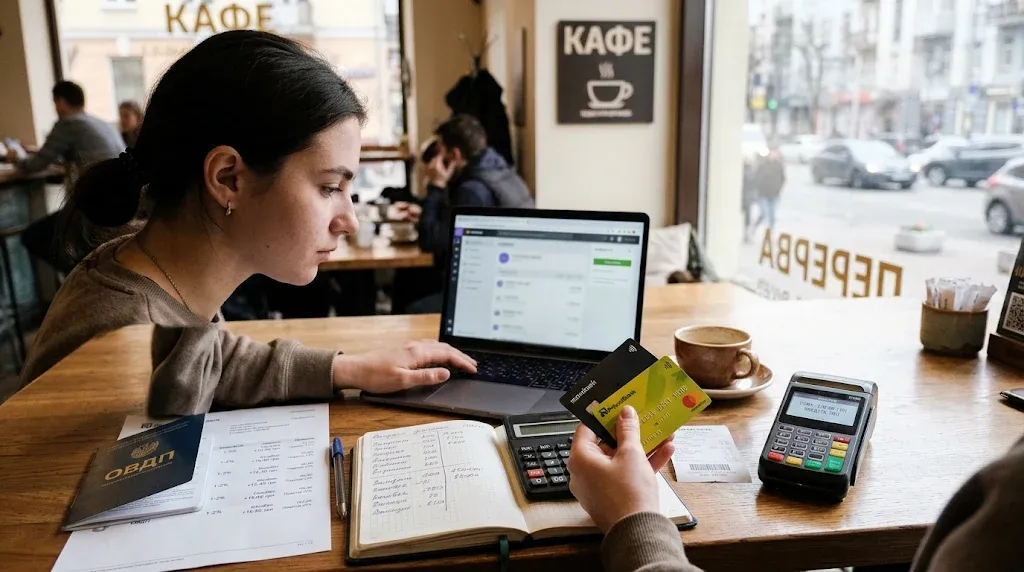
Yes. The nominal value of a single hryvnia bond is 1 000 UAH, although the actual purchase price may differ slightly. You can buy through authorised banks, brokers, digital services, and some issues of war bonds are sold directly in the Diia app.
Before buying, check the maturity date, yield and fees. If you sell before maturity, you will receive the market price, which may be lower than your purchase price.
How to compare cashback with real income - an example
Take a hypothetical scenario. A person spends 20 000 UAH a month and always keeps 50 000 UAH on a no‑interest card. 1% cashback gives them 200 UAH a month, i.e. 2 400 UAH a year before taxes.
Now they put 40 000 UAH into a one‑year deposit at 12% and leave 10 000 UAH on the card just in case. The deposit yields 4 800 UAH before tax and 3 696 UAH after.
| Per year | Amount |
|---|---|
| 1% cashback from purchases | 2 400 UAH |
| Cashback after 23% tax | 1 848 UAH |
| Deposit 40 000 UAH after tax | 3 696 UAH |
| Total | 5 544 UAH |
This is a calculation, not survey data or an experiment. But it clearly shows that the deposit here yields twice as much as the cashback. And don’t forget inflation. A nominal increase in hryvnias does not necessarily mean your purchasing power has grown.
Why does a bank return part of your spending?
For a bank, cashback is primarily a way to encourage you to pay with its card. The more transactions go through the bank, the more opportunities to earn fee income and the greater the chance you will use its other services, such as a loan, deposit or insurance.
Also, loyalty programmes help the bank understand what you spend money on, within permitted data‑processing limits. Based on spending categories it creates personalised offers. However, an active customer is not necessarily a profitable one. Rewards, account servicing and IT infrastructure all cost substantial money.
How to check whether your card is profitable?
Compare what you receive and what you pay. Pay particular attention to paid servicing, transfers, cash withdrawals and credit costs.
For example, cashback brings in 150 UAH a month, while a premium card costs 100 UAH a month. Over a year that is 1 800 UAH in rewards and 1 200 UAH in fees, so the net gain is only 600 UAH, and that’s before taxes. With credit cards it’s more complicated. You must know the grace period, the effective annual rate and fees. A small debt not repaid within the grace period can easily wipe out a year’s cashback.
Cashback, deposits and investments serve different roles. The first slightly reduces the cost of purchases, the second generate income from savings, and credit gives access to borrowed funds for a fee. So evaluate a bank on three things: the full cost of services, net income after taxes and how quickly you can withdraw your money.