
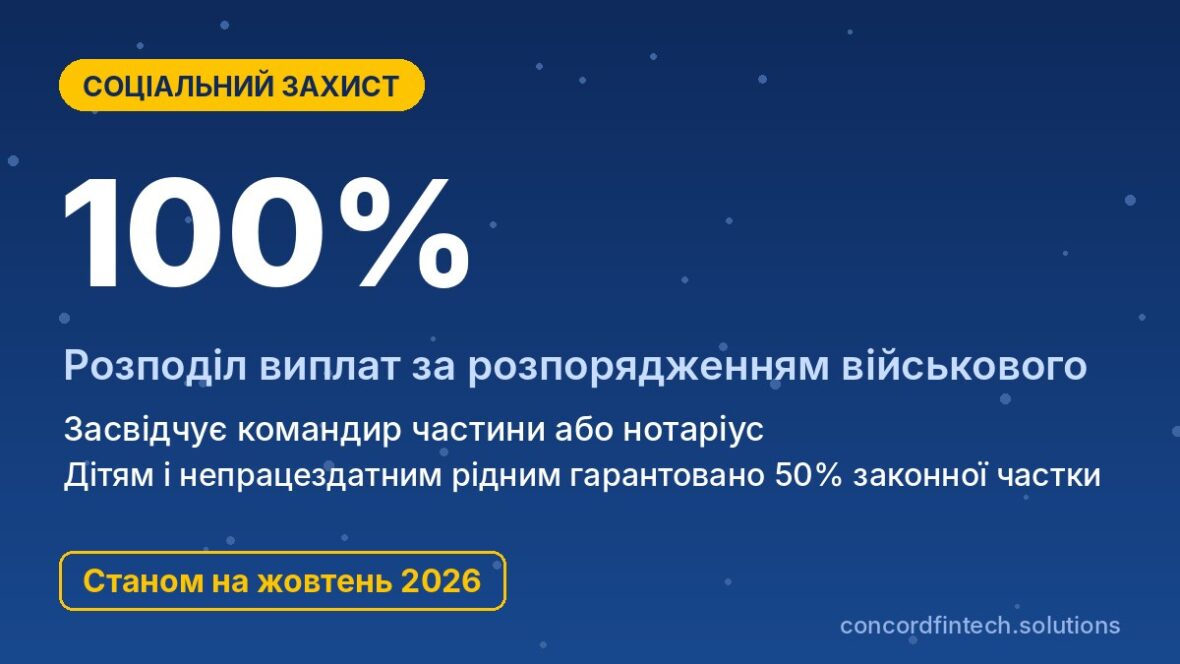
A personal directive allows a service member to decide who and in what proportions will receive state payments if the worst happens. The document may be drawn up in any written form, the signature must be certified by the commander of the military unit or by a notary, and the original is submitted to the individual’s personnel file.
The directive can name recipients of the one‑off monetary assistance in the event of death, which currently amounts to 15 mln UAH, as well as recipients of monetary support while in captivity or missing in action. Below we explain how to draw up the document, which shares the law protects and what happens if there is no directive, as of October 2026.
Why a service member needs a directive on payments
Which payments the document covers
The right to leave a directive concerning the one‑off monetary assistance in the event of death appeared on 29 March 2024 and is enshrined in Article 16‑1 of the Law “On social and legal protection of servicemen and members of their families”. The amount of the assistance and the procedure for its payment are set by Resolution No.168 of the Cabinet of Ministers (Cabinet of Ministers of Ukraine - Кабмін).
From 1 February 2025 a separate mechanism has been in force for monetary support for service members who have been taken prisoner, held hostage or gone missing. It is regulated by the Procedure approved by Cabinet of Ministers Resolution No.884, with amendments introduced by Resolutions No.550 and No.449. According to a clarification by the Ministry of Defence (Ministry of Defence of Ukraine - Міноборони), you may draw up a separate directive for this case, because its rules differ from those that apply to assistance in the event of death.
How a directive differs from a will
A will is governed by the Civil Code, relates to property and takes effect only after a person’s death. A directive is an instrument of military social protection and concerns specific state payments; for support while in captivity or when missing it operates even before death is established.
The one‑off assistance in the event of death is not part of the estate, so a will does not apply to it. The Ministry of Defence recommends having both documents to regulate property and state payments separately.
Connection with the 15 mln UAH cap
Under the current rules, 15 mln UAH is a fixed sum that the family receives after a death is confirmed, regardless of how much monetary support has been paid earlier. The directive only determines how that sum is split between recipients; it does not change the amount of the assistance itself.
Draft law No.13646, adopted by the Verkhovna Rada on 25.02.2026, proposes to make 15 mln UAH a ceiling and to include support paid to the family for the period of a person’s disappearance within that limit. As of mid‑October 2026 its signing has not been confirmed, so those are only potential changes and the rules of Resolution No.168 remain in force.
How to draw up a directive
Where the document is drawn up: the unit or a notary
The service member’s signature must be certified by the commander (head) of the military unit or by a notary, and both options have equal legal force. The choice is up to the service member, and the commander may not refuse, delay certification or influence the content of the document.
If it is not possible to have the signature certified in the unit, you may go to any notary without the commander’s consent. The directive must be signed in person; representation by power of attorney is not allowed. At the time of writing official explanations do not describe a separate possibility to draw up the directive in the “Armiya+” app, so rely on a paper document.
Required details and recipient data
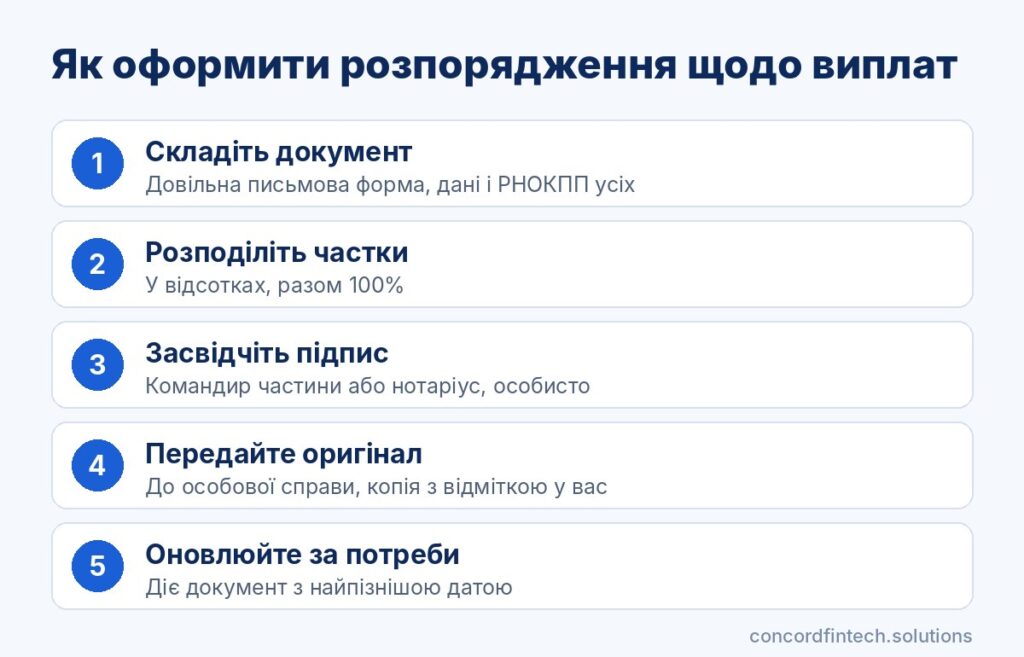
The directive may be handwritten or typed, but it must contain full details of the service member and each recipient. An error in the taxpayer identification number or date of birth can delay payment, so copy data from documents. The procedure is as follows:
- Provide your rank, surname, first name, patronymic, date of birth, place of residence and taxpayer identification number (RNOKPP).
- Name each recipient: surname, first name, patronymic, date of birth and taxpayer identification number (RNOKPP).
- Specify each person’s share as a percentage so that together they total 100%.
- Put the date and your personal signature in the presence of the commander or a notary.
- Submit the original to the commander and keep a copy with a receipt stamp.
Certification and storage
If the signature is certified by the commander, the original is submitted the same day. For a notarised document the Ministry of Defence in different explanations gives a period of 10 or 30 days, so it is safer to submit it to the unit within 10 days.
Directives regarding support while in captivity or when missing are kept in the personnel file at the military unit. Directives concerning assistance in the event of death, according to a clarification by the Ministry of Justice (Ministry of Justice of Ukraine - Мін’юст), are kept in the personnel file at the Territorial Centres for Recruitment and Social Support (ТЦК та СП) and the content of the document is not disclosed.
How to determine recipients’ shares
Choosing the circle of recipients
A recipient may be any natural person, even if they are not a relative - for example a civilian partner without a court decision or a comrade‑in‑arms. A service member may name a single person to receive 100% or split the amount among several people.
If part of the sum in the directive is left undistributed, it is divided equally among family members who are entitled to assistance under the law. It is therefore better to allocate the full 100% from the outset to avoid misunderstandings.
Distribution in percentages
Shares are specified only as percentages, not in UAH, because the payment amount may change. For the assistance in the event of death the percentage applies both to the initial 3 mln UAH lump sum and to the monthly payments used to pay the remaining 12 mln UAH.
The table gives a hypothetical example for a family with a working wife, a 10‑year‑old son, a retired mother and a brother. Without a directive 15 mln UAH would be divided equally between the wife, son and mother - 5 mln UAH each.
| Recipient | Share, % | Amount from 15 mln UAH |
|---|---|---|
| Wife | 40 | 6 000 000 UAH |
| Son, 10 years old | 25 | 3 750 000 UAH |
| Mother, pensioner | 20 | 3 000 000 UAH |
| Brother | 15 | 2 250 000 UAH |
Limits for mandatory beneficiaries
Minor and very young children, adult incapacitated children, an incapacitated widow or widower and incapacitated parents are entitled to at least 50% of the share they would receive without a directive. This right cannot be removed by the directive.
In the example the son and the mother would each be entitled to 5 mln UAH without a directive, so their guaranteed minimum is 2.5 mln UAH each. Both shares in the table exceed that threshold, so the distribution complies with the law.
Who receives payment without a directive
First‑order family members
If there is no directive, the one‑off assistance in the event of death is divided equally among all family members who are entitled to it. The list is defined by Article 16‑1 of the Law, and each recipient files their own application. They include:
- children, including adopted children, those conceived during the deceased’s life and those born after the death of the service member;
- wife or husband;
- parents, except those deprived of parental rights, unless those rights have been restored;
- grandchildren, if their parents died earlier;
- a person with whom the service member lived as a single family without marriage, by court decision;
- dependants of the deceased.
Rules are different for monetary support while in captivity or missing. Without a directive up to 50% of the support is divided equally between the wife or husband, legal representatives of minor children, adult children disabled since childhood and the parents; the remainder stays with the service member.
Parents and dependants
Parents receive an equal share of the one‑off assistance if they have not been deprived of parental rights. Parents who receive alimony from the service member are not entitled to support while in captivity.
A dependant is considered to be a person who was fully supported by the service member or received assistance from them as their main source of livelihood. This fact is confirmed by documents, and if necessary is established by a court.
Resolving disputes between relatives
Each family member may renounce their share by a written statement certified by a notary or a consul abroad. You cannot renounce on behalf of a minor or incapacitated person; a renounced share is divided equally among the remaining recipients.
If relatives cannot agree or someone claims a right after distribution, the dispute is resolved by a court. Free legal assistance is available at 0 800 213 103, and complaints about officials’ actions can be submitted to the Office of the Ombudsperson.
How to change or cancel a directive
Procedure for making changes
You cannot correct or add to an existing directive; instead you must draw up a new one with a full list of recipients and shares. It is certified and submitted in the same way as the original document.
You should review the document after marriage, divorce, the birth of a child or the death of any recipient. It is also worth checking whether the directives for death and for captivity coincide if you have drawn up both.
Cancelling the document
To simply cancel a directive without creating a new one, the service member submits a report in the same form, with certification by the commander or a notary. After that the original is removed from the personnel file and returned to the service member.
After cancellation payments are distributed according to the statutory order. If that does not match the service member’s wishes, it is better to draw up a new directive immediately.
Which document applies when there are multiple versions
The directive with the latest date applies, and each new document automatically cancels the previous one. The previous original is returned to the service member, so it is important to ensure that only the current copy remains in the personnel file.
For control, keep a copy with the unit’s or the Territorial Centres for Recruitment and Social Support’s (ТЦК та СП) acceptance stamp and remember the certification date. If a dispute about which version applies arises after a death, the family can contact the unit and, in case of dispute, take the matter to court.
Frequently asked questions
Can the directive name a person who is not a relative?
Yes, the recipient may be any person regardless of family ties. At the same time children, an incapacitated widow or widower and incapacitated parents will still receive at least half of their statutory share of the one‑off assistance.
Is notarisation required?
No, the signature can be certified by the commander of the military unit, and such a document has the same force as a notarial deed. A notary is only necessary if the service member chooses so or if certification in the unit is impossible.
What happens to a share if the recipient dies before the service member?
The Ministry of Defence’s official explanations do not directly address this case, and the share of a deceased person cannot be paid out. To ensure the service member’s wishes are not subject to interpretation, it is best to draw up a new directive immediately with a redistribution of shares.
Will the family know the contents of the directive in advance?
No, the content of the document is not disclosed and the unit or the Territorial Centres for Recruitment and Social Support do not show it to outsiders. The service member decides whether to tell relatives about the allocation; a copy with an acceptance stamp remains with the service member.