


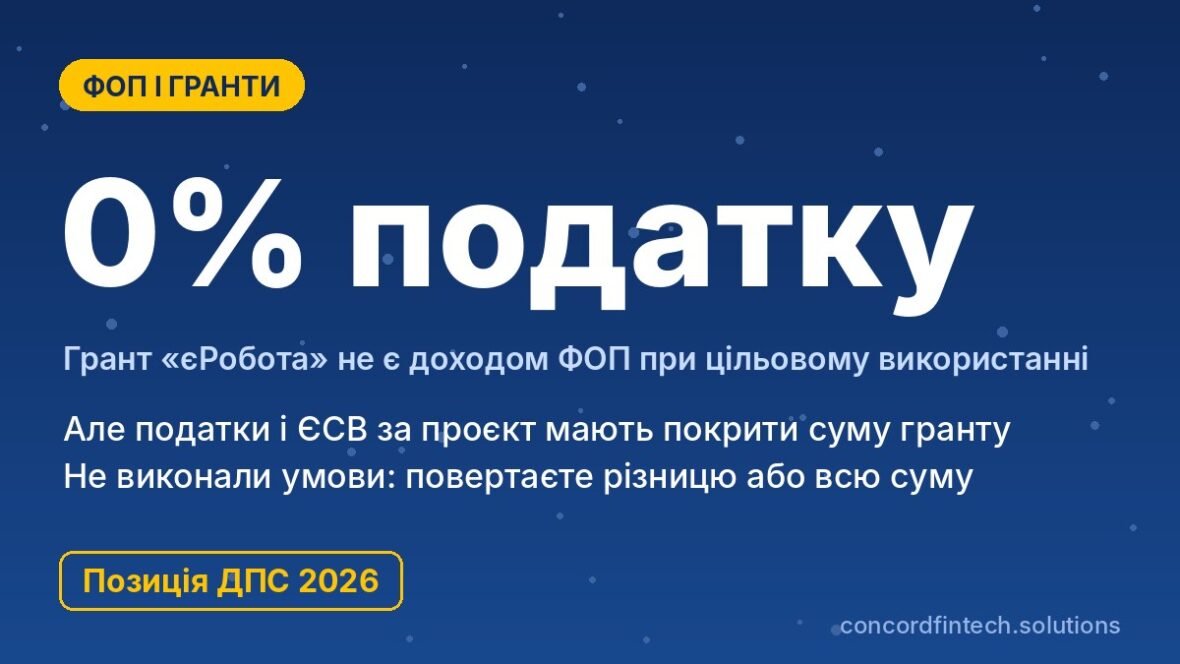
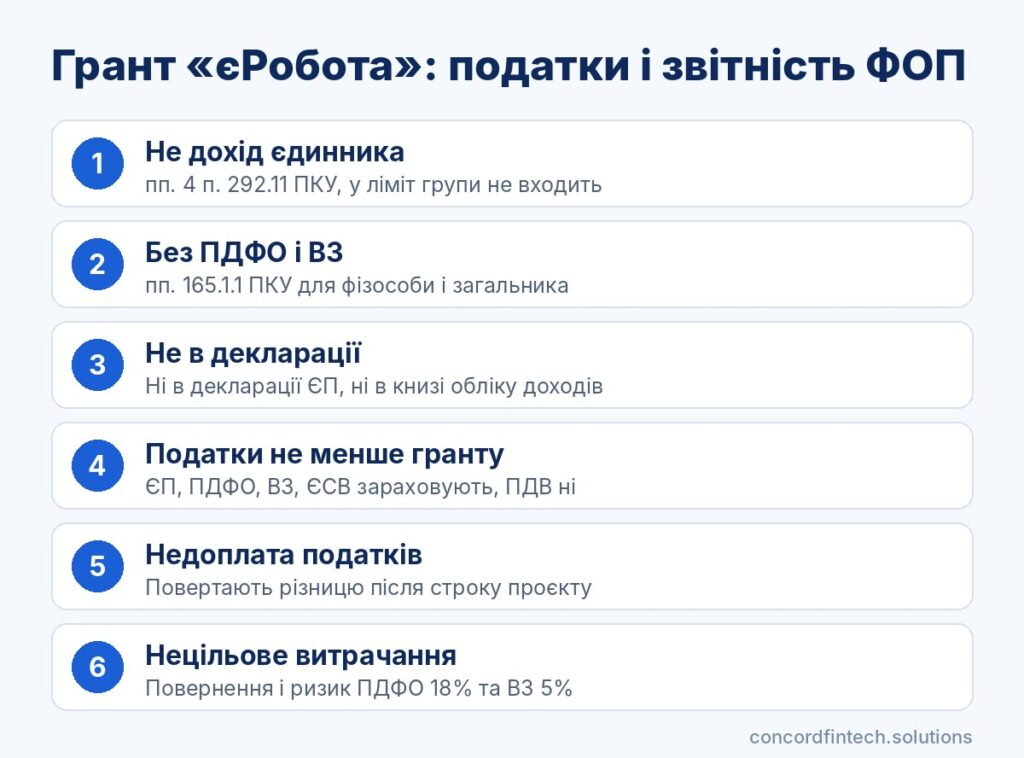
The grant under the “Власна справа” programme (service “єРобота”) is not income for individual entrepreneurs (FOP) on the single tax (ЄП) and is not subject to personal income tax (ПДФО) or the military levy, provided the funds are used for their intended purpose. It is not reported in the single-tax payer’s declaration and is not counted toward the group’s income limit.
At the same time, the grant cannot be called free money. During the project term the entrepreneur must pay taxes and the unified social contribution (ЄСВ) in an amount not less than the grant received, and if the conditions are not met part or all of the grant will have to be returned.
Is the grant income for a single-tax payer?
State Tax Service (ДПС) position on targeted funds
Income for a single-tax payer is formed by receipts from economic activity, i.e. from sales of goods, works or services. A grant is not such revenue because it is financial support unrelated to business results. In addition, sub‑point 4 of clause 292.11 of the Tax Code explicitly excludes targeted funds received from budgets or state target funds within state programmes from income. The State Tax Service (ДПС) reiterated this position in an individual tax consultation dated 16 July 2026 regarding an FOP in group 2 that received a UAH 250,000 grant.
Difference between the single-tax and the general taxation systems
For a single-tax payer it’s simple: the grant is neither entered in the book of income records nor declared. On the general taxation system and for an LLC the logic is different, because profit or net income is taxed there, so how to account for expenses paid from the grant matters. A comparison is shown below.
| System | Grant - income? | Expenses paid from the grant | Reporting |
|---|---|---|---|
| FOP groups 1-2 | No, sub‑point 4 of clause 292.11 of the Tax Code | No effect, single tax fixed | Grant is not shown in the annual declaration |
| FOP group 3 | No, sub‑point 4 of clause 292.11 of the Tax Code | No effect, tax is 5% or 3% of revenue | Grant is not shown in the quarterly declaration |
| FOP on the general system | No, sub‑point 165.1.1 of the Tax Code, military levy also not charged | Disputed issue, better to obtain a consultation from the State Tax Service (ДПС) | Grant is not included in net income |
| LLC (ТОВ) (for comparison) | Targeted financing; for single tax see sub‑point 12 of clause 292.11 | Adjustments under sub‑points 140.4.8 and 140.5.16 offset each other | Appendix RI to the corporate profit tax return |
Income limit and the grant
Since the grant is not income for a single-tax payer, it does not bring the entrepreneur closer to the group’s threshold. In 2026 the limit for group 1 is 1 444 049 UAH, for group 2 7 211 598 UAH, and for group 3 10 091 049 UAH. Even a grant of 1,500,000 UAH will not force a group‑1 FOP to move to another group.
Grant on the general taxation system
Targeted financing and personal income tax (ПДФО)
Clause 165.1.1 of the Tax Code does not include budget payments made under conditions defined by acts of the Cabinet of Ministers of Ukraine (КМУ) in taxable income, and the grant is provided precisely under CMU Resolution No. 738 with amendments in Resolution No. 616 of 15.05.2026. Therefore the 18% personal income tax (ПДФО) is not withheld on the grant and filing an annual declaration solely because of the grant is not required.
Expenses paid from the grant
An FOP on the general system pays personal income tax (ПДФО) on net income, i.e. the difference between revenue and documentarily confirmed expenses under article 177 of the Tax Code. The Code contains no separate norm on expenses paid from a tax‑exempt grant, so disputes with the tax authority are possible. Before showing such expenses in a declaration it is advisable to request an individual tax consultation, which will protect against fines if the State Tax Service (ДПС) changes its position.
Military levy
The military levy of 5% is charged on the same incomes as personal income tax, taking into account the exemptions of subsection 10 of section XX of the Tax Code. Since the grant is exempt from ПДФО, the military levy is not charged on it either.
How to reflect the grant in reporting
Single‑tax payer declaration
The grant is not shown in any line of the single‑tax payer’s declaration. FOPs in groups 1-2 submit the annual declaration for 2026 by 1 March 2027, while group 3 reports for Q4 by 9 February 2027.
Record in the book of income
The book of income records is kept for entrepreneurial receipts, therefore the grant amount is not entered there. The steps for an FOP are as follows:
- Keep the grant agreement and the bank statement showing the funds credited to the account.
- Do not enter the grant amount in the book of income records or in the single‑tax declaration.
- Pay purchases under the business plan cashlessly and collect invoices, acceptance certificates and receipts.
- Maintain a personal table of taxes and ЄСВ paid to see how much remains to reach the grant amount.
- Keep documents for the entire project term and at least 3 years thereafter.
Report on the use of the grant
There is no separate tax form for the grant. The bank that credited the funds checks targeted use, and the fulfilment of the agreement’s conditions is controlled by the employment centre. Data on paid taxes and the unified social contribution (ЄСВ) are received by the employment service from the State Tax Service (ДПС) automatically.
Tax obligations of the grant recipient
Pay taxes at least equal to the grant amount
Under the agreement, during the project term (2, 3 or 5 years) you must pay taxes and fees in an amount not less than the grant. Counted toward this amount are the single tax, personal income tax (ПДФО), the military levy, the unified social contribution (ЄСВ), profit tax, environmental tax and rent payments. VAT (ПДВ) is not included in this amount, even if the FOP is a registered payer.
Taxes on employees
For the scaling direction it is mandatory to create jobs and retain them for 18-54 months depending on the project length. ПДФО, the military levy and ЄСВ accrued on wages of employed staff are also credited against the grant amount.
ЄСВ for the entrepreneur
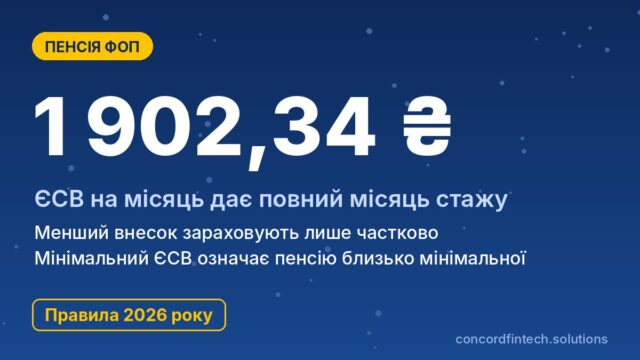
The grant itself is not the base for ЄСВ, so no extra contribution is charged on it. The minimum ЄСВ for the entrepreneur in 2026 is 1 902,34 UAH per month, and this counts toward the condition. Over 3 years the minimum contribution alone gives about 68.5 thousand UAH, and the rest of the sum is covered by the single tax and taxes on employees.
What happens if grant conditions are breached
Full or partial repayment of funds
Consequences depend on which condition is breached. The most common grounds for repayment are:
- taxes and ЄСВ paid are less than the grant received;
- jobs were not created or not retained for the agreed period;
- the business was closed or ceased before the project term ended;
- funds were spent on purposes not included in the agreed business plan;
- targeted use is not documented.
If the only problem is taxes, the difference between the grant amount and the payments actually made is returned. For example, with a 250,000 UAH grant and 180,000 UAH paid into the budget, 70,000 UAH must be returned.
Deadlines and procedure for repayment
The deadline and the details for repayment are set by the grant agreement, so it is worth rereading it before the project ends. The grant rules do not establish separate fines, but unpaid funds are recovered by the state through the courts. If property purchased with the grant was destroyed as a result of armed aggression, repayment is not required, and obligations are suspended for the period of mobilisation of the FOP.
Tax consequences of repayment
Repayment of the grant does not reduce a single‑tax payer’s income and is not their expense, because the grant was never included in income. A different situation arises if the funds were used not for their intended purpose: then they lose the status of tax‑exempt budgetary assistance. In that case there is a risk the tax authority will consider the amount income of the individual and demand personal income tax (18%) and the military levy (5%), as well as require submission of a declaration of property and income.
Changing the business plan and how to avoid repaying the grant
When a change is approved
You can change the targeted purpose of the funds within 3 months of receipt via a separate service in Diia. The change is approved if the new purchase corresponds to the project’s objective and to the budget limits.
Documents for the bank
The bank checks whether payments correspond to the budget, so each purchase must be supported by a document. Keep contracts with suppliers, invoices, acceptance certificates and fiscal receipts, as well as evidence that the equipment is actually used in the business.
Transition to the new terms of “Власна справа” 2.0
The updated programme has been in effect since 9 September 2026 under Resolution No. 616 of 15.05.2026. For those who received grants earlier, the terms of their own agreement apply, so tax rules and deadlines should be checked against that agreement. If there are doubts about crediting payments, it is better to contact the employment centre before the end of the project rather than afterwards.
Frequently asked questions
Do I have to pay tax on the grant?
No - provided the grant is used for its intended purpose, it is not income for a single‑tax payer and is not subject to personal income tax (ПДФО) or the military levy. Taxes must be paid from business revenue, and over the project term these taxes should cover the grant amount.
How to show the grant in an FOP declaration?
No way - the grant is not reflected in the single‑tax payer’s declaration or in the book of income records. Filing a declaration of property and income solely because of receiving the grant is also not required.
What happens if you do not fulfil the grant conditions?
If taxes paid are less than the grant, the difference is returned; in cases of non‑targeted use or business closure the full amount may be demanded. Unreturned funds are recovered through the courts, so it is better to resolve the issue with the employment centre in advance.
Is ЄСВ for the entrepreneur counted toward the grant amount?
Yes, ЄСВ for the entrepreneur and for employees is included among the payments that repay the grant. Only VAT (ПДВ) is not counted.