


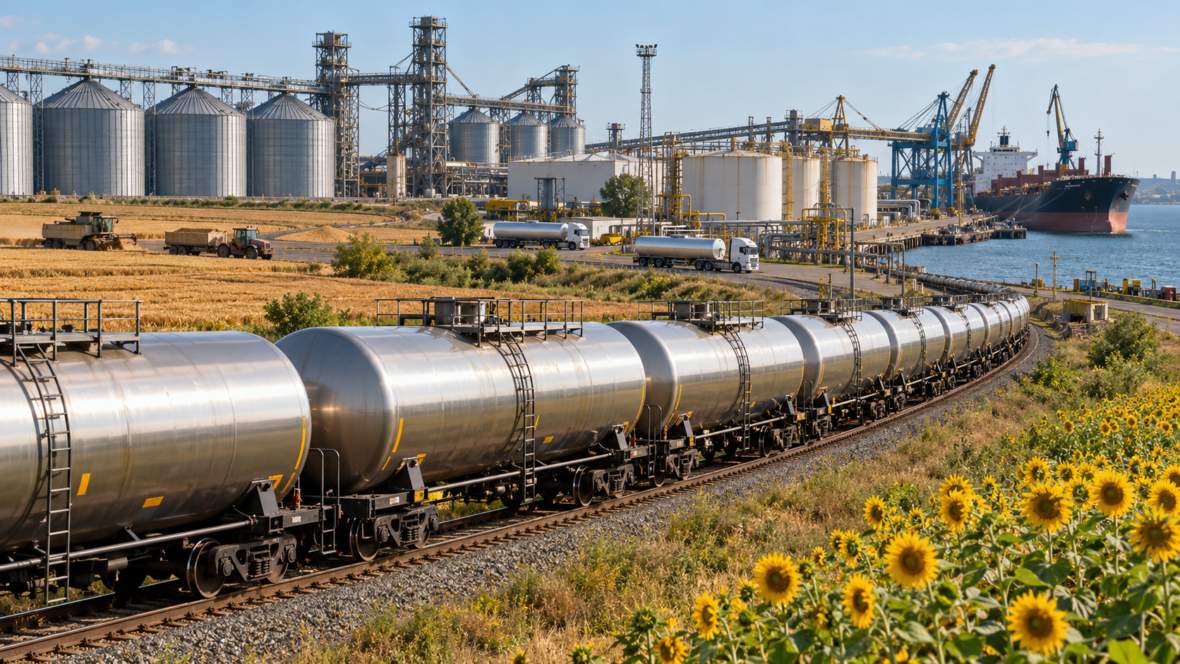
Ukrainian vegetable oil will now be shipped for export out of turn. The government has obliged the railways, ports and border authorities to prioritise it. The aim is clear: factories should not choke on finished product, and farmers should not have to wait for processors to free up space for the new harvest. At the same time, the Cabinet has kept priority for fuel imports ahead of winter.
The mechanism is being launched as an experiment. It will operate for the duration of martial law, but no longer than two years.
Which oils and how they will be prioritised
Three commodity groups are in priority: soybean oil (UKT ZED 1507), sunflower, safflower and cottonseed oil (1512), and rapeseed and mustard oil (1514). Both refined and unrefined oils qualify. Meal and cake are not included and will be transported as before.
Ukrzaliznytsia must dispatch oil first by scheduled trains to sea and river ports, border stations and transshipment points. In ports, vessels carrying bulk oil will be berthed first, and they will be allowed through the Sulina Canal on the Danube out of turn. However, if another vessel is already being loaded, operations will not be interrupted. At the border, where the infrastructure allows, separate lanes, tracks or corridors may be allocated for oil. Customs control remains in place; only the sequence is changed.
Freight tariffs and port charges remain the same. Priority does not grant discounts or impose new fees.
Why this is needed
Storage tanks at oil plants are not elastic. When exports slow, they fill up, and a plant is forced to cut production or stop lines. It then stops buying sunflower seed, and the problem is passed on to farmers. This is especially acute in October: corn is being harvested now, while elevators are still partly clogged with sunflower awaiting shipment for processing.
The government expects that faster oil exports will kick-start the whole chain: plants will free up storage, resume buying raw materials, farmers will get paid sooner, and space will be found for corn. How well this works will depend on available wagons, port throughput and conditions along the routes.
Currency matters, too. Industry estimates put oil exports at over 5 billion dollars per season. A tonne of oil on the export market costs on average about 1,300 dollars, while a tonne of corn or wheat is roughly 220, i.e. almost six times less. Of course, that is the export price, not profit: producing a tonne of oil requires considerably more seed, plus energy and logistics. Still, the processing happens in Ukraine, and some of the added value remains here.
Will grain and metal be affected
Vagons will not be taken from other exporters. Oil is transported in tank wagons, grain in hoppers, ore and metal in open wagons. But locomotives, tracks and ports are shared by all, so actual speed will depend on how traffic is organised and how congested the hubs are.
Fuel for the winter
Separately, the government has preserved priority for importing petrol, diesel and liquefied petroleum gas ahead of the 2026-2027 heating season. Diesel is needed for trucks, agricultural machinery and generators, petrol for road transport, and gas both as motor fuel and for other uses. This concerns only the logistics of import; the decision does not directly affect prices at petrol stations.