
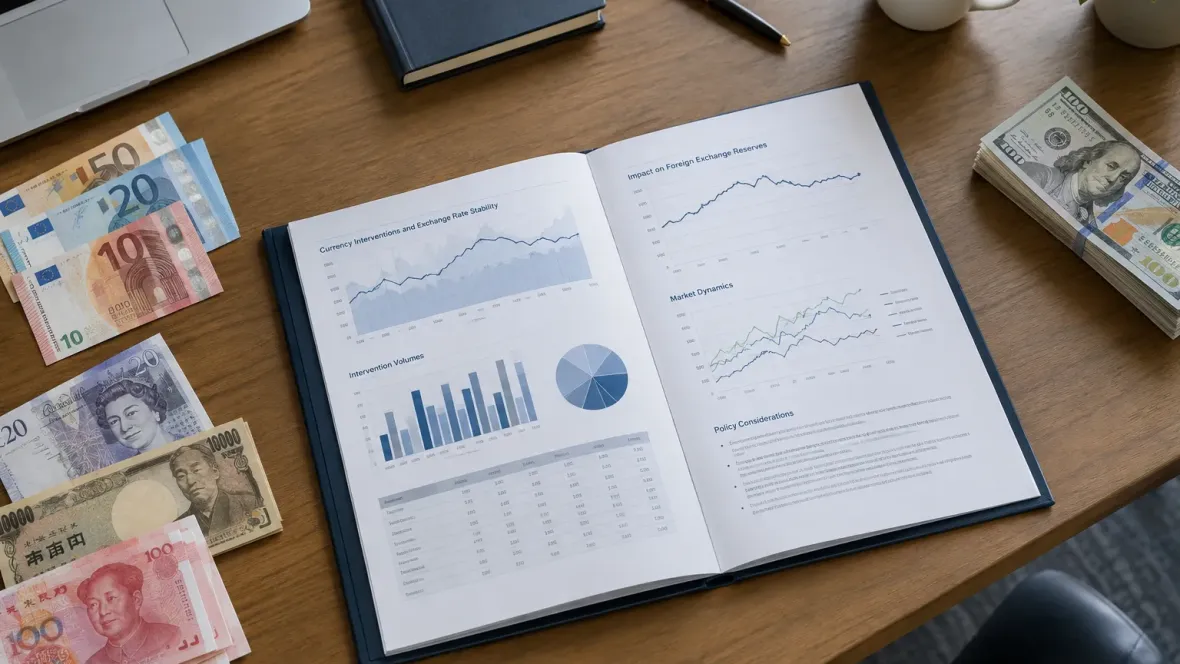
The National Bank of Ukraine (NBU) is selling increasingly more foreign currency from its international reserves: in 2022 — $22,38 billion, in 2025 — $36,1 billion, and in January–October 2026 sales exceeded $44,2 billion. At the same time, currency purchases in 2026 were minimal — 0,03 billion dollars.
How the NBU conducts foreign‑exchange interventions
Foreign‑exchange interventions are operations by the National Bank of Ukraine to buy or sell substantial volumes of foreign currency on the interbank foreign‑exchange market. The interbank market is where banks buy and sell currency to one another; interventions by the regulator affect the supply of currency and the amount of hryvnia in circulation.
When the NBU sells dollars or euros from its reserves, it withdraws hryvnia from circulation, which helps reduce currency shortages and curb sharp depreciation of the hryvnia. Conversely, when the regulator buys foreign currency it issues additional hryvnia to avoid excessive appreciation of the national currency.
Volumes of NBU interventions in 2015–2021
In 2015 the volumes of currency sold and purchased by the NBU were almost identical: $2 204 billion and $2047 billion respectively. In the period from 2016 to 2018 the NBU sold between $0,9 billion and $1,8 billion, while it bought between $2,4 and $3,1 billion.
In 2019 the NBU purchased $8,4 billion and sold $0,5 billion due to an excess of foreign currency on the market. In 2020 it sold $3,8 billion and bought $4,9 billion. In 2021 purchases amounted to $3,69 billion and sales to $1,27 billion.
Volumes of interventions in 2022–October 2026
With the start of the full‑scale war the volumes of interventions rose sharply. In 2022 the NBU sold $22,38 billion and bought $3,26 billion. In 2023 it sold $28,83 billion and bought $0, $22 billion.
In 2024 sales rose to $35, $313 billion, while purchases amounted to $0, $126 billion. Last year the NBU sold $36,103 billion and bought $0, $042 billion. From January to October 2026 the regulator sold $44, $280 billion, with purchases in 2026 at their lowest since 2015 — $0, $03 billion.
What to watch in the coming days: the dynamics of the official NBU exchange rate, the rate on the interbank market, the volumes of daily interventions and changes in international reserves. It is also worth monitoring cash exchange rates at banks and publications by the regulator on the volumes of currency purchases and sales.