



At the “Living on interest” conference, participants discussed that Ukrainians are increasingly entering the investment market with small amounts, and a significant share of those investments is going into OVDP (domestic government bonds).
The volume of retail investments in OVDP stood at about 176 billion UAH
Taras Kozak said that at the time of his remarks the volume of retail investments in government bonds was approaching 176 billion UAH. At the start of the year this figure was around 112 billion UAH - so, according to the statistics cited, the volume rose by approximately 64 billion UAH over the year, or about 57%.
Kozak also gave the example of rates of about 15-16% per annum on OVDP and suggested that, with inflation at roughly 12-12.5%, such rates could deliver a real increase in purchasing power. These rates and inflation parameters were an example cited by the speaker during the discussion. The figure of 176 billion UAH was the number the speaker quoted at the time of the discussion. For publication it should be checked against the current statistics of the depository of the National Bank of Ukraine (NBU).
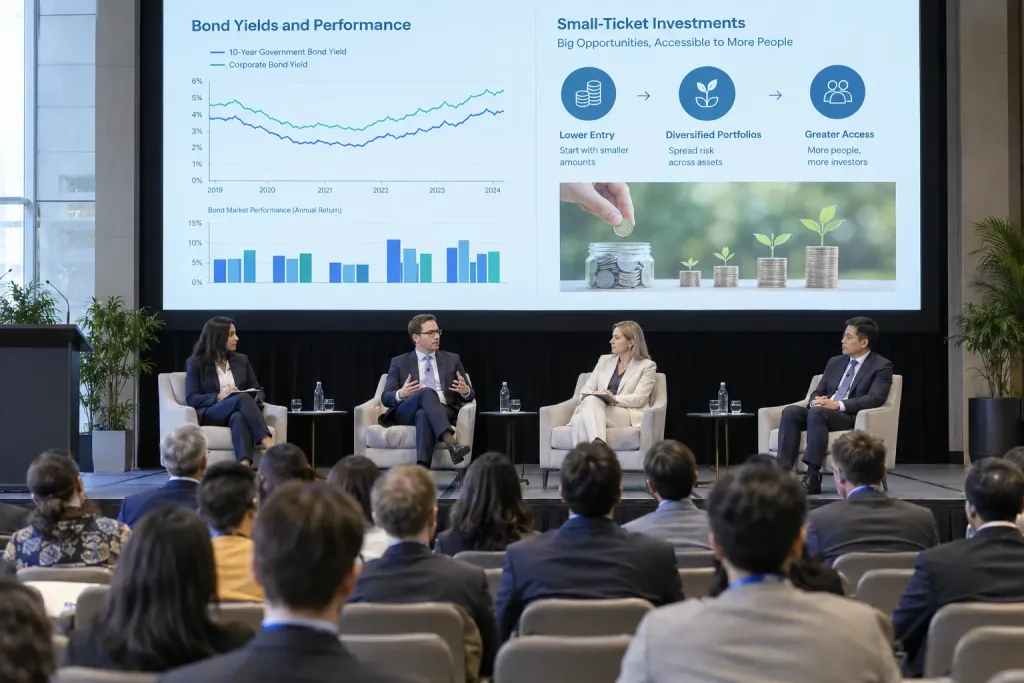
Small tickets and inflated expectations among retail investors
Land investment expert Serhii Kramarenko noted: “A small ticket is nothing to be ashamed of… Behind a small ticket there is often not a small client, but an uncertain client. It is a client who is just beginning their journey.”
Kramarenko also drew attention to the problem of inflated promises: “There are actually many investors who genuinely want to invest with a small ticket. And when they hear, for example, an annual return rate of 10%, for them that is small, for them that is a low percentage… Unfortunately, I believe the problem lies with the inflated promises of owners of various projects, developers who promise a very, very high rate.” Dmytro Karpilovskyi, co‑founder and managing partner of the community UkrInvestKlub, also emphasised the risks of inflated expectations and that a retail investor often lacks the competence to fully assess the risks of a particular business.
Investment formats available with a low entry threshold
Discussion participants noted the emergence of collective formats on the market that provide access to assets that are not available for individual purchase on a small budget. This allows investors to diversify holdings instead of concentrating capital in a single project.
Among the areas named during the discussion:
- Land - via investment structures or certificates; income can be generated from rental payments and changes in land value.
- Hotel real estate - collective formats provide access to hotel properties, but the investor does not always receive direct ownership of a specific asset.
- Energy - participation in joint structures or cooperatives with various legal forms.
- Investment funds - pooling capital to access a broader set of instruments; it is important to understand the fund’s structure, costs and strategy.
- Corporate bonds - lending to companies with issuer credit risk; payments depend on the company’s financial condition.
What to check before investing with a small ticket
Discussion participants agreed that accessibility should not replace risk due diligence. Even when investing from 1,000 UAH, an investor should understand what they are putting money into, what protection mechanisms exist and how they can exit the investment.
Key checks named during the discussion:
- Legal form - exactly what the investor is buying: a security, a company share, a claim right or another instrument.
- Business model - how income is generated and whether there is a real source of payments.
- Collateral - whether the investment is linked to a specific asset, and whether there are pledges or guarantees.
- Payment history - whether the issuer has met its obligations in the past.
- Exit conditions - whether the asset can be sold, funds returned or the claim transferred.
- Risks - consequences if the project fails to materialise or the market value of the asset falls.
Dmytro Karpilovskyi summed up: “Invest time before you invest money, and then it will work out.”