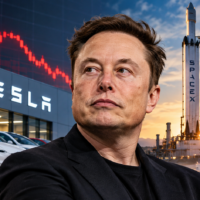

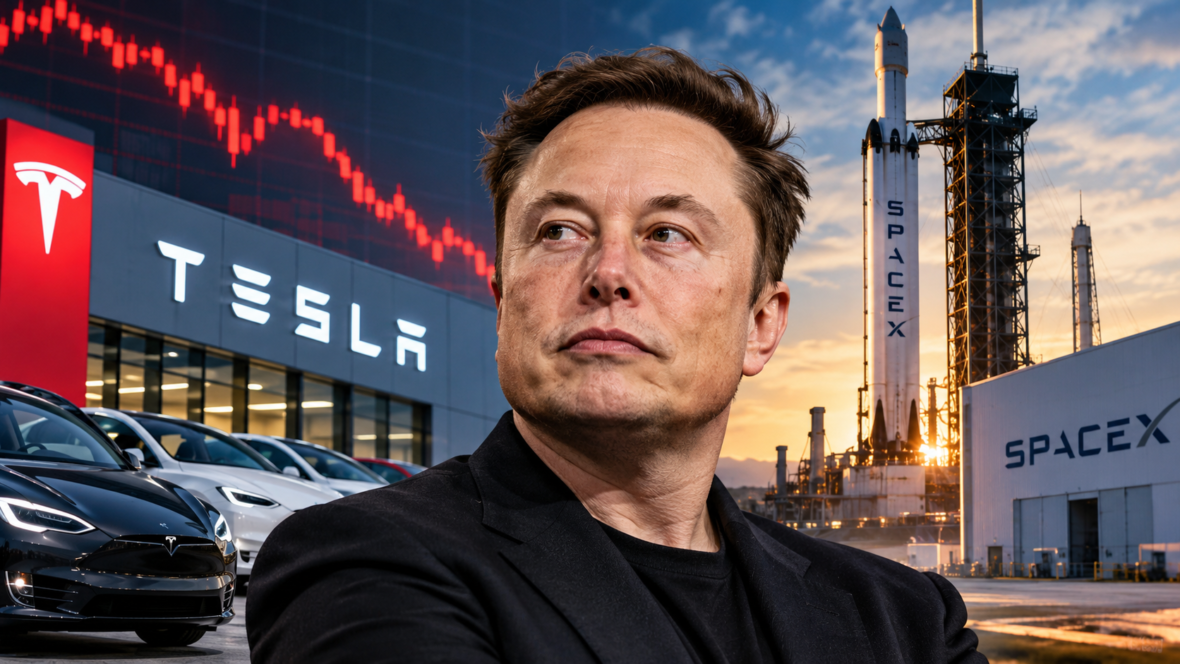
Tesla finished the third quarter of 2026 with revenue at last year’s level, but profit nearly halved. At the same time, Elon Musk confirmed that Tesla and SpaceX are discussing a merger. If the deal goes ahead, the two companies could be worth about 3.5 trillion dollars combined.
What’s behind the profit decline
The report was released on 21 October. Revenue amounted to 28.05 billion dollars, roughly the same as a year earlier, although analysts had expected a little more, about 28.34 billion. Net income attributable to shareholders fell from 1.37 billion to 787 million dollars, and operating income fell even more, by 56%, to 718 million. However, the quarter cannot be called a flop. Adjusted earnings per share were 0.48 dollars, while the market had expected 0.45.
It’s a story of costs. Over the year they rose from 3.43 to 4.78 billion dollars, because Tesla is pouring huge sums into artificial intelligence, the Optimus robots, Autopilot and new factories. The cars themselves are being sold at a healthy margin: gross margin even rose to 19.6%. In other words, the money exists — it’s simply being spent straight away on the future.
How many cars were sold
From July to September Tesla produced 464,391 cars, and customers took delivery of 486,532. That is roughly 2% fewer than a year earlier. Almost the entire volume — more than 478,000 cars — was Model 3 and Model Y; the other models together accounted for only 8,295 deliveries. The automotive segment brought in 20.56 billion dollars.
The energy business installed storage with a total capacity of 13.7 GWh, but revenue there fell from 3.42 to 2.88 billion dollars. Meanwhile, services and other areas rose to 4.61 billion dollars. The number of Supercharger stations worldwide reached 8,904. Subscriptions to FSD (Full Self-Driving) reached 1.74 million, compared with 1.48 million at the end of June.
Tesla has not lost its financial cushion. There is 45.45 billion dollars in cash and short-term investments, and free cash flow for the quarter was plus 1.53 billion dollars, although it was negative in the second quarter. The company now estimates capital expenditures for 2026 at roughly 20 billion dollars.
Merger with SpaceX
On 20 October Musk said outright that he supports the idea of combining the companies. In his view, they are being brought closer by AI, microchips, robotics and communications. The boards of directors of both companies have already set up independent committees to study a possible deal. Musk himself is not participating in the negotiations, because he heads both companies and has a conflict of interest.
The scale of the deal is striking. Tesla is valued at roughly 1.5 trillion dollars, SpaceX at more than 2 trillion. However, 3.5 trillion is only the sum of the two valuations, not the price of a deal. They still need to agree on share ratios, the structure of the new company and the rights of current shareholders.
It will not happen quickly. Tesla shareholders must approve the deal, and Musk himself acknowledged that their vote could become a serious obstacle. At SpaceX decisions will be made by a committee, the board of directors and the controlling shareholder, that is, Musk himself. Because he owns almost 20% of Tesla and control of SpaceX, investors and regulators will watch the deal closely. As of 25 October the terms have not been agreed and no timeline has been set.
The market was not particularly pleased with the report. After publication, Tesla shares fell more than 3% in after-hours trading: investors were unnerved by rising expenditures and uncertainty over revenue from robotaxis.