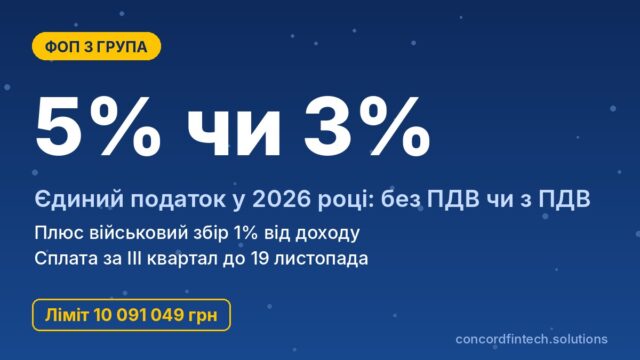




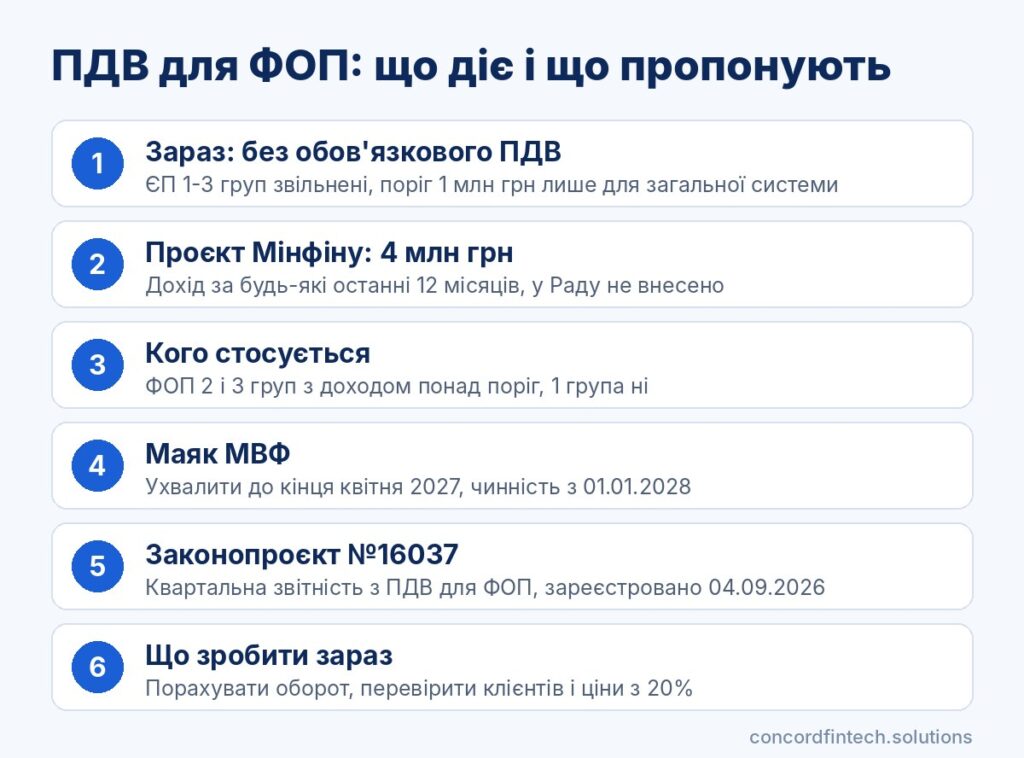
As of mid‑October 2026 value‑added tax (VAT) for individual entrepreneurs (FOP) on the single tax (ЄП) has not been introduced and there is no bill on the matter in the Verkhovna Rada. Payers of the single tax (ЄП) in groups 1–3 remain not obliged to register as VAT payers, and the 1 million hryvnia threshold applies only to the general tax system.
At the same time, the obligation remains in the programme with the International Monetary Fund (IMF). Under the revised timetable, the law must be adopted by the end of April 2027, and rules with a threshold of around 4 million hryvnia could take effect from 1 January 2028.
Current status of the VAT bill for FOP
What the Ministry of Finance proposed
The first draft of 18 December 2025 foresaw registration of single‑tax payers in groups 1–3 from 2027 after exceeding 1 million hryvnia of transactions over 12 months. In the second version, of 19 March 2026, the threshold was raised to 4 million hryvnia, but both texts remain on the Ministry of Finance (MinFin) drafts page and were not submitted to the Verkhovna Rada.
Position of the Rada’s tax committee
The chair of the relevant committee, Danylo Hetmantsev, opposes any changes for simplified taxpayers until the end of the war and reiterated this in August 2026. Without the committee’s support it is hard to reach 226 votes, so the government and the IMF postponed the deadlines.
Status as of mid‑October 2026
In the Verkhovna Rada there is only a related government bill, No.16037 of 4 September 2026, and on 13 October 2026 the Rada adopted its version No.16037‑d in the first reading. It allows FOP who are VAT payers to report quarterly, but does not oblige anyone to register.
Who VAT for single‑tax payers will affect
FOP in groups 2 and 3 with income above the threshold
Under the March draft, entrepreneurs with income exceeding 4 million hryvnia over the past 12 months would have to register. The limits for group 2 (7 211 598 hryvnia) and group 3 (10 091 049 hryvnia) are much higher, so according to the State Tax Service (DPS) data for 2025 roughly 224,000 FOP in group 2 and almost 70,000 FOP in group 3 would fall under the rule.
Does it concern group 1?
The limit for group 1 in 2026 is 1 444 049 hryvnia, which is almost three times below the threshold. Therefore, under the 4 million hryvnia version group 1 entrepreneurs would not be subject to mandatory registration.
Exceptions for certain activities
The March draft explicitly excluded only e‑residents in group 3; there are no sectoral exemptions for IT or trade. Services with the place of supply abroad, as now, are not an object of VAT.
Why the IMF requires the reform
Commitments in the memorandum
Abolition of the exemption is a structural benchmark of the programme Extended Fund Facility (EFF) worth 8.1 billion USD, and was originally to be completed by the end of March 2026 with a start in 2027. After the first review, considered by the IMF Executive Board on 20 July 2026, the IMF report No.26/188 records adoption by the end of April 2027 and entry into force on 1 January 2028.
Arguments about “fragmentation schemes”
The Fund believes that large businesses artificially split into several FOP to operate without VAT. Therefore, by the end of December 2026 the government must separately prepare measures against fragmentation and disguising employment as contracts with FOP.
Fiscal effect
According to the estimate in the updated memorandum, abolishing the exemption would yield about 0.4% of GDP in additional revenues. Tranches depend on meeting the benchmarks, and following the first review Ukraine received about 690 million USD.
Possible scenarios and implementation dates
Adoption by April 2027
The base scenario matches the IMF timetable: the law is adopted in spring 2027 and takes effect on 1 January 2028. In September 2026 Deputy Minister of Finance Svitlana Vorobei said the threshold would be the equivalent of 85,000 euros, i.e. over 4 million hryvnia at the current exchange rate.
The table compares the current rules and the Ministry of Finance’s proposals. The right column describes the draft, not current law.
| Parameter | Applies now | Ministry of Finance bill |
|---|---|---|
| Registration threshold | 1 million hryvnia over 12 months, only for the general system | 4 million hryvnia over 12 months |
| Who must register | Single‑tax payers (ЄП) in groups 1–3 are exempt; group 3 may opt in at 3% | FOP in groups 2 and 3 with income above the threshold |
| Rate | 20% | 20% plus single‑tax (ЄП) 3% or 5% |
| Start | Not set | Draft: 2027, IMF benchmark: 01.01.2028 |
| Reporting | Month or quarter | Quarter, fine of 1 hryvnia for initial violations |
Start in 2028 with a transition period
The Ministry of Finance has also mentioned a first year without full penalties and full responsibility only from 2029. So far these are statements by officials, not an agreed legal text.
Postponement until the end of martial law
Some MPs propose revisiting the issue after the war, but that would require renegotiating the IMF benchmark. In July 2026 the obligation was not cancelled, only postponed.
What FOP should do now
Calculate turnover for the last 12 months
The threshold in the draft is calculated over any last 12 months, not the calendar year. You can prepare without any cost — here are the main steps.
- Compile monthly revenue for the last 12–24 months.
- Separate export of services, which is not an object of VAT.
- Compare the total with the 4 million hryvnia threshold allowing a margin for the euro exchange rate.
- Check your business model for signs of fragmentation.
Check clients and counterparties for VAT status
For buyers who are VAT payers your VAT will be neutral because they will receive an input tax credit. Retail customers will bear the 20% themselves, while input VAT from suppliers will partly reduce your burden.
Assess prices taking into account 20%
If you cannot raise prices, VAT will have to be covered from the existing price and net revenue will fall by one sixth. The 1 million hryvnia threshold under paragraph 181.1 of the Tax Code already applies to those switching to the general system.
Timeline of news about VAT for FOP
First attempt at a bill
The first draft appeared immediately after the agreement with the IMF. It was criticised for a low threshold and coverage of all three groups.
- 18 December 2025: draft with a 1 million hryvnia threshold and start in 2027.
- 13 February 2026: the government announced raising the threshold to 4 million hryvnia.
Second Ministry of Finance draft
The second version was included in a large tax package. The government never approved it.
- 19 March 2026: draft with a 4 million hryvnia threshold and quarterly reporting.
- 19 April 2026: Prime Minister Olha Stefanishyna stated she was seeking alternatives with the IMF.
Postponement in July 2026
The new dates were fixed by the first review documents. The focus then shifted to preparing administration.
- 20–21 July 2026: the IMF completed the first review and the start was moved to 2028 (government statement).
- 4 September 2026: bill No.16037 was registered.
- 22 September 2026: the Ministry of Finance set the threshold as equivalent to 85,000 euros.
Frequently asked questions
When will VAT for FOP be introduced?
There is no law yet, so there is no exact date. Under the IMF timetable it should be adopted by the end of April 2027 with a start date of 1 January 2028.
Will group 2 FOP have to pay VAT?
Not at present, because group 2 is exempt from mandatory registration. Under the Ministry of Finance’s version VAT would apply only to those whose income over 12 months exceeds 4 million hryvnia.
What income threshold is being proposed?
In the latest published draft it is 4 million hryvnia over 12 months. In September 2026 the Ministry of Finance cited the equivalent of 85,000 euros, so the amount may still change.