


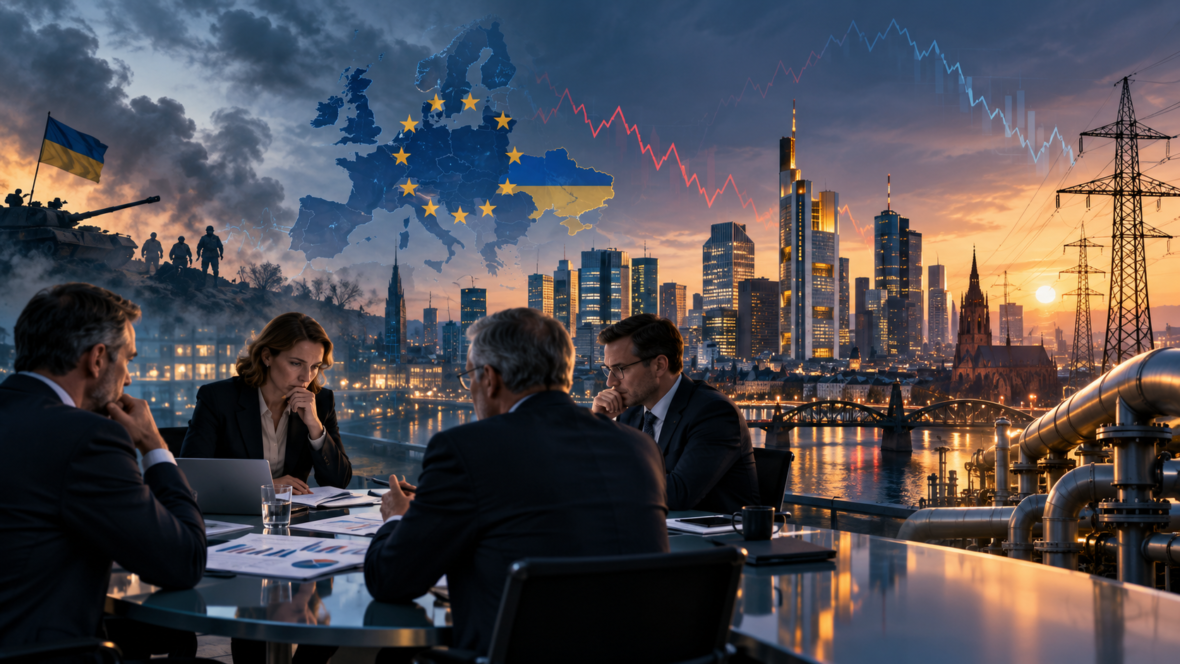
The European economy is still growing, but increasingly slowly. The energy shock of recent years has been weathered, but other problems have emerged that will be harder to fix. Large public debts, an ageing population, labour shortages and Russia’s war against Ukraine dominated the discussions at the Annual Meetings of the International Monetary Fund (IMF) and the World Bank, which took place 12-18 October in Bangkok.
The meetings were summarised by the head of the National Bank of Ukraine (NBU), Andriy Pyshnyi. His main point: merely surviving crises is no longer enough for Europe. It must find sources of new growth — investment, reforms and closer cooperation between countries.
Resilience is not the same as growth
Pandemic, the invasion of Ukraine, a spike in energy prices, new conflicts — Europe has been through all of this and kept going. But the director of the IMF’s European Department, Mateusz Szczurek, presenting the regional outlook, warned that standing firm and growing are different things. Even if energy markets calm down, growth could remain sluggish.
The hardest hit are Central, Eastern and South-Eastern Europe. For years these countries relied on cheap labour and competitive exports, and that model is now running out. Wages have risen, business costs have risen too, and productivity has not kept up. The IMF forecasts growth in the region will slow from 2.4% in 2025 to 2.2% in 2026, with some pick-up thereafter. The euro area excluding Ireland, the fund estimates, will add 1.2% this year and 1.1% next year. These figures assume a normalisation of energy prices and spending on infrastructure and defence. A new escalation of conflicts would easily spoil them.
Without technological upgrades and structural reforms, the IMF stresses, cheaper energy by itself will not lift the economy. The fund reminds that low productivity leaves Europe vulnerable even to small shocks.
War as a factor for the whole continent
Szczurek urged against growing accustomed to the war against Ukraine as background noise. Its consequences are felt far beyond the Ukrainian economy: businesses are delaying investments, governments are revising budgets, and energy security is under threat. Pyshnyi went further, noting that for Europe’s medium-term prospects the Russian invasion may matter more than a number of other geopolitical events.
The Ukrainian delegation came to Bangkok with concrete tasks. These included securing external financing for 2027 and increasing economic pressure on Russia, in particular by limiting its revenues from energy exports. The volume of future assistance will depend on agreements with partners and on meeting programme conditions.
Energy, inflation and the opportunity from EU integration
Energy prices remain a nervous issue, especially given the war in the Middle East. Renewables have helped Europe reduce dependence on imported fuels, so the latest shock proved milder than expected. However, high energy prices hit more than gas bills. Businesses pass costs on to consumers, and fuel pushes up the price of food, transport and industrial goods. Pyshnyi urged central banks to watch precisely these second-round effects, whose strength depends on trust in the regulator and the state of public finances. The IMF expects inflation in the euro area to return to target only in 2028.
There is also good news. The fund estimates that the Western Balkans and Moldova could see roughly 30% higher incomes over ten years after joining the EU. There are no guarantees: everything depends on the quality of reforms and how institutions perform. For Ukraine, which is also moving towards membership, that arithmetic is quite realistic. Among the remedies discussed at the meetings were innovation and digitalisation, private capital, worker retraining, fewer barriers for entrepreneurs, integration of energy markets and joint infrastructure projects. The logic is simple: a crisis in one country quickly spills over to neighbours, so it is better to respond together.